Introduction: The Crisis of the “Lost Generation”
It often starts quietly. A drop in grades. A loss of interest in sports. A change in friendship groups. Then, the bedroom door closes, and the silence sets in.
For parents of a troubled young adult (aged 17–25), the feeling is one of helpless confusion. You look at your child—physically grown, intelligent, capable—and wonder why they are “stuck.” Why can’t they hold a job? Why are they paralyzed by anxiety? Why do they seek escape in drugs, gaming, or high-risk behaviors?
We are facing a crisis. This generation is navigating a “perfect storm” of pressures: an economy that makes independence feel impossible, a digital landscape that hijacks their dopamine systems, and the ubiquity of high-potency cannabis and synthetic drugs.
When parents reach the breaking point, they often turn to the traditional medical system. They send their 19-year-old to a psychiatrist or a standard “adult” rehab. And often, it fails.
Why? Because a 19-year-old is not just a “small adult.” Their brain architecture, their social drivers, and their emotional needs are fundamentally different from a 40-year-old alcoholic. Placing them in a hospital ward or a group therapy circle with middle-aged professionals is often alienating and ineffective.
This guide introduces the solution: The Therapeutic Community (TC). This is not a hospital. It is a “School for Life.” It is a model designed specifically for the developing brain, using the power of peer connection, responsibility, and action to turn “lost boys and girls” into independent adults.
The Neuroscience of the Young Brain (Why They Can’t “Just Stop”)
To understand why your child is struggling—and why standard therapy often bounces off them—you must understand their biology. It is not just “bad behavior” or “laziness”; it is a developmental mismatch.
The “Gas Pedal” vs. The “Brake”
The human brain develops from the back to the front. The last area to come online is the Prefrontal Cortex—the “CEO” of the brain. This is the area responsible for:
Impulse control (“I want it, but I shouldn’t take it”).
Future planning (“If I do X today, Y will happen tomorrow”).
Emotional regulation.
This part of the brain does not fully mature until age 25. However, the Limbic System (the pleasure and emotional center) is fully active by age 15.
The Result: Your child has the emotional engine of a Ferrari (high drive for pleasure, risk, and social connection) but the brakes of a bicycle (low impulse control).
The Dopamine Deficit
Adolescents are chemically wired to seek Dopamine (the “reward” molecule) more aggressively than adults. This is an evolutionary trait designed to push them out of the nest to find mates and new territory. However, in the modern world, this drive is hijacked by “Super-Stimuli”:
High-Potency Skunk/Cannabis: Floods the brain with unnatural calm.
Video Games/Gambling: Provides instant, unearned dopamine hits.
Social Media: Creates a feedback loop of validation and anxiety.
Why Talk Therapy Fails: Sitting in a chair discussing consequences requires a fully functioning Prefrontal Cortex. If your child’s cortex is underdeveloped or hijacked by drugs, they literally cannot process that logic. They need an environment that acts as an “External Cortex”—providing the structure, boundaries, and consequences they cannot yet provide for themselves.

What is a Therapeutic Community (TC)?
The Therapeutic Community is the gold standard for treating personality disorders and addiction in young adults. It flips the “Medical Model” on its head.
The “Medical Model” vs. The “TC Model”
The Medical Model (Hospital): The patient is “sick” and passive. The doctor is the expert who does things to the patient (medication, observation). The goal is stabilization.
The TC Model (Community): The resident is a responsible member of a society. The “community” (peers and staff) is the healer. The resident is active. The goal is maturation.
The Philosophy: “Right Living”
In a TC, therapy doesn’t just happen in a 1-hour session. Therapy is the entire 24-hour cycle.
Accountability: If a resident leaves their dishes in the sink, a peer will call them out on it. This isn’t “snitching”; it’s learning that your actions affect others.
Hierarchy: Residents start with zero privileges. They must earn their way up the ladder (e.g., becoming “Head of Gardening” or “Kitchen Manager”). This rebuilds the self-esteem that comes from competence.
Mirroring: The community acts as a mirror. If a resident acts out in anger, the community reflects back the impact of that anger, forcing the resident to see themselves clearly for the first time.
The “Failure to Launch” Epidemic
We are seeing a generation of young adults who are physically capable but emotionally paralyzed. This is known as “Failure to Launch” Syndrome.
The Symptoms
Dropping out of university after one semester.
Quitting jobs the moment they become difficult.
Reversing day and night cycles (sleeping until 2 PM, awake until 4 AM).
Extreme financial dependence on parents.
The Cause: The “Comfort Trap”
Anxiety leads to avoidance. The more the young adult avoids the scary world (jobs, socializing, failure), the smaller their world becomes. The bedroom becomes a bunker. Parents, out of love, often enable this by making the “bunker” comfortable (bringing food, paying bills, doing laundry).
The TC Solution: The “Life Incubator”
A Therapeutic Community breaks the “Comfort Trap.”
Mandatory Responsibility: Residents must cook, clean, and contribute. There are no maids.
Action Before Motivation: We don’t wait for them to “feel like” doing it. They do it because the community relies on them.
Skill Building: They learn to budget, plan meals, and resolve conflicts. By the time they leave, they haven’t just stopped using drugs; they have learned how to be an adult.
The “Digital Heroin” – Gaming & Social Media
For the 17–25 demographic, substance abuse is rarely the only issue. It is almost always co-occurring with Digital Addiction.
The “Fortnite” Factor
Video games are engineered to be addictive. They provide a “Skinner Box” of variable rewards. For a young man who feels like a failure in real life (bad grades, no girlfriend), the game offers a world where he is a hero, a leader, and a success. Why would he want to leave that world?
The Social Media Dysmorphia
For young women (and men), TikTok and Instagram create a constant comparison engine. This fuels body dysmorphia, eating disorders, and crippling social anxiety.
The Rehab Protocol: You cannot treat a digital addict by just taking the phone away for 28 days and then giving it back. A modern TC teaches Digital Hygiene:
Detox Phase: Complete removal of devices to reset dopamine baselines.
Re-Integration Phase: Controlled access (e.g., 1 hour a day) to learn how to use technology as a tool, not a pacifier.
Reality Therapy: Replacing the “virtual hit” of a game with the “real hit” of climbing a mountain, completing a farm task, or connecting deeply with a friend.

Action-Based Healing (Why Farms Work Better Than Clinics)
Adolescents are kinetic learners. They learn by doing. Asking a high-energy 19-year-old with ADHD to sit in a chair and “process his feelings” for 8 hours a day is a recipe for boredom and resistance.
This is why Farm-Based Therapeutic Communities (like Holina Cyprus) show such high success rates.
The Power of “Care Therapy”
Many young addicts are deeply self-absorbed. Their world has shrunk to “Me and My Feelings.”
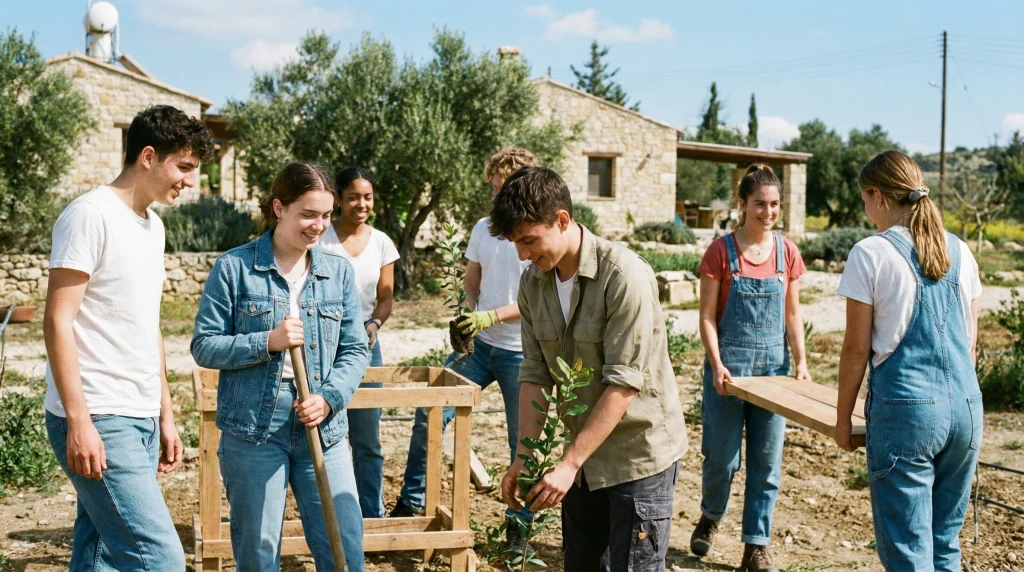
The Shift: Placing them on a farm changes the focus. The goats need feeding. The orchards need watering. The chickens need coop cleaning.
The Lesson: “If I don’t get up, another living creature suffers.” This teaches Empathy and Duty in a visceral, non-verbal way. It forces them to step out of their own head and be of service to something else.
Adventure Therapy
Recovery must be exciting. If sobriety feels boring, they won’t stick with it.
Dopamine Replacement: High-adrenaline activities (rock climbing, hiking, ocean swimming) release natural dopamine and endorphins. This shows the young brain that it is possible to feel a “rush” and a sense of aliveness without chemical assistance.
Resilience: Reaching the top of a mountain teaches resilience. “I didn’t think I could do it, but I did.” This rebuilds the self-confidence that addiction destroyed.
Why Go Abroad? (The Cyprus Strategy)
Many UK and European parents ask: “Why send them to Cyprus? Why not a clinic down the road?”
There are three strategic reasons to choose a destination like Cyprus:
1. The Pattern Interrupt (Distance) If your child is in a rehab 20 miles from home, they know that if they walk out, they can call a friend to pick them up in 30 minutes. The temptation to leave when the work gets hard is massive. Being on an island in the Mediterranean creates a “safe container.” The physical distance breaks the psychological tether to their dealer, their enabling friends, and their old triggers.
2. The Climate Factor (SAD) Seasonal Affective Disorder (SAD) is real. Trying to recover from depression in a grey, rainy UK winter is an uphill battle. Sunlight (Vitamin D) is a natural antidepressant. Being able to be outdoors 300 days a year allows for the “Action Therapy” (farming, sports, hiking) that is vital for this age group.
3. “Geo-Arbitrage” (Cost)
UK Private Rehab: £15,000 – £25,000 per month.
Cyprus Rehab: €9,000 – €12,000 per month. Because operating costs are lower in Cyprus, you get a higher standard of care (larger facility, more staff, better food) for significantly less money.
Part 7: A Real Day in the Life (The Holina Schedule)
Fear of the unknown is a major barrier for young adults. They worry it will be like a prison or a boring hospital ward. The reality at Holina Cyprus is a high-energy, structured flow designed to keep the brain engaged and the body moving.
Here is the actual daily schedule our residents follow:
07:15 – Wake Up: Starting the day with a consistent routine to reset the circadian rhythm.
07:30 – Day Ahead Group: A 30-minute intention-setting session. “What is my goal today? How will I handle my triggers?”
08:00 – Morning Walk: Before breakfast, the community moves together. This regulates the nervous system and gets sunlight (Vitamin D) into the eyes early, which is crucial for treating depression.
08:30 – Breakfast: Nutritious, community-style meal.
09:30 – Animal Feeding: This is the heart of our Farm Therapy. Residents are responsible for feeding and caring for the goats and poultry. It teaches empathy and service—if you don’t show up, another living creature goes hungry.
10:00 – Somatic & Active Workshops: The morning block rotates daily between high-energy and grounding activities:
Mondays: Entertainment & Creative Expression.
Wednesdays: Yoga & Meditation.
Thursdays: Physical Workout/Circuit Training.
11:00 – Focus Block: One-on-One Therapy sessions, written assignments, or “Room Blitz” (deep cleaning/organization skills).
12:00 – Process Group: The core clinical work. A 60-minute peer group session facilitated by a therapist to process emotions and interpersonal conflicts.
13:00 – Lunch: A break to connect and refuel.
14:15 – Afternoon Activity: Experiential therapy. This includes Art Therapy, off-site Excursions, or outdoor challenges.
16:00 – Therapeutic Duties: Residents take ownership of the facility. This isn’t just “chores”; it is taking pride in their environment (gardening, maintenance, kitchen prep).
17:00 – Free Time: Unstructured time to read, journal, or play sports.
19:00 – Closing Group: A formal end to the therapeutic day. Reviewing what went well and clearing any resentments before bed.
19:30 – Evening Connection: We end the day with fun, sober connection to replace the “party” dopamine hits they are used to:
Tuesdays: Bonfire & Gratitude Circle.
Wednesdays: “Story Slam” (Public speaking/Sharing).
Fridays/Sundays: Movie Night.
Saturdays: BBQ Dinner (Cooked by residents).
The Parent’s Playbook – Stop Enabling, Start Supporting
Rehab isn’t just for the child; it’s for the parents too. Almost every young adult in rehab comes from a family system that—usually out of love—has become “enabling.”
The Difference
Enabling: Protecting them from consequences. Paying off their drug debts. Lying to their university about why they missed exams. Giving them cash “for food” that goes to drugs.
Supporting: Empowering them to face consequences. “We love you, but we will not fund your addiction. We will fund your recovery.”
How to Stage the Intervention
United Front: Both parents (and siblings) must be on the exact same page. No “good cop, bad cop.”
The Lever: You must find your leverage. Usually, this is financial (housing, phone, car, tuition).
The Script: “We are no longer willing to watch you kill yourself. We have found a place that can help. You are going on Tuesday. If you choose not to go, that is your right, but you can no longer live here/we will no longer pay your bills.”
Family Support: A top-tier Young Adult program will include mandatory Family Support (usually via Zoom). This is where you learn to detach with love and prepare for their return, ensuring the “failure to launch” dynamic doesn’t restart the moment they walk through the door.
Financials & ROI
Is it worth the money? Rehab is expensive. It is a major financial sacrifice for most families.
But consider the alternative cost of not treating the issue at age 20:
The Economic Cost: University tuition fees wasted (dropouts). Chronic unemployment.
The Legal Cost: DUI charges, possession charges, or theft.
The Health Cost: Long-term mental health care or hospitalization.
Intervening early, while the brain is still plastic and adaptable (17–25), offers the highest Return on Investment of any medical intervention. You are not just buying “sobriety”; you are buying your child’s future capacity to be an independent, tax-paying, happy adult.
Conclusion: A Place to Grow Up
A Therapeutic Community is more than a rehab; it is a school for life. It is a place where young people learn that they matter—not because of their Instagram likes or their grades, but because they contributed to the community today. They fed the animals. They supported a friend. They cleaned the kitchen.
They learn that self-esteem comes from doing estimable acts.
They arrive as frightened, angry children. They leave as young men and women ready to face the world.
A Haven for Healing: Holina Village Cyprus
If you are looking for a specialized Therapeutic Community that understands the unique needs of the 17–25 age group, Holina Village Cyprus is a Center of Excellence in Behavioral Health.
Located in the serene hills of Achnas, we offer a safe, contained environment that functions as a Therapeutic Farm.
Why Choose Holina Village:
Farm-Based Action Therapy: We operate as a functioning farm. Residents build resilience and empathy by caring for our animals (goats, poultry) and maintaining our fruit orchards. This hands-on responsibility bypasses the resistance often found in clinical talk therapy.
Exclusively 17–25: We do not treat older adults. Your child will be surrounded by a cohort of peers facing similar struggles—from digital addiction to social anxiety—creating a powerful, shame-free “tribe.”
Clinical Rigor: Behind the rustic setting is a sophisticated clinical engine. We utilize CBT, DBT, and Trauma Therapy, alongside creative modalities like Art and Adventure Therapy.
Academic Support: Life doesn’t stop for rehab. We provide tutoring areas and vocational support (CV writing, career planning) so residents can continue their education and “launch” successfully upon graduation.
EU Standards: Located in Cyprus (an EU member state), we offer the highest standards of safety and care, with the added therapeutic benefit of the Mediterranean climate.
Give them the space to grow. Visit www.holinacyprus.com to download our brochure and speak with our admissions team about our Therapeutic Community programs.


