The pain comes back every time the bladder fills. A few hours of relief after each visit to the bathroom, and then the pressure builds again, low and insistent, and the only thing that has ever touched it is the very substance that caused it. This is the trap that brings people to a urologist, or to a page like this one, often years after the first quiet warning they chose to ignore. If you have arrived here frightened, on your own behalf or someone else’s, you should know two things at once. The damage ketamine does to the urinary tract is real and sometimes severe. And the single most powerful thing that can be done about it is also, in our experience, the hardest. So let us be plain about both.
Reading time: 7 minutes
Key points from this article
- Ketamine bladder is a chemical injury to the bladder lining, not a bacterial infection, which means antibiotics will not help and the correct diagnosis requires disclosing ketamine use to your clinician.
- The damage exists on a spectrum from mild irritation to permanent scarring and reduced capacity. Early stages are largely reversible; late-stage fibrosis is not.
- Complete, sustained cessation is the foundation of every meaningful recovery. Supportive medical treatments work on top of that foundation, not instead of it.
- Ketamine numbs the very pain it causes, creating a trap that is very difficult to break without structured support. Treating the substance use and the underlying drivers together is the evidence-informed approach.
Table of Contents
- What is ketamine bladder
- What is ketamine cystitis, and how is it different
- What is ketamine bladder syndrome
- The warning signs people talk themselves out of
- Why ketamine attacks the bladder at all
- How much use does it take
- Is ketamine bladder permanent
- Ketamine cystitis or a UTI – telling them apart
- What tests actually find it
- When this becomes an emergency
- The best treatment for ketamine cystitis
- How long healing takes once the use stops
- Why you cannot use through it
- Lifestyle changes that lower the daily burden
- How addiction treatment supports the physical recovery
- Where this leaves you
“Ketamine bladder” – what the phrase actually means
“Ketamine bladder” is not a formal diagnosis. It is the phrase people reach for to describe the whole cluster of urinary harm that follows heavy or repeated ketamine use. Doctors do not write it in your notes. Patients, families, and harm-reduction workers say it because it is honest and immediate.
Under that umbrella sits a wide spread of severity. At one end, mild discomfort on passing urine that seems to come and go. At the other, a bladder so inflamed and scarred that it holds a fraction of what it once did, and the person plans their day around toilets. The clinical literature on the urinary effects of the drug describes exactly this range, from irritation to structural injury, and the term ketamine bladder covers all of it without pretending the mild cases and the catastrophic ones are the same thing.
What is ketamine cystitis, and how is it different
People use “ketamine bladder” and “ketamine cystitis” as if they were interchangeable. They are not quite.
Ketamine cystitis is the more precise term. It names the inflammation of the bladder lining itself, the raw, swollen, irritated state of the tissue. “Ketamine bladder” is the looser, broader word for the whole picture, symptoms and damage together, across the system.
The distinction matters for one reason that spares people a great deal of wasted time. This inflammation is not caused by bacteria. Ordinary cystitis comes from infection. This one is a chemical injury, the lining attacked from the inside by the urine itself, and that single difference changes everything about how it is found, treated, and understood.
What “ketamine-associated uropathy” means
When urologists want to be exact, they write “ketamine-associated uropathy.” Uropathy means disease of the urinary tract, and the word is chosen deliberately, because the harm does not always stay in the bladder. It can travel upward, along the ureters toward the kidneys. A condition that begins as a sore bladder can, left long enough, become a kidney problem.
What is ketamine bladder syndrome
Ask someone living with it to describe a normal day, and you start to understand why “syndrome” is the right word.
Ketamine bladder syndrome is the recognisable group of chronic symptoms that arrive together: fierce pelvic pain, an urgency that allows no warning, the sensation of a bladder that is never quite empty, and the need to urinate many times an hour. Sleep goes first. Then work, because no one can hold a job while leaving the room every twenty minutes. Then the world narrows to the distance between the person and the nearest toilet.
Clinicians sometimes compare it to interstitial cystitis, the bladder pain syndrome that arises without an obvious cause. The lived experience can look similar. The difference here is that the cause is not a mystery. It is in the room.
The warning signs people talk themselves out of
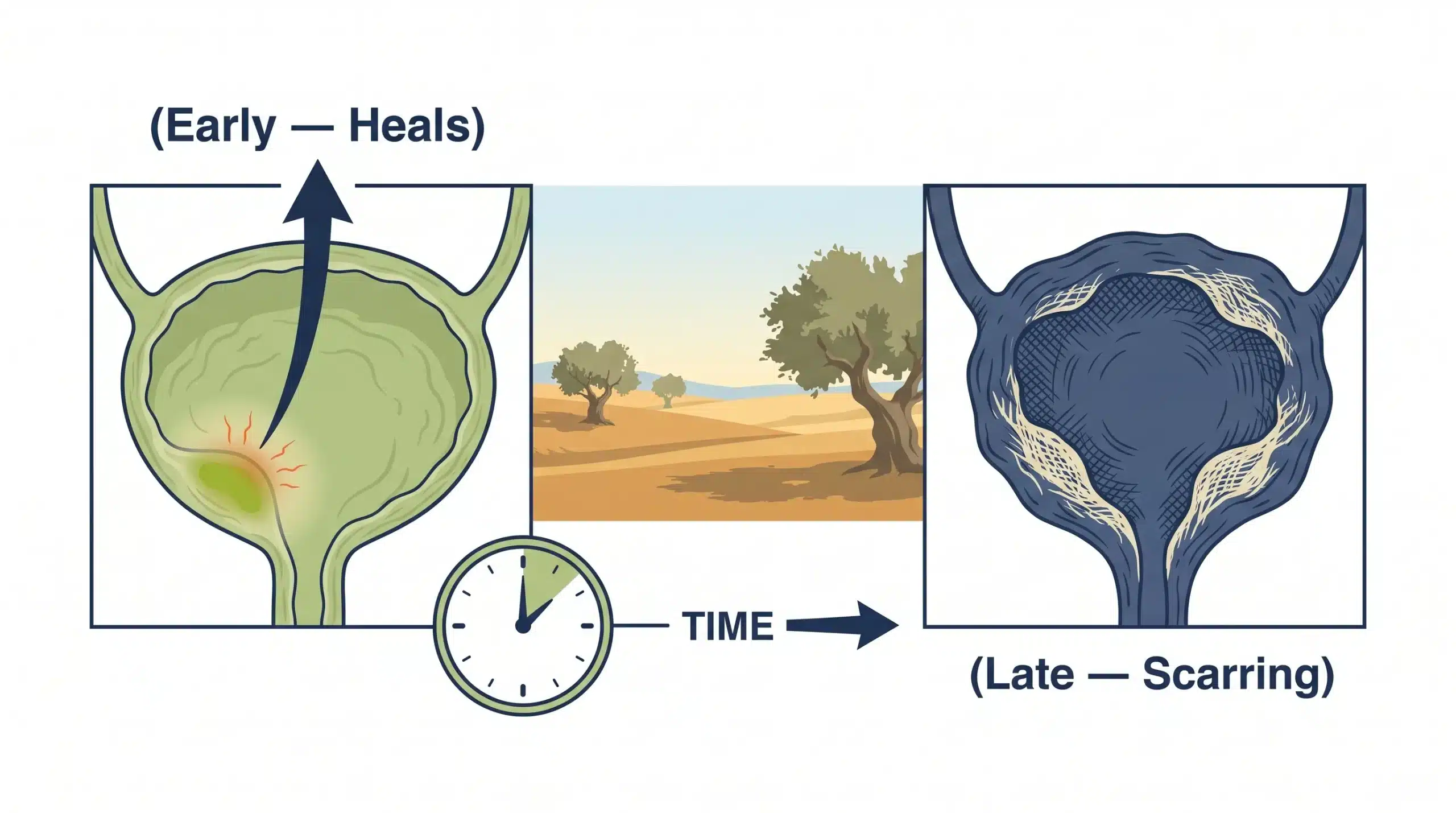
Early warning signs are often dismissed as temporary, but the underlying damage continues regardless of whether symptoms are loud that week.
Almost no one acts on the first sign. That is the pattern, and it is worth saying out loud, because the early damage is the most reversible damage there is.
The first signs are quiet. Needing to pass urine more often, especially waking in the night to do it. A weaker stream. A mild burning that feels like it might be a one-off. Because these symptoms come in waves, easing for days at a time, the mind does the obvious thing and decides it has passed.
It has not passed. The ketamine physical damage underneath continues whether or not the surface symptoms are loud that week. A few red flags deserve real attention: blood in the urine even once, pain that worsens as the bladder fills, urgency that has begun to organise the day around it, and any sign that the bladder no longer empties fully. If a family member is using and has started disappearing to the bathroom far more than before, that, too, is information.
Why ketamine attacks the bladder at all
The mechanism is almost cruelly simple once you see it.
Ketamine and its breakdown products leave the body through the kidneys and collect, concentrated, in the bladder, where they sit against the lining and wait to be passed. A healthy bladder is protected by a slick inner barrier called the GAG layer, the glycosaminoglycan coating that keeps acidic urine from touching the living tissue beneath. Ketamine strips that barrier. Once it is breached, ordinary urine reaches the raw wall, and the body answers with inflammation. Repeated insult turns acute inflammation into something the tissue cannot fully undo.
What ketamine physical damage looks like inside the bladder
When a urologist passes a camera into an affected bladder, the findings are consistent and sobering. Bleeding ulcers on the wall. A bladder lining thickened and angry rather than smooth. And a loss of the natural elasticity that lets a healthy bladder stretch and hold, so that the organ itself shrinks. Published clinical reviews on the pathophysiology and management of ketamine-induced cystitis describe reduced bladder capacity and fibrosis as the late, hard-to-reverse stages of this same process.
How much use does it take – less than people hope
There is no known safe dose. That is the honest answer, and people do not like it, because they want a number that tells them they are still on the right side of the line.
The line is not in the same place for everyone. Some people develop severe symptoms after a small amount of use over a short time. Others use heavily for years before the bladder complains. Sensitivity varies enormously, and nobody knows in advance which kind of body they have.
This is why the amount someone has used is the wrong thing to measure. The symptoms are the measurement. If the warning signs have started, the body has already told you which group it belongs to, and the quantity that got you there is no longer the relevant question.
Is ketamine bladder permanent
This is the question everyone actually wants answered, so here it is, without softening and without false comfort.
It depends on how much structural damage has already been done. In the early stages, stopping use leads to substantial improvement and often to full recovery. The inflammation is something the body can heal once the source is removed. The problem is scarring. When fibrosis has set in and the bladder has permanently shrunk, some of that loss does not come back, and the work shifts from healing to managing.
So the realistic picture is hopeful and urgent at the same time. Research on the mechanisms and treatment of ketamine-related cystitis reinforces what every clinician working with this will tell you. The earlier the use stops, the more the body can repair. Time is not neutral here. It is on the side of the damage.
Ketamine cystitis or a UTI – telling them apart
Many people with ketamine cystitis spend months being treated for infections they do not have.
A urinary tract infection is bacterial. It shows up on a urine culture, and it responds to antibiotics, usually fast. Ketamine cystitis is a chemical injury. The cultures come back sterile, clean, negative for bacteria, and the antibiotics do nothing, because there is nothing for them to kill. You can read the standard description of how urinary tract infections present and are diagnosed and see how easily the surface symptoms overlap.
One detail helps separate them. With ketamine cystitis, the pain tends to build as the bladder fills and ease the moment it empties. Repeated courses of antibiotics that never quite work are a sign the diagnosis is wrong, and chasing the wrong diagnosis costs time the bladder cannot spare.
| Feature | Bacterial UTI | Ketamine cystitis |
|---|---|---|
| Cause | Bacterial infection | Chemical injury to the lining |
| Urine culture | Positive for bacteria | Usually sterile |
| Response to antibiotics | Improves quickly | No real effect |
| Pain pattern | Constant burning | Worsens as bladder fills, eases after emptying |
| What actually helps | Correct antibiotic | Stopping ketamine use |
What to tell the clinician so you get the right workup
The thing that gets people the wrong treatment is the thing they are too ashamed to say. Tell the doctor about the ketamine. How much, how often, how long. Describe whether the pain rises with a full bladder, whether you have seen blood, whether you wake at night to urinate. None of this is information a urologist has not heard before, and withholding it is the single most reliable way to be misdiagnosed.
What tests actually find it
Diagnosis is a sequence, not a single test, and most of it is gentler than people fear.
It begins with an honest history, which is why the conversation above matters so much. Urine tests rule out infection. Imaging, usually an ultrasound of the urinary tract, is non-invasive and can show the thickness of the bladder wall, whether the bladder empties properly, and whether the kidneys have been affected. When the picture is still unclear, a cystoscopy lets the urologist look directly inside. The diagnostic logic mirrors the established workup for bladder pain syndrome, with the ketamine history as the piece that points everything in the right direction. The aim of the whole sequence is not to label ketamine bladder for its own sake. It is to find out how far the damage has reached.
When this becomes an emergency
Most of this article is about a slow problem. This section is about the moments when it stops being slow.
Go to an emergency department, without delay, for a complete inability to pass urine, for severe pain in the lower back or flank, for significant blood or clots in the urine, or for a high fever with shaking chills. These are not symptoms to sleep on.
The reason for the urgency is the kidneys. When scarred ureters obstruct the flow of urine, pressure backs up toward the kidney, a condition called hydronephrosis, and that is where reversible bladder trouble can become permanent kidney injury. Flank pain and fever are the body asking for help loudly. Answer it.
The best treatment for ketamine cystitis
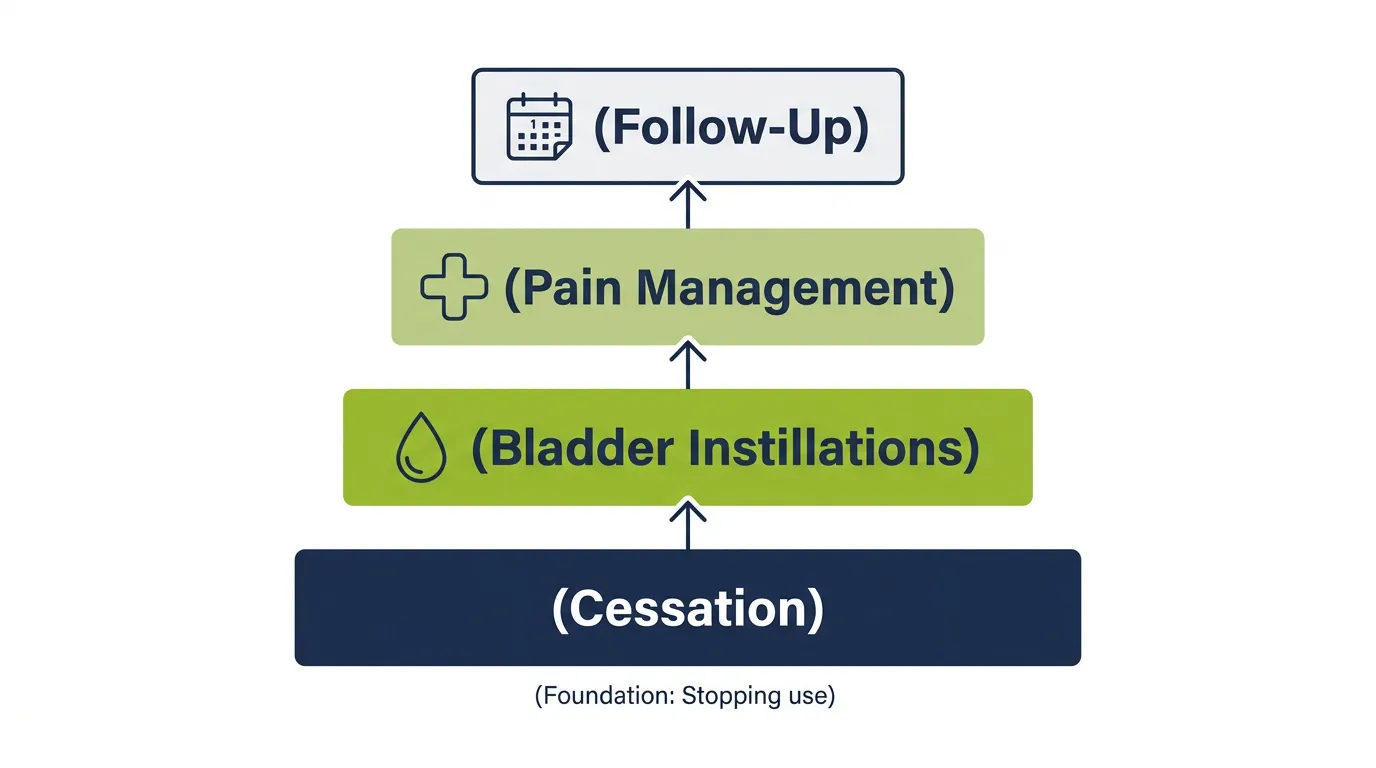
Supportive medical treatments have a genuine role, but every one of them requires complete cessation as the foundation on which they work.
Here the honest answer disappoints people who came hoping for a procedure.
The foundation of every recovery from ketamine cystitis is complete, sustained cessation. Nothing else works while use continues. There are genuine supportive treatments, and they have their place. Medications to calm bladder spasm. Bladder instillations that try to rebuild the protective lining, hyaluronic acid among them, with comparative outcomes documented in the research on intravesical treatments for ketamine-associated cystitis. Tailored pain management for the worst stretches.
But every one of these is built on the same foundation, and without it they are sandcastles. Any clinician who promises a cure that does not start with stopping is not telling you the truth. The instillations soothe a wall that ketamine keeps re-injuring. Remove the ketamine and they have something to heal. Leave it in place and they are emptying a bath with the tap running.
How long healing takes once the use stops
There is no single timeline, and anyone who gives you one is guessing.
Some people feel meaningful relief within a few weeks of stopping. For others, whose bladder function was more seriously damaged, the tissue takes many months to settle and the process needs ongoing medical follow-up. The improvement is rarely a straight line. There are good weeks and worse weeks, and that unevenness is normal rather than a sign of failure.
What is not negotiable is the cost of going back. A short return to use, a single heavy episode, can return the physical symptoms to where they started, instantly, undoing weeks of repair. This is the part that makes the bladder problem and the addiction problem inseparable. The bladder cannot heal in fits and starts. It needs the use to be over, and to stay over.
Why you cannot use through it
This is the cruellest mechanism in the whole condition, and it deserves naming directly.
Ketamine is a dissociative anaesthetic. It dulls pain, including the pain it has caused. So a person in agony from a ravaged bladder discovers that a dose of the very thing destroying that bladder makes the pain recede for a while. The relief is real and the damage underneath is worse for it. This is a pain trap, and it closes quickly. The substance numbs the symptom while accelerating the ketamine physical damage producing it, so that more is needed, more often, to hold off pain that keeps getting worse.
You cannot manage this condition by using through it. The thing that quiets the pain is the thing widening the wound. Breaking that loop is not a matter of willpower applied to a bad habit. It is treating an injury whose anaesthetic is its own cause.
A confidential conversation costs nothing
If you or someone you care about is caught in the trap this article describes, the team at Holina Village Cyprus is available to talk – no pressure, no obligation, just an honest conversation about what is happening and what structured support looks like.
Lifestyle changes that lower the daily burden
Stopping is the work. These are the things that make the days more bearable while the body catches up.
Diet has a measurable effect on bladder irritation. Cutting acidic, spicy, and stimulating foods and drinks helps, with caffeine and alcohol the two worth removing first. Sensible, steady hydration matters more than people expect, since dilute urine irritates less than concentrated urine. Keeping a simple symptom diary turns vague suffering into a pattern you can act on. Warmth across the pelvis eases spasm, and gentle pelvic-floor relaxation can take the edge off urgency.
What to avoid during a flare
When the pain spikes, hold off on carbonated drinks, citrus juices, and heavily processed, salty food, all of which sharpen bladder irritation. And resist the urge to start antibiotics on your own without a positive culture, because if there is no infection they will not help, and they obscure the real picture for the doctor who is trying to find it.
How addiction treatment supports the physical recovery

At Holina Village Cyprus, a working farm with orchards, animals, and open sky creates the physical environment for both the body and the person to settle and begin healing.
Since complete cessation is the only thing that lets the urinary system heal, the real question becomes a different one. Not “how do I treat my bladder,” but “how do I stop, and stay stopped, when stopping is the hardest part.”
That is the gap structured treatment exists to fill. Ketamine withdrawal and the cravings that follow are difficult to hold alone, and the pain trap makes white-knuckling especially fragile. At Holina Village, the setting is a working farm with orchards, animals, and open sky, where the body has room to settle while the harder work begins. The held container of a residential setting matters here, because it removes the substance from reach during exactly the weeks the bladder most needs it gone.
Most people who use ketamine heavily are not chasing a high so much as escaping something underneath. Anxiety, depression, grief, an old trauma the dissociation was managing. Sustainable recovery means engaging in a comprehensive addiction treatment programme that addresses both the physical healing and the emotional reasons the use started. This is the same logic that underpins evidence-based addiction care – treating the substance use alone, without addressing what drove it, consistently produces fragile outcomes.
You can read about how this works day to day on the page describing the residential programme and its structure. What a protected period of residence offers the bladder is the one thing no medication can supply on its own: a stretch of real, supported time in which the use is genuinely over, long enough for the tissue to begin doing what it has been waiting to do.
| Room option | From (per month, all-inclusive) | What it offers |
|---|---|---|
| Shared Room | €7,950 | Full clinical and farm programme, shared living, the most companionship |
| Single Room, Shared Bathroom | €10,950 | Private sleeping space with the same complete programme |
| Single Room, Private Bathroom | €12,950 | Most privacy, useful when urinary symptoms make a private bathroom a daily relief |
Every tier includes accommodation, meals, clinical and group sessions, adventure and farm activities, and airport transfers. Personal spending money is the only extra. For the person whose nights are broken by trips to the bathroom, the private bathroom option is not a luxury so much as practical mercy.
Where this leaves you
The hard facts of ketamine bladder are not the whole story, and the better part is the part most people miss while they are frightened. Caught early, this is a body that wants to heal and largely can. The thing standing between a person and that recovery is rarely the bladder. It is the substance, and the trap it sets, and the difficulty of putting it down for good when it briefly numbs the very pain it causes.
If you recognise yourself or someone you love in any of this, the next step is not heroic. It is a single honest conversation, with a urologist about the body and with people who understand the using. If you would like that conversation to be with us, you can reach the team at Holina directly. The bladder has been waiting for the use to stop. The willingness to be met is where that begins.
Frequently asked questions
If you are ready to talk, we are ready to listen
Holina Village Cyprus is a residential therapeutic community for adults on the island of Cyprus. Everything discussed in an initial conversation is confidential. There is no commitment and no pressure involved in making contact.
About the Author

Yossi Zubari
CEO & Founder
Director and Senior Therapist working with addiction for over 25 years, and in personal recovery for almost 30 years.