The car is parked outside the house with the engine off. He has been sitting in it for eleven minutes. Inside, dinner is happening without him, and he can see the kitchen light through the frosted glass of the front door. He is not in danger. He has not lost his job. He drove home perfectly well.
At six that morning he made himself a promise, and he meant it, in the way people mean things at six in the morning when the previous night is still sitting on their chest. By four in the afternoon the promise had thinned out into something negotiable. By six it was gone.
If you recognise that eleven minutes, either as the person in the car or as the person watching the door, this article sets out what tends to work, what tends to fail, and why the failures are so predictable that clinicians can almost set a clock by them.
Reading time: 13 minutes
Key points
- Stopping cocaine is a chemical event that can happen in days. Recovery is a slower, separate project of rebuilding a life in which using no longer serves a function.
- Cravings follow a predictable arc, rising and falling within twenty to forty minutes, provided they are not fed with planning or negotiation.
- There is currently no medication that treats cocaine addiction directly, though treating co-occurring depression, anxiety or ADHD often removes a major driver of use.
- Residential treatment changes the environment rather than the person, which matters most when cues cannot be separated from ordinary daily life.
Table of contents
- Why the first step is not stopping, but stopping alone
- Two different projects that get the same name
- The functioning user is the hardest person to help
- The first twenty-four hours belong to logistics, not resolve
- Withdrawal from cocaine is mostly not a physical event
- A craving has a shape, and the shape has an end
- The tapering plan that sounds reasonable and almost never works
- The alcohol question hiding inside the cocaine question
- What effective treatment actually consists of
- The pill that does not exist
- When the room you are standing in is the problem
- Seven days, one page, one goal
- The flatness that arrives around week three
- Money, contacts, and the sentence “just this once”
- A slip is information
- What families do wrong with the best intentions
- The part nobody plans for, which is month seven
Why the first step is not stopping, but stopping alone
The first step is to stop treating this as a private test of character. What works is a structured plan with three parts. Professional support, a physical barrier between you and access, and a living environment that is not saturated with cues.
There is a reason willpower performs so badly here. Cocaine acts directly on the brain’s reward and motivation circuitry, and repeated use shifts the baseline against which every ordinary pleasure is measured. The NIDA overview of the neurobiology of addiction describes this reasonably plainly. The decision to use stops arriving as a decision. It arrives as urgency.
You cannot out-argue urgency at the moment it appears. You can only make sure that fewer of those moments happen, and that when one does, something in the environment is in the way. That is what a structured treatment programme is for.
Two different projects that get the same name
Stopping is an interruption of the chemistry. It happens over days. Plenty of people manage it repeatedly, which is precisely the problem.
Recovery is a different piece of work entirely. It is the slow construction of a life in which using no longer serves a function. That distinction matters because the thing cocaine is doing for someone is rarely recreational by the time they are reading an article like this one. It is doing a job. Flattening grief. Covering social terror. Producing an hour of confidence for a man who has not felt competent since his father died.
People are sometimes three months clean and in more danger than they were on the day they started, because nothing underneath has been touched. Stable recovery looks like a workable daily rhythm, relationships in which you are actually known, boundaries you can hold under pressure, and some way of feeling a difficult feeling all the way through without needing to interrupt it.
The short film below gives a sense of what a recovery journey through a structured programme can look like day to day.
The functioning user is the hardest person to help
Addiction is not defined by ruin. It is defined by loss of control over how much and how often, by continuing despite real damage, and by repeated attempts to stop that did not hold.
The salary, the mortgage and the clean driving licence prove nothing. In practice the functioning user is often the hardest person to bring into treatment, because every argument for delay is available and each one sounds reasonable. Nobody has intervened. Nothing has collapsed yet. There is always a better month to do this in.
What tends to be true underneath is narrower. Weekends have crept into weekdays. Use has become a way to reset rather than to celebrate. The spending is hidden. There is a growing gap between the version of the person who exists at work and the one who exists at two in the morning.
Five questions that usually settle the argument
Have you promised yourself you would stop and then used within the same week? Do you feel a specific, heavy regret in the hours afterwards that you never mention to anyone? Has anyone close to you had to be lied to about money? Do you drink differently now, faster and with a purpose? And if you imagine the next six months with no change at all, does anything in you flinch? A flinch is data. Treat it as data.
The first twenty-four hours belong to logistics, not resolve
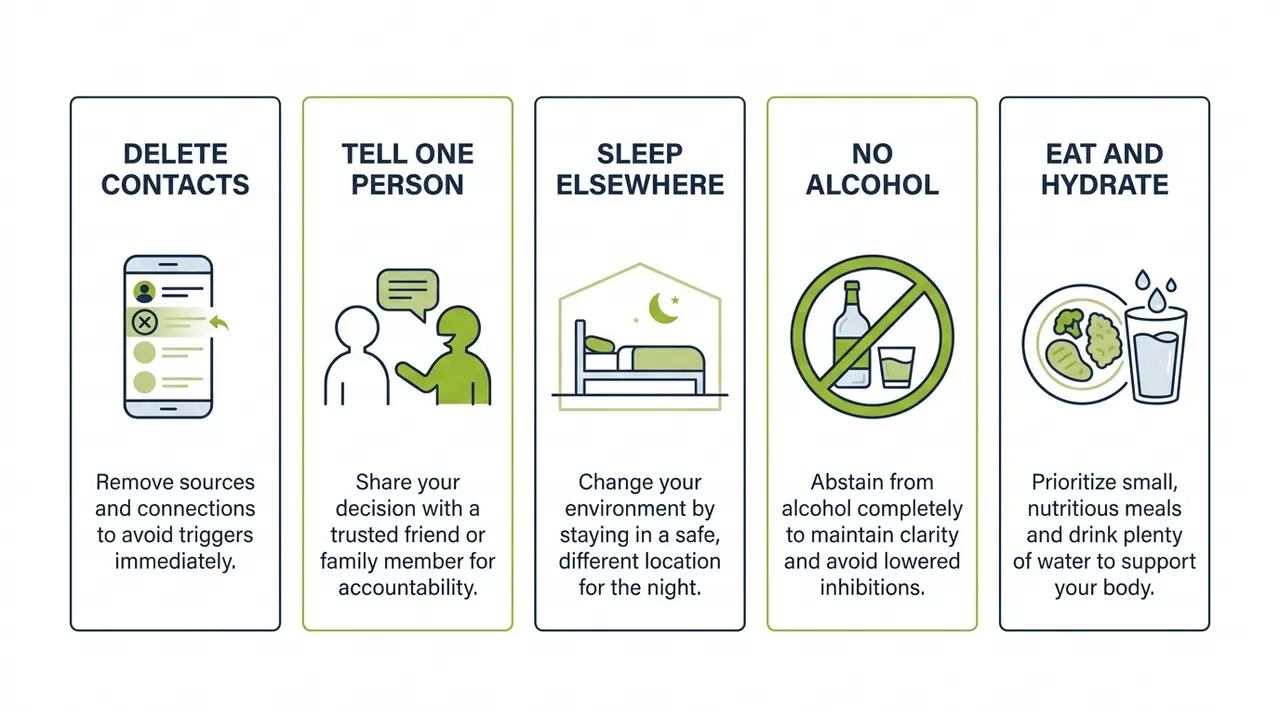
Suppose the decision has been made today. The first day is not about strength. It is about removing options while you still want them removed.
That means deleting supplier contacts rather than archiving them, telling one trustworthy person out loud what you are doing, and sleeping somewhere that is not the room you usually use in. It means no alcohol at all, because alcohol is the trapdoor. It means eating and drinking water, badly and often, because a blood sugar crash at eight in the evening feels exactly like craving.
If there is chest pain, severe agitation, thoughts of harming yourself or a collapse in the ability to function, that is a medical situation and needs urgent medical attention rather than a plan. The MedlinePlus entry on cocaine withdrawal is a sober summary of what to expect and when supervision is warranted.
Withdrawal from cocaine is mostly not a physical event
People brace for something dramatic and are then confused when what arrives is a flat, grey exhaustion. There is no shaking, no fever. There is a crash. Deep sleep, enormous fatigue, appetite returning all at once, a mood that sits somewhere between irritable and empty, and cravings that come in short violent bursts rather than as a constant hum.
Anhedonia is the part that catches people out. Food is dull. Sex is dull. Music, which used to do something, does nothing. This is the reward system recalibrating after a long period of being flooded, and it is temporary, though it does not feel temporary from the inside.
Duration depends on how much, how long, how often, and what else is going on psychiatrically. The map below is rough and honest rather than precise.
| Period | What tends to dominate | What helps most |
|---|---|---|
| Days 1 to 3 | The crash. Heavy sleep, exhaustion, low mood, hunger, sharp intermittent craving | No access, food, sleep, another person in the building |
| Days 4 to 14 | Mood swings, restlessness, broken sleep, vivid dreams, irritability others notice first | Daily structure, daily contact, complete abstinence from alcohol |
| Weeks 3 to 6 | Flatness, low motivation, craving triggered by places and people rather than by mood | Therapy, physical exertion, changed environment |
| Months 2 to 6 | Genuine stabilising, punctuated by occasional sharp cravings around stress or celebration | Relapse-prevention work, aftercare, honest conversation about the near misses |
A craving has a shape, and the shape has an end
This is the single most useful thing to know about the first month. A craving is not a state. It is a wave. It rises, peaks, and falls, usually within twenty to forty minutes, provided you do not feed it with planning, negotiating or scrolling through the contacts you meant to delete.
Feed it and it does not decay. It sustains itself, sometimes for hours, and eventually it wins by attrition. Most relapses described in group are not failures of resolve. They are people who sat still inside the wave and argued with it.
Clinicians who use the Cocaine Selective Severity Assessment track craving intensity precisely because it fluctuates so much across a single day. What you feel at nine in the evening is not a prediction of what you will feel at ten.
What to do in the twenty minutes you have to survive
Leave the room, then leave the building. Movement changes the internal weather faster than reasoning does. Call the person you told on day one, and say the actual sentence, which is that you want to use right now. Do something physically demanding for eight or ten minutes until your breathing changes. Eat or drink something. Then read the note you wrote to yourself on a clear day about what the next morning will cost. Written in advance, in your own handwriting, that note carries more weight than any argument you can generate mid-wave.
The tapering plan that sounds reasonable and almost never works
Reducing gradually is the plan almost everyone tries first, and there is a logic to it. Softer landing, less disruption, no need to tell anyone.
It fails for a specific reason. Cocaine use is not governed by a stable daily quantity, it is governed by situations. A hard week, a wedding, a fight at home, three drinks. Any of these will overwrite whatever ceiling was agreed on Sunday. A tapering plan requires the person to make a fresh decision every time they are already inside the situation where their judgement is least available.
Full cessation with support is, for most people with a real dependence, the more reliable route, because it removes the negotiation entirely. There is nothing to decide. Any honest clinician will say this is easier to say than to do, which is exactly why the environment around the decision matters more than the decision itself.
The alcohol question hiding inside the cocaine question
Ask most people who want to stop cocaine whether they also intend to stop drinking, and you get a pause. Sometimes a small laugh.
The two are usually welded together. Alcohol lowers the threshold at which the idea becomes appealing and then dissolves the reasoning that would have stopped it. Combining the two also produces additional metabolites in the body and places real strain on the heart, which is not a detail worth gambling on.
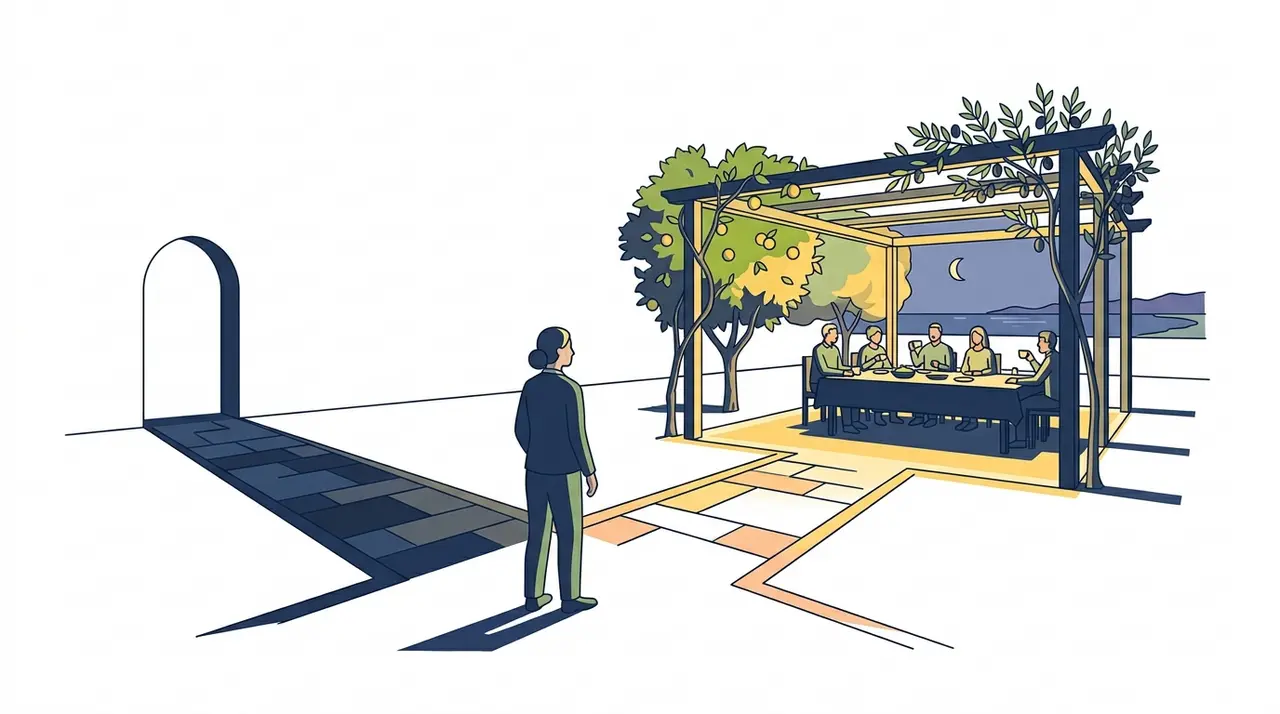
So the plan has to include drinking, at least for the first stretch, and it has to include the places and people attached to it. Not permanently, necessarily, and not as a moral position. But a Friday night in the same bar with the same three friends is not an environment in which anyone should be testing their new resolve. Building an alternative social life is slow, unglamorous work, and it is one of the reasons residential settings help. The alternative is already running when you arrive.
If reading this has raised questions about your own situation, or someone you love, our team is available for a confidential conversation about what treatment could look like for you.
No pressure, no obligation, just an honest conversation.
What effective treatment actually consists of
There is no procedure. There is no week where something is removed. Effective treatment for cocaine use disorder is behavioural and psychological, and its quality lives in the consistency rather than in the technique.
The evidence base points to cognitive behavioural therapy, contingency management, motivational work in the early ambivalent phase, and structured relapse prevention. The NIDA research summary on cocaine sets out which approaches have held up under study. Group work does something the individual hour cannot, which is to remove the possibility of quietly editing your own story.
Underneath all of it sits the relational substrate. People stop using durably when they are in relationships where being known is survivable. That is harder to schedule than a therapy timetable, and it is the reason the people delivering the work matter as much as the model they are trained in.
How to read a programme before you commit to it
| Clinical indicator | Outpatient is usually reasonable | Residential is usually the better call |
|---|---|---|
| Access to supply | Contact can genuinely be cut | Suppliers are embedded in the social circle or the workplace |
| Home environment | Home is calm and free of use | Home is where use happens, or a partner is also using |
| Previous attempts | First serious attempt with real support | Two or more attempts that collapsed within weeks |
| Mental health | Mood stable, no active risk | Depression, panic or thoughts of self-harm alongside use |
| Alcohol | Not part of the pattern | Drinking reliably precedes every episode |
The pill that does not exist
Families ask this early, and they deserve a straight answer. There is at present no medication that treats cocaine addiction itself. Nothing blocks the craving the way certain medications work in opioid dependence.
What medication can do is treat what sits alongside it. Depression that predates the use and was being self-medicated. An anxiety disorder that made the first line of cocaine feel like relief rather than pleasure. Sleep that will not reorganise itself after week two. Untreated ADHD, which turns up more often in this population than most people expect.
This is why a proper psychiatric assessment at the start is not bureaucracy. Roughly half the people assessed in clinical practice have a co-occurring condition that nobody has ever formally named. Treat the substance and leave that untouched and you have removed the coping mechanism while leaving the reason for it intact. That arrangement does not hold for long.
When the room you are standing in is the problem
Residential treatment is not a more serious version of outpatient care. It is a different intervention, and what it changes is the environment rather than the person.
It becomes the right choice when the cues are inseparable from ordinary life, when several genuine attempts have already failed, or when someone needs a period in a contained space with round-the-clock support in order to reach a state where therapy can actually land. It is difficult to do reflective work while the phone is still ringing.
Holina Village sits on a farm outside Achnas, with orchards, animals and a great deal of open sky, and it deliberately feels nothing like a clinical facility. Days are structured from morning to evening, and part of the week is spent outdoors on physical and adventure work, because a nervous system that has been chemically overstimulated for years responds better to exertion than to explanation.
What a stay costs and what changes with length
| Accommodation | From, per month | Included |
|---|---|---|
| Shared room | €7,950 | Accommodation, all meals, individual and group clinical sessions, farm and adventure activities, airport transfers |
| Single room, shared bathroom | €10,950 | All of the above, with private sleeping space during the settling-in period |
| Single room, private bathroom | €12,950 | All of the above, with fully private facilities |
Everything is all-inclusive. Personal spending money is the only extra. On duration, four weeks is generally enough for the nervous system to recalibrate and for the fog to lift. Twelve weeks is where new patterns actually hold under pressure, because by then they have been tested on ordinary Tuesdays rather than only on good days.
Seven days, one page, one goal
The first week has exactly one objective, which is to reach the end of each day without using. Nothing else counts as failure.
A workable shape looks like this. Mornings begin with movement and ten minutes of writing down what the day contains, because unstructured hours are where the trouble grows. Middays hold whatever the therapeutic contact is, a session, a call, a group. Evenings are the dangerous stretch, so they are planned in advance and kept away from alcohol, from the phone after a certain hour, and from anyone who was part of the pattern.
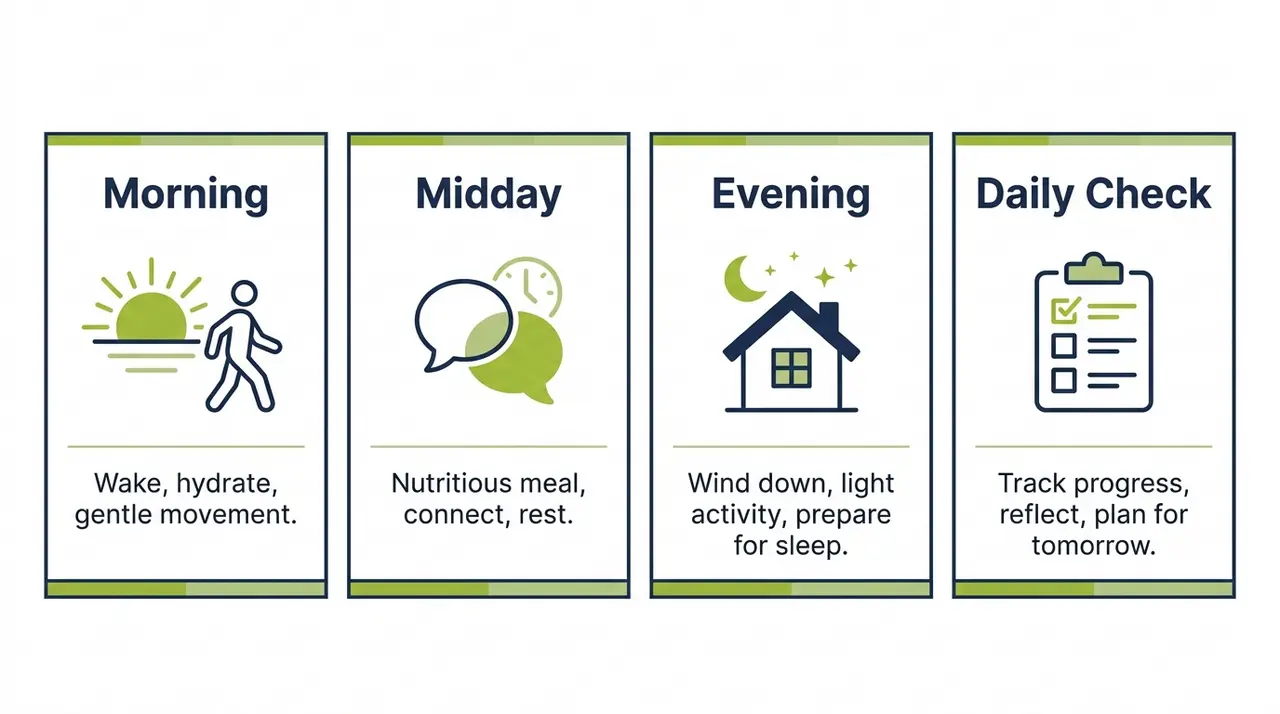
Ambition is the enemy in week one. Do not also start a diet, end a relationship or resign from a job. One thing. Repeatedly.
The daily check that keeps the week honest
Each evening, five questions. Did you eat properly, did you drink water, did you sleep something close to seven hours, did you speak to one person who knows what you are doing, and did you do one thing that moves recovery forward rather than simply avoiding harm. Five yeses is a good day. Three is a warning. Two means tomorrow needs to look different and someone else needs to know that.
The flatness that arrives around week three
The crisis passes and something worse in its way replaces it. Not craving. Absence. People describe it as being behind glass, or as having been switched to a lower voltage.
It is a normal part of the brain re-establishing a baseline it has not had to maintain for years, and it is dangerous because it is so easy to interpret as evidence. The thought goes something like this. If sobriety feels like nothing, what exactly am I doing this for.
What helps is unglamorous. Movement most days, ideally hard enough to be uncomfortable. Real daylight. Continued therapeutic work rather than a pause because the acute phase is over. And loss that has never been processed, which surfaces reliably at this point, particularly in younger adults carrying unmetabolised grief. If thoughts of ending your life appear, that requires immediate professional help on the same day, not at the next scheduled appointment.
Money, contacts, and the sentence “just this once”
Trigger management is planning done on a calm day so that willpower is not asked to perform on a bad one.
Practically, that means the supplier’s number is gone rather than blocked, because blocked numbers can be unblocked in four seconds. It often means someone trustworthy holding financial access temporarily, since immediate liquidity at eleven at night is a genuine risk factor and there is nothing shameful about admitting it. It means a truthful conversation with two or three people about why you will not be at certain gatherings for a while.
And it means learning the sound of your own voice when it starts making the case. Just tonight. You have done well, you have earned it. It will be different this time because now you understand it. That voice is not insight. It is the craving wearing a suit.
A slip is information
A lapse is a single episode. A relapse is a return to the pattern. The distance between them is usually measured in hours, and what determines the direction is almost never the substance. It is shame.
The person who uses on a Saturday and tells someone on Sunday morning generally recovers the ground within a week. The person who uses on a Saturday and decides to say nothing has, by Wednesday, constructed a private world in which the whole attempt is already lost.
So the response is mechanical rather than emotional. Stop. Tell someone that day. Then work out with a clinician what was actually happening in the twelve hours beforehand, because there is always a chain, and the first link is rarely the craving itself. It is usually an argument, an unpaid bill, a skipped meal, or a night with three hours of sleep.
What families do wrong with the best intentions
The most common mistake is not indifference. It is a mother covering a debt for the fourth time, or a wife telling the employer that he has flu.
Every one of those acts comes from love, and every one of them removes a consequence that the person needed to meet. The shift families have to make is from protection to something harder, which is warmth combined with a boundary that does not move. I will not give you money. I will drive you to an assessment tomorrow and sit with you in the waiting room.
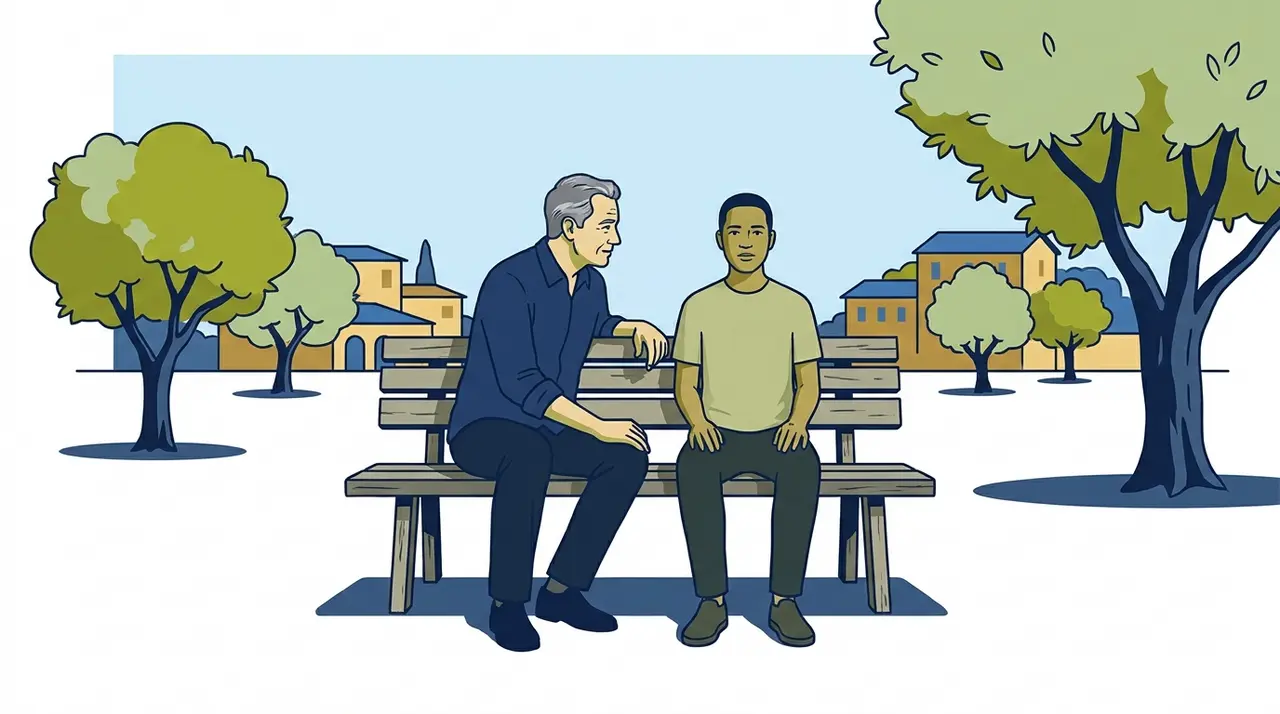
Families also need their own support, separately, because a decade of vigilance leaves marks that do not disappear when the person stops using. Treatment that includes the family from the beginning rather than at discharge tends to hold better, and the first conversation with our admissions team is deliberately calm, because most people who reach out are already frightened enough.
The part nobody plans for, which is month seven
Everyone prepares for the first fortnight. Almost nobody prepares for the month when things are going well.
By then the crisis has receded, the job may be back, the relationship has softened, and the daily practices that produced all of that start to look optional. The meeting gets missed. The therapy appointment is rescheduled twice and then quietly dropped. Sleep goes first, usually. Then the old social circle re-forms around a birthday.
Durable recovery is maintained the way physical fitness is maintained, through something regular and slightly boring. Continued group contact. Periodic review with a clinician who knows the history. Sleep, food and exertion treated as clinical matters rather than lifestyle preferences. A re-entry plan written before you leave a programme rather than improvised in the taxi home.
Whether you are the person sitting in the car or the person watching the door, a calm and confidential conversation with our clinical team can help clarify what a realistic next step looks like for your situation.
No pressure, no obligation, just an honest conversation.
How long does cocaine withdrawal actually last?
The acute crash usually settles within three to four days. Mood swings and disrupted sleep can continue for two to three weeks. A flatter, low-motivation phase often follows for a further month or so before mood begins to stabilise properly, with occasional sharp cravings possible for several months after that.
Is there medication that stops cocaine cravings?
No medication currently treats cocaine addiction directly. Medication can, however, treat co-occurring conditions such as depression, anxiety or untreated ADHD, which are often driving the use in the first place.
Can someone stop on their own without any professional support?
Some people do manage short periods of abstinence alone, but sustained recovery generally requires structured support, because the environment and relationships around a person matter as much as their intentions. Professional support reduces the number of unsupported decision points where relapse tends to happen.
Why does residential treatment help when outpatient care has already failed?
Residential treatment changes the environment, not just the person’s intentions. When suppliers, drinking habits and daily cues are embedded in ordinary life, removing them temporarily gives therapeutic work the space it needs to actually take hold.
Stopping cocaine and recovering from cocaine are two different projects. The first can happen in days. The second is slower, and it depends on structure, honesty with at least one other person, and treatment of whatever the use was covering for. None of this requires anyone to have already hit bottom. It only requires one true sentence, said out loud, before the end of today. If you would like to talk through what that could look like for you or someone you love, our team is available for a confidential conversation, with no pressure and no obligation.

About the Author
Yossi Zubari
CEO & Founder
Director and Senior Therapist working with addiction for over 25 years, and in personal recovery for almost 30 years.