The flat is not particularly untidy. The person living in it goes to work most days, answers messages eventually, and laughed at something on the phone last week. From the outside, nothing has collapsed. But if you look closely at the evening, a pattern emerges. The window opens at the same hour. The same playlist. The same slow settling, and then the same nothing, until bedtime arrives without anything having happened in between.
That nothing is often the first symptom. Not red eyes, not the smell, not the stereotype. Cannabis addiction symptoms rarely announce themselves with drama. They arrive as a quiet shrinking of a life, and because the shrinking is gradual, everyone adapts to it. This article is about the signs that survive that adaptation, the ones worth trusting.
Reading time: 5 minutes
Key Points
- Cannabis dependence is measured in function and control, not in quantity consumed.
- Cannabis withdrawal is real, predictable in timeline, and often mistaken for a bad mood.
- When cannabis use and anxiety or depression feed each other, both layers need treating at once.
- A professional assessment is a structured conversation that commits you to nothing.
Table of Contents
What cannabis addiction symptoms actually look like, past the stereotypes
Clinicians do not diagnose addiction by how someone looks on a Tuesday. They look at control. The clinical picture, described plainly in the standard definition of substance use disorder from MedlinePlus, is a pattern of using more than intended, wanting to stop and not managing it, spending increasing amounts of time obtaining or recovering from the substance, and continuing despite clear costs to work, study, relationships or health.
Translated into an actual life, cannabis addiction symptoms tend to cluster in three places. Physically, there is tolerance, meaning more is needed for the same effect, and withdrawal when use pauses, which we will come to. Emotionally, there is irritability that has no other explanation, flatness where enjoyment used to be, and low-grade anxiety that hums under everything. Behaviourally, the day starts to organise itself around the substance rather than around the person’s own wishes.
It is the third cluster that matters most. Bodies adapt, moods fluctuate, but a life rearranging itself around a substance is the signature. If someone has begun declining invitations because they would rather smoke at home, or keeps a private stash they would be embarrassed by, the question is no longer whether they enjoy it. It is whether they can still choose otherwise.
The question frequency cannot answer
Families arrive at our door having counted joints. Three a day, five a day, only weekends, only evenings. The counting feels scientific, and it is almost useless. Cannabis dependence is not measured in quantity. It is measured in function. A person who smokes a small, steady amount every evening and cannot imagine an evening without it may be more dependent than someone who smokes heavily at parties and then forgets about it for a fortnight.
The honest test is not how much but what happens without it. Three questions, asked sincerely, tell you more than any count. Have there been genuine attempts to cut down or stop, and did they hold for longer than a few days? Does the same amount now do less than it used to, so that the dose keeps creeping upward? And when the substance is unavailable for a night, is there a distinct restlessness, an agitation, a difficulty being in one’s own company?
If you have arrived at this page asking these questions about yourself, notice what the answers cost you. People who are simply fond of cannabis find the questions mildly interesting. People who are dependent find them uncomfortable. That discomfort is data.
Dependence and addiction are not the same word, and the difference removes blame
The two terms get used interchangeably in everyday conversation, and the confusion is not harmless. It keeps people arguing about labels instead of getting help.
Dependence is a nervous-system adaptation. With regular use, the brain dials down its own production of endocannabinoids, the internally made messengers that regulate mood, appetite and sleep. The external supply becomes part of the baseline. Remove it, and the system is briefly under-staffed. That is withdrawal, and it is a physiological fact, not a moral failing.
Addiction is the behavioural layer on top, the compulsion to use despite wanting not to, despite consequences a person can name clearly. Someone can be dependent without being addicted, as happens with many prescribed medications. Someone can be addicted while insisting, sincerely, that they could stop whenever they like. Most people who need help for cannabis are dealing with both at once.
Why does the distinction matter to a family at two in the morning? Because it reframes the behaviour. Your son is not lying to you because he is a liar. His nervous system is demanding something, and his judgment is being recruited to supply it. Understanding this does not excuse the behaviour. It points toward what actually treats it.
The behavioural signs: how the shape of a life changes
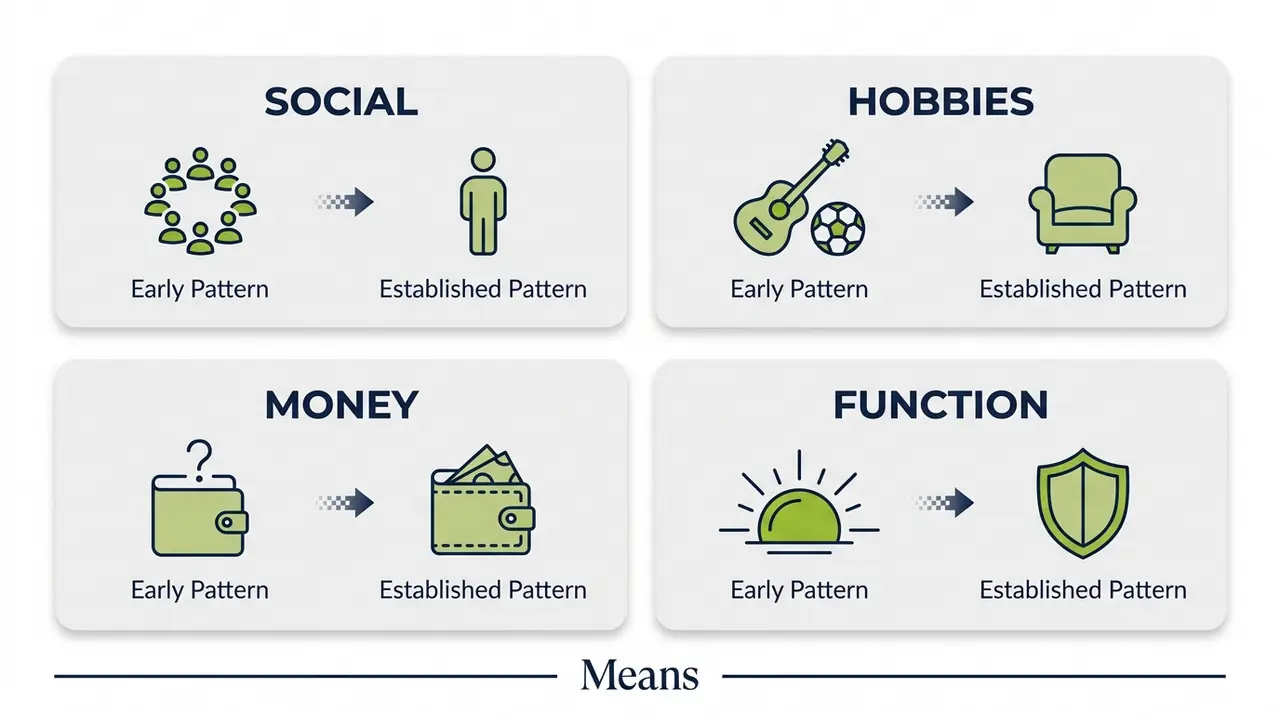
Behaviour change with cannabis is slow enough to be deniable. Nobody notices a single evening spent in instead of out. What families eventually notice is the accumulated pattern, and by then each individual piece has already been explained away.
| Early pattern | Established pattern | What it means |
|---|---|---|
| Social calendar gently reshaped around where smoking is possible | Friend groups replaced almost entirely by people who use | The substance is now selecting the environment |
| Hobbies postponed until things calm down | Sport, music, and old interests abandoned without comment | The reward system has narrowed to one source |
| Vague answers about money or whereabouts | Sustained concealment, small deceptions maintained daily | Shame is present, and shame maintains addiction |
| Smoking to enhance an occasion | Smoking to make ordinary time bearable | The function has shifted from pleasure to avoidance |
That last row is the hinge. The move from using to feel good, to using to not feel bad, happens quietly, usually without the person registering it. If you ask someone in this stage whether they still enjoy it, many will pause. Some will say, honestly, that they cannot remember the last time it was actually fun. They use it the way other people use a painkiller. It works less and less, and they take it anyway.
There is a particular version of this worth naming, because it hides well. The high-functioning pattern. A senior job held, bills paid, family maintained. From the outside, evidence against addiction. From the inside, a life running on two tracks, the visible one that performs, and the private one that plans, procures, conceals and counts. The cost is not visible. It is chronic tiredness, emotional absence at the dinner table, and a low fear of discovery that never fully switches off. External success is not proof of internal freedom.
There is no such thing as cannabis withdrawal
This sentence is said with confidence in kitchens across Europe, and it is wrong. It is also, in our experience, the single most damaging myth in this whole field, because it takes the clearest signal of dependence and deletes it.
The physiology is straightforward. The brain, having reduced its own endocannabinoid production to accommodate regular supply, does not restore it overnight when supply stops. For a period of days to weeks, the system runs low on its own regulating chemistry. A clinical review of cannabis withdrawal in the medical literature describes onset within one to two days of stopping, peak intensity across the first week, and symptoms that commonly include irritability, anxiety, depressed mood, appetite loss and disturbed sleep.
Families experience this as the person becoming, frankly, difficult. Short-tempered over nothing. Withdrawn, or suddenly furious about small things. It looks like a bad mood. It is a nervous system recalibrating, and if nobody names it as withdrawal, the family concludes the person is simply angry, and the person concludes they cannot function without cannabis, and both conclusions push toward resuming use.
The timeline is predictable enough to plan around. Days one to three bring the worst physical restlessness, appetite loss, night sweats. Weeks one and two bring a paradoxical mental intensity, with vivid and sometimes disturbing dreams, fragmented sleep, and mood swings. By weeks three and four, most people notice the fog thinning, energy returning, and emotional regulation stabilising.
There is a threshold worth stating plainly. Withdrawal from cannabis is not medically dangerous in the way alcohol withdrawal can be, but it can be psychologically brutal. When stopping produces deep depression, intrusive hopelessness, or panic attacks that do not fade across the first week, that person needs professional support, not willpower. This is not a character assessment. It is a triage question.
Sleep: the paradox families get backwards
Many people begin using cannabis as a sleep aid, which makes the sleep problem invisible. It looks like a solution. Over time it becomes the opposite. Regular use suppresses REM sleep, the stage where dreaming and certain kinds of emotional processing happen, so the sleeper gets less restorative architecture than they believe. The eight hours feel heavy and deliver little.
The proof arrives on the first night without it. The REM suppression lifts, and the brain repays the debt all at once. Dreams return with unusual vividness, sometimes as outright nightmares, waking the person at three in the morning with their heart going. Insomnia, plain and stubborn, fills the rest of the night. This rebound, which sleep researchers call REM rebound, is one of the most reliable single indicators of established dependence. Someone who cannot fall asleep without smoking has not got a sleep problem that cannabis treats. They have a cannabis pattern that created a sleep problem.
The good news is mundane and real. Sleep architecture normalises within weeks of stopping, and it is one of the earliest markers of recovery people report to us. The first ordinary dream, unremarkable and forgotten by lunchtime, is a small private milestone. People mention it.
Motivation, concentration, and the fog nobody tests for
There is a clinical term, amotivational syndrome, that describes what families describe in plainer language when they say he just stopped doing things. The clinical debate about whether it is a distinct syndrome matters less than the everyday reality. Chronic use, particularly at higher THC concentrations, affects the very functions needed to change course, including working memory, sustained attention, and the ability to initiate tasks and hold them through difficulty.
In practice this shows up as a morning fog that takes hours to clear, procrastination that hardens into a lifestyle, and a particular flatness toward the future. Goals stop being generated. Not because the person has decided against them, but because the machinery that produces wanting, the anticipatory reward system, has been flooded and quieted by an external supply. Cannabis makes boredom bearable, and a life in which boredom is bearable stops generating reasons to leave it.
The encouraging part, and any honest clinician will tell you this, is that much of this reverses. Cognitive clarity is among the slower returns, taking weeks to months rather than days, but it does return, and motivation follows it. We watch this happen at Holina, and it is one of the more moving parts of the work, when someone in week six remembers, slightly bewildered, that they used to want things.
The younger the brain, the higher the stakes
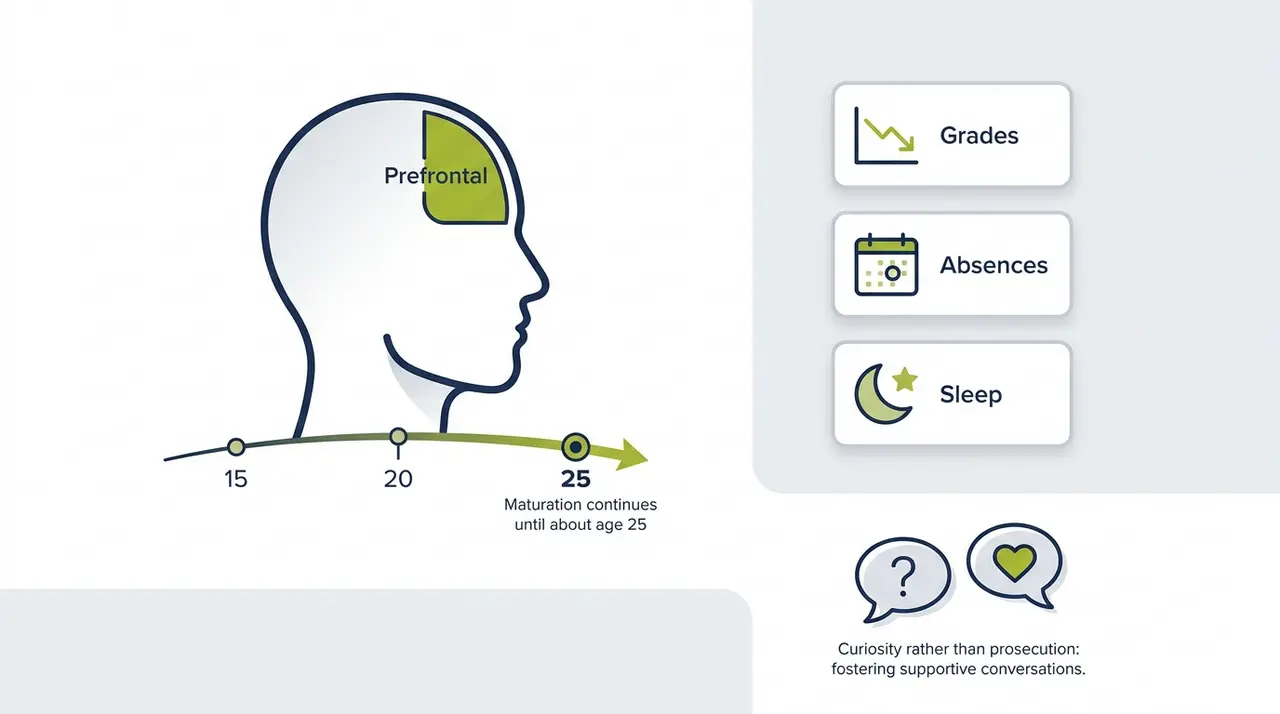
The human brain continues developing until roughly age twenty-five, with the prefrontal regions responsible for judgment, impulse control and long-range planning maturing last. Introduce a substance that acts on the reward and regulatory systems during that construction window, and the effects are not the same as in an adult brain. They are deeper.
In adolescents and young adults, the warning signs have their own grammar. A sharp drop in academic performance. Absences that increase by increments. Sleep and eating patterns shifting dramatically, in either direction. Old interests discarded without replacement. And a distinctive escalation of conflict at home, which families often misread as ordinary teenage turbulence. Sometimes it is. But ordinary turbulence does not usually come with red eyes at breakfast, money that cannot be accounted for, and a locked bedroom that has become a territory rather than a room.
The response matters as much as the identification. A punitive confrontation with a seventeen-year-old will produce a wall, not a conversation. What works, and this is consistent across everything we know about engagement, is a stance of curiosity rather than prosecution. Not a declaration that we know what you are doing and it is unacceptable, but rather the message that we have noticed you seem far away, we are worried, and we would like to understand. It sounds soft. It is in fact the clinically supported approach, because the single strongest predictor of a young person entering treatment is the quality of the alliance that precedes it.
Cannabis, anxiety and depression: which is treating which
Here is the question we ask at assessment, because it reframes most of what families thought they understood. Did the anxiety come before the cannabis, or after? The answer changes the treatment, and both answers are common.
Many people begin using to manage pre-existing anxiety, sleeplessness, or emotional pain, and for a while it genuinely works. Others develop anxiety because of cannabis, since high doses and regular use can trigger paranoia, sudden panic attacks, and a generalised anxious hum that never fully settles. MedlinePlus, in its overview of cannabis effects on health, lists both mood disturbance and impaired mental functioning among the recognised effects of heavy use. When a pre-existing condition and a substance pattern are feeding each other, clinicians call it dual diagnosis, and treating only one of the two is a well-documented route to treating neither.
This is where a great deal of failed treatment comes from, in our view. A person stops smoking, the underlying anxiety surfaces undamped for the first time in years, and with no tools to meet it, relapse follows within weeks. The substance was never the whole problem. It was the solution to a problem nobody had named. Effective care has to work both layers at once, the pattern of use and the thing the pattern was managing. We have written about this dynamic more fully in our article on cannabis-induced anxiety and psychosis, which goes into the more severe end of that spectrum.
Red flags that end the debate
Most of the signs above invite reflection. A few end it. If any of the following are present, the conversation has moved past keeping an eye on it.
| Red flag | Why it changes the picture |
|---|---|
| Driving or undertaking risky work while affected, repeatedly | Judgment itself is compromised, not just mood |
| Use beginning within an hour of waking, alone, daily | The pattern has become physiological, not social |
| Borrowing money or selling possessions to fund use | Financial control has been ceded to the substance |
| Paranoid thinking, beliefs of being watched, or detachment from shared reality | Possible cannabis-induced psychotic symptoms, needing prompt professional assessment |
| Complete withdrawal from family and partner relationships | Isolation is both a symptom and an accelerant |
The last row is easy to underrate because it looks passive. It is not. Isolation removes the relationships that make recovery thinkable, and addiction protects itself by dismantling them one by one.
How to raise it without raising the drawbridge
If you are the family member, your first conversation matters more than you think, and the most common version goes wrong in a predictable way. It opens with an accusation, is delivered mid-conflict, and ends with a door. Here is what we coach instead.
Choose a moment when the person is neither intoxicated nor under fire. Use sentences that begin with what you have noticed and what you feel, not what they are. Saying that you have watched them become distant over these months and that you miss them lands differently than telling them they are ruining their life. Then stop. Do not fill the silence with a lecture. The listening is the intervention, because the felt absence of being heard is very often what the cannabis is standing in for.
Expect denial, and do not treat it as the final word. Defensiveness in the first conversation is normal; it is not evidence that you are wrong. State what you have seen, say the door stays open, and leave the outcome unforced. And set whatever boundaries you need for your own wellbeing. Supporting someone is not the same as absorbing them, and families who hold that line, kindly, tend to get the second conversation that actually goes somewhere.
What a professional assessment actually involves
The phrase professional assessment frightens people, so let us demystify it. An assessment is a structured conversation, nothing more. It maps the history of use, when it started, how it grew, what it costs now. It looks at the emotional backdrop, because anxiety, trauma and depression are so often the engine under the pattern that a clinician who skips this step is working half-blind. It screens for co-occurring conditions. And it ends with a plan, proportionate to what was found.
Crucially, an assessment commits you to nothing. We regularly meet people who feared that admitting themselves to a conversation meant signing up for a programme. It does not. Some people we assess need weekly therapy. Some need a residential stay. Some need, most of all, an honest outside opinion they can finally trust, and that is a legitimate outcome too. If you are unsure where to begin, you can read about how our programme is structured, or simply speak with our team without obligation.
If any of this described someone you know, or described you, one confidential conversation is enough to start. No pressure, no obligation, just an honest conversation with a clinician who will not flinch.
Why the setting of treatment matters: the case for a contained space
Suppose the assessment points toward residential care. The natural objection follows immediately, which is why anyone would leave home, work and country to stop smoking a plant. The answer is that stopping is rarely the hard part. Staying stopped, in the same kitchen, with the same evening ahead and the same feelings arriving on schedule, is the hard part.
A residential setting removes that first stretch of exposure. For the weeks when the nervous system is recalibrating, when dreams are loud and moods swing and the old solution calls from every drawer, a person needs an environment that is not asking them to also perform. A therapeutic community in Cyprus offers something specific, which is enough distance from the triggers to let new patterns form, and enough structure and human contact that the distance does not become loneliness.
At Holina Village the model is deliberately layered. Individual psychotherapy and evidence-based group work address the underlying architecture, the anxiety or trauma the substance was managing. Alongside that, the physical setting, a working farm with orchards and animals, does quiet work of its own. Mornings have tasks, bodies have rhythms, and being responsible for something outside yourself is an old and reliable medicine. Families sometimes ask whether their son or daughter will be ready for that. Our answer is that nobody feels ready, and that the settling-in period exists precisely for this.
The goal, we should say plainly, is not sobriety as an achievement to be framed. Sobriety is the doorway. The goal is a life with enough meaning in it that the substance no longer has a vacancy to fill. That takes longer than a detox, and it is worth every week it takes.
Questions families and users ask us most
Can someone quit cannabis on their own, at home?
Yes, and many people with mild patterns do. But when use is daily, long-standing, or layered over anxiety or depression, the odds shift sharply. The first two weeks of abstinence are exactly when an unsupported person meets their unmedicated feelings with no tools, and that is where most solo attempts end. Professional support does not make quitting easier so much as it makes it survivable, and it substantially lowers the chance of the quick return to the old pattern.
What if there is a relapse?
Then something was learned, if someone is willing to look. A relapse is not the collapse of recovery; it is information about where the support was too thin. The productive response is not self-punishment, which reliably deepens use, but a fast, honest return to whatever was working, with adjustments. In our community this is treated as clinical data, not as scandal.
Does medical cannabis carry the same risk?
Prescription does not neutralise biology. Tolerance and dependence can develop with licensed medical use just as with any other regular supply, particularly with high-THC products and self-managed dose escalation. Anyone concerned about their medical use should not simply stop, but should discuss the pattern with the prescribing physician, honestly, including the parts that feel embarrassing to admit.
The signs worth trusting are the quiet ones. A life shrinking around a substance, sleep that cannot happen without it, withdrawal mistaken for a bad mood, and anxiety and use feeding each other in a loop. None of these mean someone has failed. They mean a pattern has taken hold, and patterns can be treated. The next step does not need to be dramatic. It can be one conversation with one person who will not flinch, and in our experience, that is enough to start.
About the Author
Yossi Zubari
CEO & Founder
Director and Senior Therapist working with addiction for over 25 years, and in personal recovery for almost 30 years.