The phone is face-down on the table, which is the tell. A man checks it anyway, twice, in the ten minutes he has promised his daughter he would not. The account is already overdrawn. He knows the number. He has known it for three days. He opens the betting app and the knowing falls quiet for a moment, the way a held breath goes quiet, and then the breath has to be let out and the knowing comes back louder.
This is not weakness of character. It is not a moral failing dressed up as a habit. What he is living inside is a behavioural addiction, and the reason willpower has stopped working is that willpower was never the system under strain. This article explains what behavioural addiction treatment actually involves, when residential care earns its place, and what a serious programme looks like from arrival through to leaving.
Reading time: 5 minutes
Key points from this article
- Behavioural addiction activates the same reward circuitry as substance use – the absence of a chemical does not make the harm theoretical.
- Residential treatment removes the daily cues that sustain the pattern, giving the nervous system the space to settle that outpatient work often cannot.
- CBT, DBT, and peer group work are the core clinical tools – each targeting a different layer of the pattern, from distorted thinking to unbearable emotion to entrenched shame.
- Co-occurring conditions such as depression, anxiety, and unresolved trauma must be treated alongside the behaviour, not after it.
Table of Contents
What behavioural addiction treatment actually means
People arrive expecting a lecture. What behavioural addiction treatment really is, in practice, is structured work to interrupt a compulsive pattern and replace the machinery underneath it. It maps the cues that fire the behaviour, traces the thought that rides each cue, and rebuilds a response that does not end in shame. Cognitive and behavioural tools do most of the heavy lifting here.
It is for the person who has lost control of one part of their life – screens, gambling, spending, pornography, the eating-something-and-not-tasting-it kind of compulsion. It is also for the wife who finds herself reading bank statements at 2am, and for the brother who keeps lending money he knows he will not see again. Families come to this page too, and they are not on the outside of the problem.
Process addiction, defined by what it is not
A process addiction is not a chemical entering the body. There is no powder, no pill, no drink. The pull is toward the experience itself – the relief, the brief lift, the small private high the action manufactures out of nothing but the action.
Common forms are ordinary and that is exactly what hides them – compulsive shopping, gaming, pornography, the endless scroll, work that has stopped being ambition and become escape. The American Psychiatric Association has noted that some of these, like internet gaming disorder, are still being defined precisely, while others, like gambling, are firmly established as clinical conditions in their own right.
The loop is the same in every version. Tension or emptiness arrives. The behaviour answers it. Relief comes, thin and short. Then shame. Then, because shame is unbearable, the behaviour again. Round and round, and each turn of it cuts a deeper groove.
Is it really as serious as a drug problem
People say it half to themselves. “It’s only gambling. It’s only a screen.” As if the absence of a substance made the harm theoretical.
The brain disagrees. The same reward circuitry, the same dopamine signalling that responds to drugs, responds to the behaviour. Research published by the National Institute on Drug Abuse on addiction treatment and recovery describes how repeated activation reshapes the circuits that govern judgment and self-control – which is precisely why stopping by sheer effort fails so reliably.
And the wreckage is not theoretical at all. Gambling debt can erase a pension in a season. Relationships go silent, then formal, then gone. A person who was once at the centre of a family ends up eating alone, lying by reflex, awake at strange hours. The body suffers too. None of this is softer because there was no needle.
The point where stopping on your own stops working
Most people try to handle it alone first. They should. Cutting up a card, deleting an app, a promise made on a Sunday night with real intention behind it. Sometimes that holds. When it stops holding, there is usually a moment people can name later, even if they could not see it at the time.
The red flags are quiet ones – hiding the behaviour, lying about money and then lying about the lie, money meant for rent or food going somewhere else, doing the thing again with full, clear-eyed knowledge of the damage. That last part is the one that frightens people most about themselves.
This is where a behavioural addiction rehab setting earns its place. Not because the person is broken beyond ordinary help, but because the pattern has wired itself into daily life so tightly that interrupting it needs a different kind of container. Outpatient therapy has genuine value, and many people recover within it. Its limit is that it sends you home each evening, back into the exact room where the pattern lives.
Why living inside the treatment changes the odds
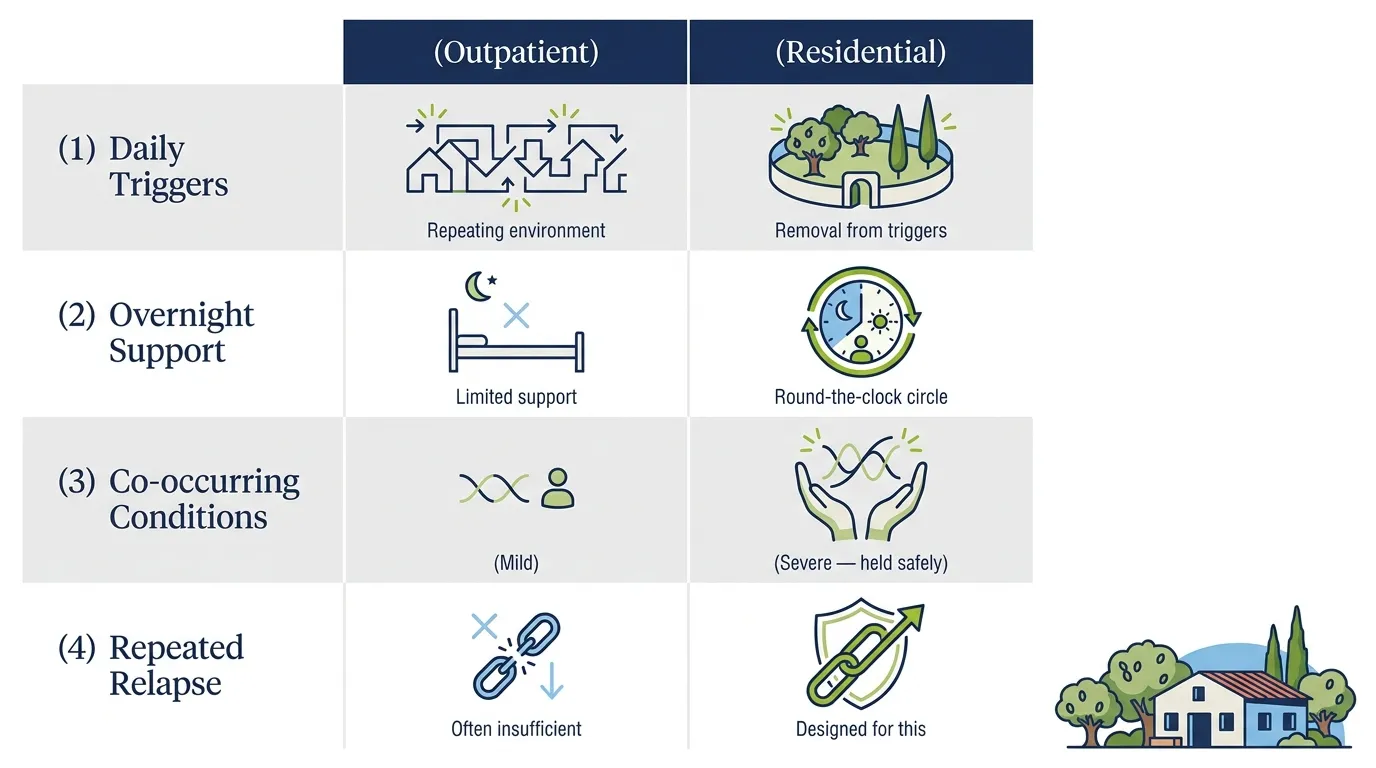
You cannot out-think a trigger you are sitting next to every night.
A residential programme – treatment where you live on site for a stretch of weeks – takes the person out of the environment that has been firing the behaviour all day, every day. The desk. The commute. The hour after the house goes dark. Remove those cues and the nervous system finally gets a chance to settle instead of bracing.
What the setting gives is a contained space and round-the-clock support, with peers who are inside the same work rather than watching from the shore. For a defined period, recovery is the only job. No bills to answer mid-session, no app one tap away, no performance of being fine.
| Clinical indicator | Outpatient | Residential |
|---|---|---|
| Daily exposure to triggers | Remains constant | Removed for the stay |
| Support overnight, when urges peak | Not available | Round-the-clock |
| Co-occurring depression or trauma | Manageable if mild | Held safely when severe |
| Repeated relapse despite real effort | Often insufficient | Designed for this |
How the work unfolds, from arrival to leaving
Uncertainty is its own kind of fear. Families ask what actually happens, day to day, and the honest answer is that there is a shape to it. Knowing the shape takes some of the dread out of the decision. The structure below is what a stay tends to look like in the residential programme at Holina Village, though the detail is always tuned to the person.
The first weeks – assessment and a plan that fits one person
Before any treatment plan is written, there is a full clinical assessment – how severe is the pattern, what sets it off in the psychological and social sense, and crucially, what else is present underneath. A depression, an anxiety that predates everything, an old trauma that the behaviour has been quietly medicating. There is no single protocol that suits everyone. The plan is built around this person, their body, their history, their particular emptiness, and it is revised as we learn more.
Building a day worth living in
Recovery needs scaffolding before it needs insight. Regular meals. Sleep that returns to a rhythm. Movement, time outdoors, real contact with other people who are not asking anything performative of you. Within the supervised setting, access to screens, phones, and money is managed carefully – not as punishment, but to take the loaded gun off the table while the hand learns to stay still.
The deeper work – changing what drives the pattern
Individual and group sessions are where the connection gets made between a hard feeling and the reflex to escape it. Most people have never traced that line consciously. A great deal of the work is the slow processing of shame, the naming of the anxieties that ride underneath, the core beliefs a person formed long ago and never questioned. This is unhurried by design.
Re-entry and the plan for after
Leaving is its own clinical event, not an afterthought. Together we build a toolkit for the days after discharge – the early-warning signs, the people to call, the structures to keep. Recovery holds or fails in the ordinary weeks that come next, and those weeks are planned for here, not left to luck.
Thinking about whether residential care might be the right step
A confidential conversation costs nothing and commits you to nothing. We will listen, answer your questions honestly, and help you think it through at your own pace.
CBT, and the lies a craving tells
Cognitive behavioural therapy is the most studied, most reliable tool we have for behavioural addiction, and it works by taking the thought seriously enough to argue with it.
The thoughts are predictable once you learn to hear them. “I have to buy this now or I’ll feel terrible.” “This time I’ll definitely win it back.” “One round won’t matter.” CBT calls these what they are – distortions – and the National Institute of Mental Health evidence on psychotherapy approaches describes the clinical basis for teaching people to catch and test these automatic thoughts before they do damage.
The techniques are concrete. Cognitive restructuring – learning to question the automatic thought before it spends your money. Exposure and response prevention – sitting in the presence of the cue and deliberately not acting. And planning real alternatives in advance, because a craving meets an empty schedule and an empty schedule loses.
DBT, for when the feeling is unbearable
Some people do not have a thinking problem so much as a feeling problem. The emotion arrives at full volume and the urge follows instantly, with no gap to think inside. For them, dialectical behaviour therapy is often the difference.
DBT teaches four sets of skills – mindfulness, the capacity to notice without immediately reacting; distress tolerance, getting through a wave of pain without making it worse; emotion regulation; and interpersonal effectiveness, asking for what you need without burning the relationship down.
What people learn, in practice, is that an unbearable feeling is survivable without the behaviour. That emptiness can be sat with. It does not feel good at first. It feels, frankly, like nothing. But nothing, it turns out, passes.
Why the group does what individual work cannot
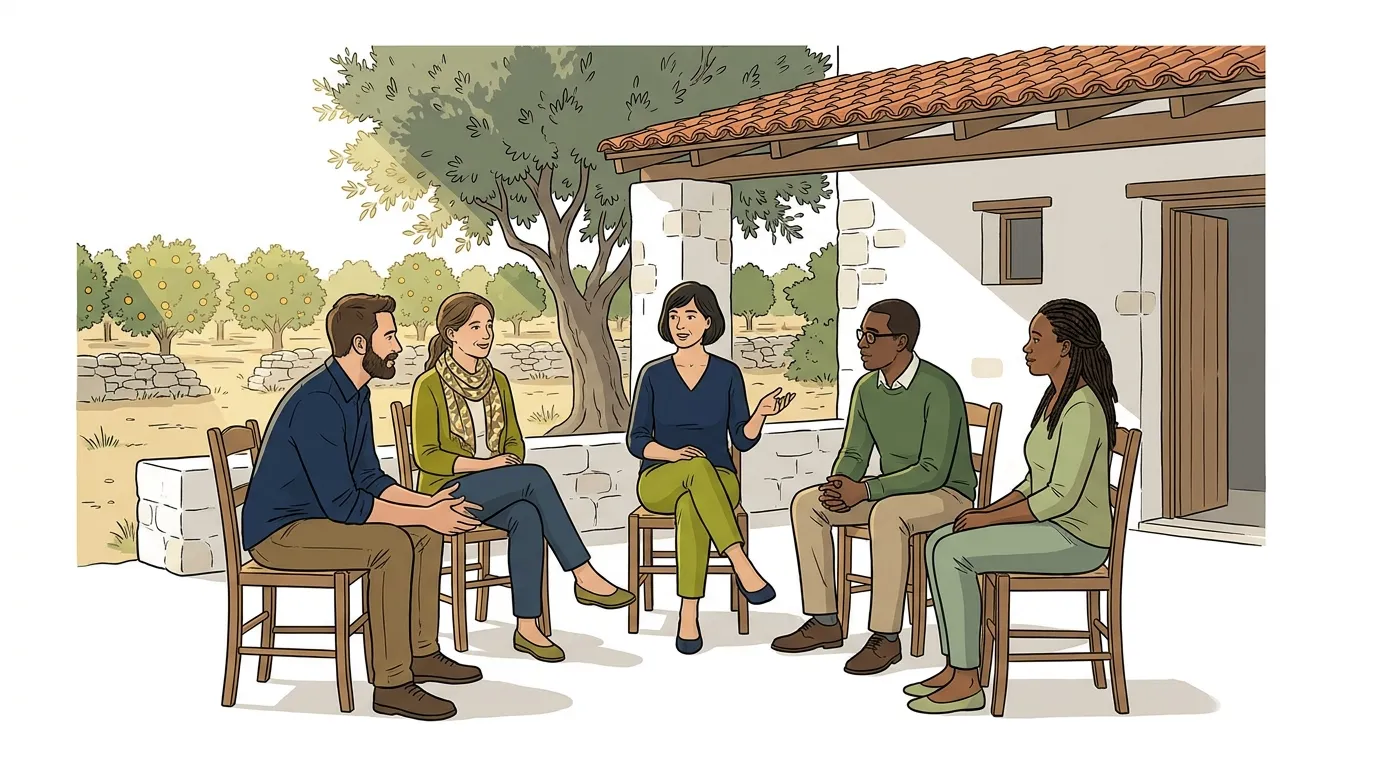
Shame is the engine of every process addiction, and shame cannot survive being spoken aloud to people who recognise it. That is the quiet power of the group, and it is not a soft add-on to the real treatment. It is real treatment.
When someone describes the 2am pattern and four people in the circle nod because they know it from the inside, the isolation cracks. The SAMHSA clinical guidance on group therapy in substance use treatment sets out how peer connection reduces shame and lifts commitment to recovery.
The group is also where you practise the hard things in low stakes – setting a boundary, asking for support, saying a true sentence and surviving the silence after it. This is the relational substrate the whole programme rests on.
What to do when the urge actually hits
Insight is useless at the moment a craving peaks. You need something to do with your hands and your attention right then.
The first tool is to stop treating the urge as a command. It is a wave. Urge surfing means watching it rise, knowing it will crest and fall on its own within minutes, and declining to act while it does. You do not fight it. You let it pass through, the way weather passes over the orchards here without your permission and without your effort.
The second tool is to build the barriers before you are weak, not during. Blocking software on devices. A daily card limit set when you are calm. Handing temporary control of finances to someone trusted – a genuinely effective move that people resist out of pride and later wish they had made sooner. You are not removing your freedom. You are protecting your future self from a version of you that will, predictably, argue otherwise at midnight.
The other diagnosis nobody mentioned
Treat the gambling and leave the depression untouched, and the gambling comes back wearing a different coat. This is the trap of missing what clinicians call dual diagnosis.
Behavioural addiction rarely travels alone. It sits beside anxiety, depression, post-traumatic stress, attention difficulties. And very often it began as a fix for one of those – a way to mute a pain the person had no other language for. Self-medication, by behaviour rather than substance. The National Institute of Mental Health guidance on co-occurring substance use and mental health conditions is clear that both have to be treated together, at the same time, by the same team.
Address only the behaviour and you have pulled a weed and left the root. Any honest clinician will tell you the root grows back.
The family is not a bystander
Addiction is often called a family illness, and the phrase is accurate rather than poetic. The whole system bends around the behaviour. People reorganise their lives, their finances, their truth-telling – all to manage someone else’s compulsion.
Two patterns do quiet damage. Enabling, where love covers the consequences and so removes the very pressure that might prompt change. And codependency, where a person’s whole sense of self becomes wrapped around managing the addicted one. Naming these is not blame. It is relief, usually, for people who have been exhausting themselves in the wrong direction.
This is why family sessions matter, and why the work includes rebuilding trust that has been genuinely broken. We see some of the same dynamics in adjacent experiences of grief and loss, and our writing on grief in early adulthood and its relationship to recovery touches some of the same ground for those who find it useful.
The questions worth asking before you choose anywhere
Families in crisis tend to ring the first centre they find and accept whatever they are told. A few precise questions sort the serious places from the rest.
| Ask this | Why it matters |
|---|---|
| What is the staff-to-client ratio? | It determines whether your person is known, or processed. |
| What individual and group work happens each week? | A real schedule, not a vague promise of “therapy.” |
| How do you handle co-occurring depression, anxiety, trauma? | If they don’t treat it together, the relapse is built in. |
| Is there a structured aftercare plan? | Recovery is won or lost in the months after discharge. |
If a centre is vague on any of these, that vagueness is your answer.
What Holina Village offers, and why the setting matters
The harder questions above are ones a serious programme should welcome. Holina Village is a residential therapeutic community in Achnas, Cyprus, on a working farm that feels nothing like a clinical facility – orchards, animals, open sky, the kind of quiet that lets a nervous system finally stand down.
The clinical work is uncompromising. Psychotherapy, CBT, and DBT are delivered by a multidisciplinary team you can read about on the Holina Village team page. Around that sits the slower, body-and-mind work – time with animals, movement, and the structured outdoor challenges that rebuild a person’s sense of their own capability. Recovery here is not separated from living a life.
The tone is the part people remember. Warm, familial, and not once judging. Most families arrive frightened, so admissions are kept clear and calm. Everyone is met as a person who got into difficulty, not a case to be corrected.
| Room | From | Included |
|---|---|---|
| Shared Room | €7,950/month | Accommodation, meals, all clinical and group sessions, farm and adventure activities, airport transfers |
| Single, Shared Bathroom | €10,950/month | As above, with a private room |
| Single, Private Bathroom | €12,950/month | As above, with private bathroom |
Every tier is all-inclusive. Personal spending money is the only extra.
Common questions
Behavioural addiction is a real clinical condition, not a lack of character. The same brain circuits involved in substance use are involved here, and the same evidence-based approaches – CBT, DBT, group therapy, trauma-informed care – provide a reliable path through it. Residential treatment changes the odds by removing the environment that sustains the pattern and replacing it with structure, clinical attention, and the company of people doing the same work.
If you have read this far, something has likely already been decided in you, even if you cannot say it yet. The man with the phone face-down on the table did not need to be told the number. He needed somewhere the knowing could finally be put down. That is what is on offer here – not a cure, which nobody honest will promise, but a held container, a real plan, and the willingness to be met without judgment.
When you are ready, we are here
No pressure, no obligation – just an honest conversation about what is happening and whether we can help. Everything discussed is confidential.
About the Author
Yossi Zubari
CEO & Founder
Director and Senior Therapist working with addiction for over 25 years, and in personal recovery for almost 30 years.