If you’re reading this, your family has probably already had the hard conversation. You know residential treatment is likely the right next step — now you’re trying to work out how to actually compare the centres that come up when you search for residential rehab Europe. That’s the part nobody prepares you for.
Whether you’re in the UK, elsewhere in Europe, or the Middle East, and whether the person you’re supporting is dealing with addiction, trauma, anxiety, depression, or difficult behaviour — the questions worth asking are largely the same.
What to check before choosing residential rehab in Europe
Accreditation and real qualifications – Ask directly which health authority the centre is registered with, and what clinical modalities its therapists are trained in. A serious programme names specifics: Cognitive Behavioural Therapy (CBT), Dialectical Behaviour Therapy (DBT), EMDR, trauma-informed care, motivational interviewing. A vague answer is information too.
A length of stay built around recovery, not a sales minimum – Short stays feel appealing when someone is in crisis and a family wants relief fast. But 7 or 10 days is rarely enough to work through addiction alongside trauma or a co-occurring condition. Look for a minimum stay of around four weeks, with 12 weeks recommended for anything complex. Recovery that holds tends to need that runway.
What an actual day looks like, not the brochure version – Ask to see a real daily schedule. Group therapy, one-to-one counselling, structured activity, and downtime should all have a place. Programmes built as a therapeutic community — where residents live, eat, and work through recovery together with peer accountability alongside clinical care — tend to build the kind of daily structure that actually sticks once someone goes home.
Family involvement that goes beyond a phone call – A good centre treats you as part of the process, not a bystander waiting for updates. Weekly communication and planned family visits, built into the treatment plan rather than offered as an afterthought, make a real difference to how someone reintegrates once they leave.
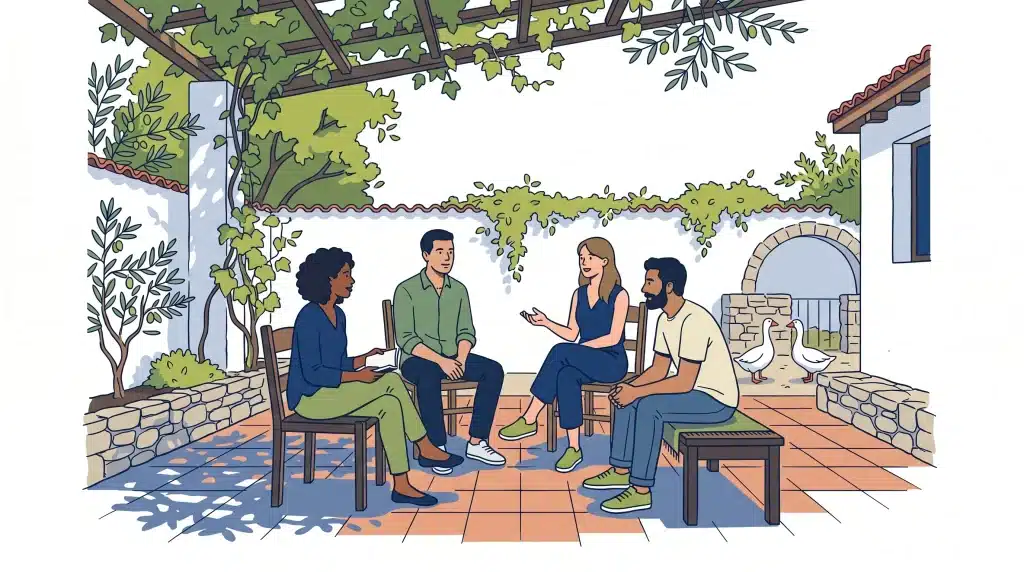
An environment that supports the work, not just houses it – A residential facility with outdoor space, meaningful daily activity, and room to genuinely step outside ordinary life gives people something a clinical ward can’t: a reason to engage with the world again, not just sit through sessions in it. A working farm, animals, and orchards sound like small details until you see how much they change someone’s willingness to show up each day.
The bottom line
There’s no version of this that’s simple, and nobody should pretend otherwise. What helps is asking sharper questions — about accreditation, length of stay, what a real day looks like, and how your family stays involved. We built Holina’s therapeutic community in Cyprus around exactly these answers: evidence-based therapy, a working farm setting, and a minimum four-week programme for people dealing with addiction, trauma, anxiety, or depression together.
If you’d like to talk it through, call us on +357 95 668677. This isn’t a substitute for a professional assessment — but it’s a conversation that can help you figure out what’s next.
FAQ
How long does residential rehab in Europe usually take?
Most serious programmes ask for a minimum of four weeks, with 12 weeks recommended when trauma or another condition sits alongside addiction. Bottom line: be wary of any centre promising fast results.
Can families visit during treatment?
At a well-run centre, yes — visits are planned as part of the treatment process, alongside regular updates, not left to chance. Bottom line: ask exactly how and when family contact happens before you commit.
Does it matter if the centre is outside my home country?
Not on its own. What matters more is accreditation, the clinical team’s training, and how closely the family stays involved from a distance. Many families travelling from the UK, Europe, or the Middle East choose care abroad specifically for the environment and the level of privacy it allows. Bottom line: a centre outside your home country can still keep you fully in the loop — ask how.