
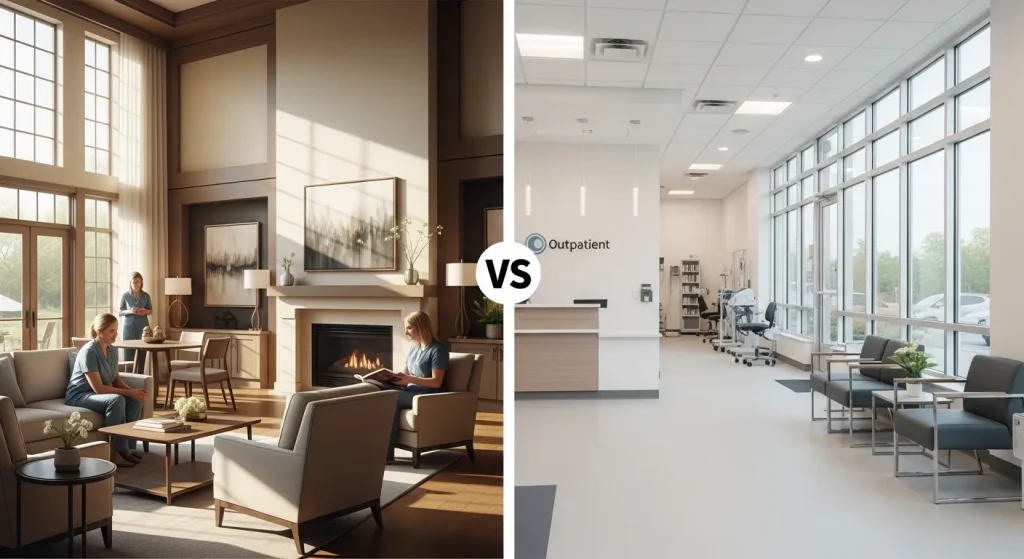
When your teenager is struggling — whether with addiction, depression, anxiety, or behaviour that has started to frighten the people who love them most — the question of what kind of help is actually needed becomes one of the most urgent decisions a family will ever face. Two paths come up repeatedly in conversations with clinicians and treatment centres: residential vs outpatient teen programmes. Understanding the difference between them is not a matter of preference. It is a matter of clinical fit.
Outpatient therapy has genuine value. For young people with mild-to-moderate difficulties, strong family support at home, and a stable environment, regular sessions with a skilled therapist can create meaningful change. But for teenagers whose symptoms are severe, whose home environment has become part of the problem, or whose safety cannot be reliably maintained between appointments, outpatient therapy often falls short — not because the therapist is inadequate, but because the structure simply is not there.
Inpatient teen therapy — or residential treatment — offers something fundamentally different: a clinically supervised, immersive environment where young people are removed from the triggers, pressures, and patterns that have been sustaining their difficulties. It is not a last resort. For many families, it is the first intervention that actually works.
This article breaks down both options honestly, so you can make an informed decision for your child.
Residential vs. Outpatient Treatment for Teenagers
When a teenager is struggling with addiction, a mental health crisis, or serious behavioural difficulties, one of the first and most consequential decisions a family faces is choosing the right level of care. The terms “residential treatment” and “outpatient therapy” are often used interchangeably in conversation, but clinically they represent fundamentally different approaches — and for a young person in genuine distress, that difference matters enormously.
Outpatient therapy typically involves scheduled sessions with a therapist, counsellor, or psychiatrist, ranging from once a week to several hours per day in more intensive day programmes. The young person lives at home, attends school or work where possible, and continues to exist within the same environment that may be contributing to their difficulties. For mild to moderate presentations — early-stage anxiety, situational depression, or experimentation with substances that has not yet escalated — structured outpatient support can be genuinely effective, particularly when the home environment is stable and the family is actively engaged.
Residential treatment operates on an entirely different premise. A young person lives full-time within a clinically supervised environment, removed from the triggers, social pressures, and patterns of behaviour that have been sustaining their difficulties. Treatment is not confined to a one-hour appointment. It is woven into the structure of every day — through individual therapy, group work, psychiatric oversight, family involvement, nutritional support, and carefully managed daily routine. This continuity of care is something outpatient settings, however well-resourced, cannot replicate.
What residential treatment provides that outpatient cannot includes:
- Round-the-clock clinical supervision and crisis response
- Removal from harmful peer networks and environmental triggers
- Consistent therapeutic structure across mornings, evenings, and weekends
- Integrated assessment and treatment of co-occurring conditions such as depression, trauma, and substance use simultaneously
- A contained space in which a young person can begin to stabilise before engaging in deeper therapeutic work
The choice between these two models is not about which is “better” in the abstract. It is about accurately matching the level of care to the severity and complexity of what a young person is experiencing. That clinical matching process is where families most often need support — and where getting it wrong carries the highest cost.
What Residential Treatment Offers and When It Helps
For many families, outpatient therapy is the first step — and for some young people, it is genuinely enough. Weekly sessions with a therapist can support a teenager managing mild anxiety, early-stage substance use, or adjustment difficulties, provided their home environment is stable and their safety is not at risk. But there is a point at which outpatient support reaches its structural limits, and understanding where that boundary lies is critical.
Residential treatment is not simply “more therapy.” It is a fundamentally different model of care. When a young person aged 17 to 25 enters a residential programme, they are stepping into a therapeutically structured environment around the clock — not just for fifty minutes on a Tuesday afternoon. That distinction matters enormously in clinical terms.
Here is what a well-designed residential programme provides that outpatient settings cannot replicate:
- Continuous clinical supervision: Qualified professionals monitor your child’s physical and psychological state throughout the day and night, allowing for real-time adjustments to the treatment plan as symptoms shift or new information emerges.
- Removal from triggering environments: For adolescents and young adults with addiction or trauma-driven behaviours, the home environment, peer group, or social media access can actively undermine recovery. Residential care creates genuine distance from these pressures.
- Structured daily rhythm: Evidence consistently shows that routine is not merely helpful for young people in crisis — it is therapeutic in itself. Meals, sleep, group sessions, individual therapy, and physical activity are organised with clinical intention, not convenience.
- Integrated dual diagnosis treatment: Many young people presenting with addiction are simultaneously managing depression, anxiety, trauma, or undiagnosed neurodevelopmental conditions. A residential setting allows psychiatrists, psychologists, and addiction specialists to work collaboratively on both simultaneously.
- Structured family involvement: Rather than excluding families, high-quality residential programmes actively incorporate parents and siblings into the treatment process through family support sessions, guided communication, and discharge planning.
The clinical evidence supporting residential care is particularly strong in cases involving co-occurring disorders, repeated failed attempts at outpatient treatment, active substance dependence requiring medically supervised withdrawal, or serious self-harm risk. When these factors are present, outpatient therapy alone is not a clinically adequate response — regardless of how skilled the individual therapist may be.
What residential treatment offers, at its core, is containment in the most therapeutic sense of the word: a safe, boundaried space in which a young person can stop surviving moment to moment and begin, with proper clinical support, to actually heal.
How to Choose the Right Level of Care for Your Child
There is no universal answer to whether residential treatment or outpatient therapy is the better option — but there are clear clinical indicators that can guide your decision. The most important step is an honest assessment of your child’s current level of risk, the severity of their symptoms, and whether the environment they are returning to each evening is genuinely supportive of recovery.
Outpatient therapy is appropriate when a young person has strong family support, a stable home environment, no immediate safety concerns, and a pattern of engagement with professional help. It works best when the issues are identified early, the young person has some degree of motivation, and the problems have not yet become entrenched in daily behaviour.
Residential treatment is typically recommended when one or more of the following apply:
- Previous outpatient treatment has not produced lasting change
- The young person is unable to maintain safety at home
- Substance use is daily, escalating, or involves dependency
- Co-occurring mental health conditions such as depression, anxiety, or trauma are present alongside addictive behaviour
- Family relationships have broken down to the point where the home environment is actively counterproductive to recovery
- Academic performance has collapsed and social withdrawal is severe
A well-structured, clinically supervised residential programme offers something outpatient care fundamentally cannot: a complete change of environment. At Holina Village Cyprus, young people aged 17 to 25 receive round-the-clock therapeutic support, evidence-based individual and group treatment, psychiatric assessment, and structured family involvement throughout the programme — not just at discharge.
Family support is not an optional add-on here. Research consistently shows that outcomes for adolescents and young adults are significantly better when parents are actively engaged in the treatment process. Understanding what has driven your child’s behaviour is as important as treating the behaviour itself.
If you are weighing these options and not sure where to begin, a confidential clinical consultation with our team can help you assess what level of care is most appropriate — without any obligation to proceed.
There is no single answer that fits every young person, and any honest clinician will tell you that. What matters is matching the level of care to the actual severity of what your child is facing — not what feels most convenient or least disruptive to family life. For teenagers and young adults managing serious addiction, co-occurring mental health conditions, or deeply entrenched behavioural patterns, outpatient therapy often cannot provide the structure, clinical intensity, or round-the-clock support that genuine recovery requires. The research is consistent on this point.
Residential treatment, when it is evidence-based, clinically supervised, and meaningfully family-involved, offers something outpatient simply cannot: a contained environment where change can actually take root before a young person is returned to the pressures and triggers of everyday life. That foundation matters enormously in early recovery.
If you are weighing these options for your child, the team at Holina Village Cyprus is available to speak with you directly, answer your clinical questions honestly, and help you understand whether a residential programme is the right step. Reach out today.