The room smells faintly of it, the way it always does by Thursday. There is a window open. The intention this morning was a clean day, the first in a while, and it held until about four in the afternoon, when something tightened in the chest and the easiest way to loosen it was the way it had always been loosened. This is not the picture most people carry of addiction. There is no rock bottom in it, no dramatic collapse. Just a quiet, repeating failure to do the thing you keep promising yourself you will do. If you have arrived here, you probably already know that part. This article addresses what actually changes it – the real clinical work, the structure of treatment, and what choosing residential support genuinely involves.
Reading time: 5 minutes
Key points from this article
- Cannabis use disorder sits on a spectrum of severity, and the clearest sign of dependence is not how much someone uses but what happens each time they try to stop.
- Effective treatment addresses the emotional triggers underneath the use, not just the substance itself – leaving those triggers untouched is the main reason people relapse.
- Residential treatment works by removing the person from the environment that feeds the pattern, offering round-the-clock structure while new coping skills are still fragile.
- Aftercare – sustained therapy, peer support, and a relapse-prevention plan – is what separates stopping from genuine recovery.
What treatment is actually trying to fix
Cannabis addiction treatment is not, at its core, the act of putting down the substance. Stopping is the easy part, in the sense that almost everyone reading this has stopped, many times, for a day or a week. The hard part is the return.
So the real work is somewhere else. It is in the reason the substance got reached for in the first place. Good treatment sets out to identify the emotional triggers underneath the use, to build coping mechanisms that actually hold under pressure, to repair a sleep cycle and an appetite that have drifted, and to mend the relationships that quietly frayed while the person was elsewhere. The aim is not a life spent resisting cannabis. The aim is a life with enough meaning and function in it that the reaching becomes unnecessary.
Addiction is best understood as a chronic condition that changes how the brain weighs reward and effort, which is why willpower alone so reliably fails. The National Institute on Drug Abuse guidance on treatment and recovery is clear that lasting change requires behavioural and environmental work, not a single act of resolve.
Addiction or just a habit – the honest test
People ask this question carefully, sometimes about themselves, sometimes about a son or a partner. It is a fair question, and it deserves a plain answer rather than a label.
Recreational use comes and goes around the edges of a life. Dependence rearranges the life around itself. The clearest marker is loss of control – not whether someone wants to cut down, but what happens when they try. Repeated attempts to reduce or stop that collapse within days are the signal worth paying attention to.
The other markers are quieter. Commitments at work or in study start slipping. A family dinner gets skipped because staying in to smoke felt easier. Short-term memory frays, focus thins, and a flat, unmotivated quality settles in. Amounts and timing get hidden, even from people the person trusts. Heavy, sustained use measurably affects decision-making, learning, attention and coordination, which the CDC’s overview of cannabis and brain health documents in detail.
Cannabis use disorder versus marijuana addiction
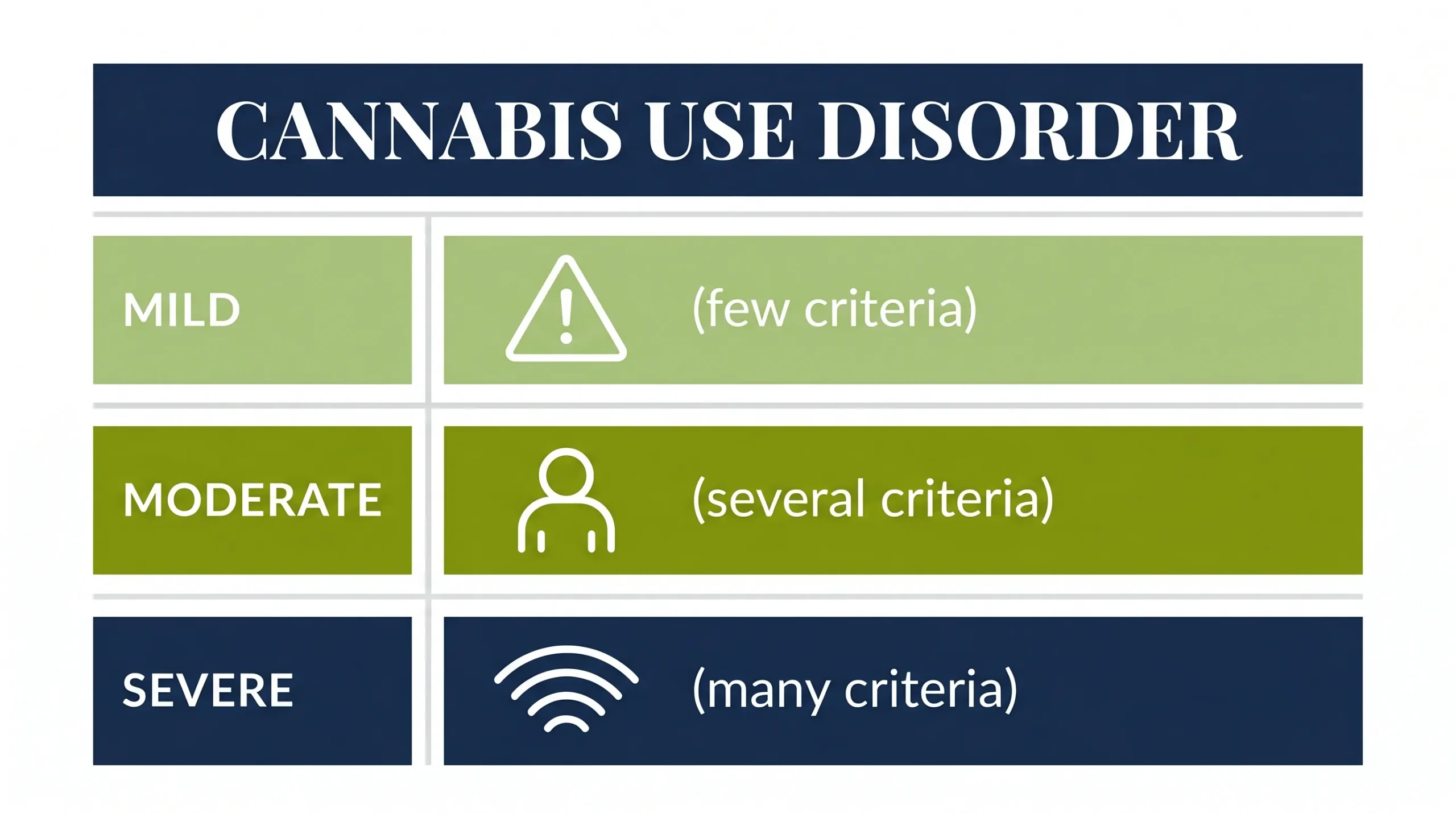
The word the public uses is addiction. The word clinicians use is cannabis use disorder, or CUD. They point at the same thing, but the clinical term carries something useful – it comes with a graded severity, so the conversation stops being whether someone “is an addict” and becomes how far along a spectrum they have travelled.
The DSM-5 sorts CUD into mild, moderate and severe according to how many diagnostic criteria are present. Those criteria include intense craving, using in physically risky situations such as driving, continued use despite problems it is directly causing, and tolerance – meaning steadily larger amounts are needed for the same effect. Most people searching for treatment are somewhere in the moderate band by the time they look. The CDC’s explanation of cannabis use disorder risk factors and signs lays out the full picture plainly.
Why stopping is so hard even when you can see the damage
There is a stubborn belief that cannabis cannot be addictive because it grows out of the ground. The logic does not survive contact with the biology. THC binds to cannabinoid receptors throughout the brain and nudges the reward system, the dopamine circuitry, into treating the substance as something worth repeating. The plant’s origin has nothing to do with it.
The psychological grip is stronger than the chemical one for most people. Cannabis becomes a kind of emotional plaster, smoothed over boredom, anger, loneliness, the low hum of anxiety. It works, briefly. That is the trap.
Then the loop closes. The substance manufactures a short calm and a longer agitation, so the anxiety it was meant to mute comes back larger, and the obvious answer to a larger anxiety is the thing that softened the smaller one. People are not weak for being caught in this. The mechanism is designed to catch.
Cannabis withdrawal – what the first month really looks like
Nobody should walk into the first drug-free days blind. Knowing what is coming lowers the panic, and panic is one of the main reasons people abandon a quit attempt before it has had a chance. The discomfort, when it arrives, is not a sign of failure. It is proof the body had become dependent and is now recalibrating.
| Window | What tends to surface |
|---|---|
| 24 to 72 hours | Symptoms begin. Difficulty falling asleep, irritability, sharp mood swings, physical restlessness. |
| Week 1 to 2 (peak) | Night sweats, unusually vivid dreams, poor appetite, nausea, and strong cravings. |
| Week 3 to 4 onward | The physical symptoms fade. The work shifts to the mental and emotional, which is where it stays for a while. |
Getting through the first week without running back
Insomnia is the quiet saboteur of week one, and it is why so many solo attempts end on day three. Keep sleep boundaries strict – the same hours each night, screens off well before bed, a hot shower and slow breathing to bring the body down. Walk, even briefly. Light movement outdoors helps the body make its own endorphins and eases the muscular tension that builds in those days. And do not do it alone. Tell one trusted person, or reach out to a professional. Solitude is what relapse feeds on.
Do you need a detox, and when does it need supervision
Detoxification simply means clearing the active substances from the body. Here is the honest part any clinician will tell you – unlike alcohol or opioids, withdrawing from cannabis alone is not directly life-threatening. That fact reassures people, and it should, up to a point. Not dangerous is not the same as manageable. The psychological crises that ride alongside cannabis withdrawal can be more than someone can hold by themselves.
Supervision earns its place in three situations. When other substances are in the picture – alcohol or sedatives layered on top – the risk profile changes entirely. When there is a mental-health history underneath, severe panic, major depression, or a vulnerability to psychosis that use stirred up or worsened. And when the home itself is the problem, when the people around the person are smoking and the supply is always within reach, which turns a home detox into a quiet impossibility.
Not sure which level of support fits your situation?
A confidential conversation with our team takes about twenty minutes and costs nothing. No pressure, no obligation – just an honest discussion about what would actually help.
What residential cannabis rehab is, and who it suits
Cannabis rehab in the residential sense means living, for a stretch of weeks, inside an environment built entirely around recovery. The single most underrated thing it offers is removal – distance from the familiar room, from the daily pressures that trigger use, and from the substance simply being there, an arm’s length away, every evening.
It is not for everyone, and it does not need to be. It tends to fit the person who has tried, sincerely, at home or in weekly therapy, and kept falling back. It fits younger people who have lost their footing, dropped out of study or work, and need a genuine reset rather than another adjustment. And it fits anyone who needs round-the-clock structure to relearn the basics – a sleep cycle, a meal at a regular hour, a day with a shape to it. Our residential programme at Holina Village is built on exactly this principle of the held container.
Residential versus outpatient – where each one reaches its limit
Outpatient and intensive outpatient therapy have genuine value. People keep their lives, their jobs, their beds at home, and come in for several hours of treatment a week. For the right person, that is enough. The trouble is the demands it makes.
Outpatient work asks for a level of self-discipline, a stable home, and a relative steadiness of mood that the very thing being treated tends to erode. If the home is where the triggers live, sending someone back to it each evening is asking the impossible.
| Indicator | Outpatient / IOP | Residential |
|---|---|---|
| Where you live | At home, attending sessions | On site, fully immersed |
| Best suited to | Stable home, strong support, milder dependence | Repeated relapse, unstable environment, co-occurring conditions |
| Daily structure | A few hours weekly | Morning to evening, built around recovery |
| Exposure to triggers | Constant, between sessions | Removed during the stay |
| Depth of work | Limited by daily life | Uninterrupted, with a supportive peer group |
The holistic side, and why it is not a spa
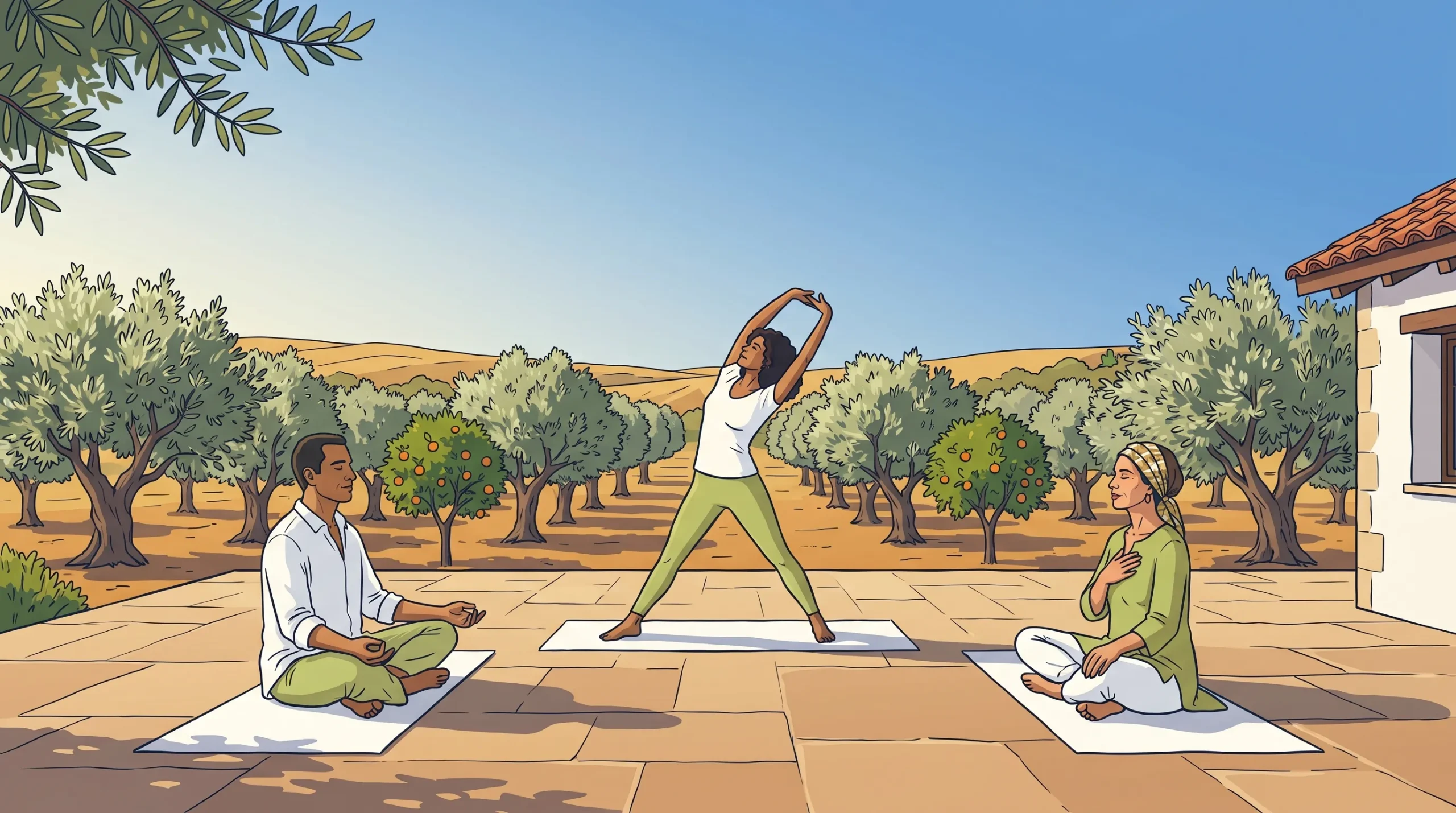
When people hear “holistic,” they brace for vague talk. That is not this. The body-mind work in serious addiction treatment is an applied toolkit for a nervous system worn down by long use, not a wellness add-on.
Mindfulness and meditation train a person to notice a craving without immediately obeying it, which loosens the automatic link between urge and action. Bodywork, yoga, breathwork and sport release the tension that gets stored physically and help reset a hormonal balance thrown off by months of use. Nutrition matters more than people expect, because the eating that accompanies heavy cannabis use – the late-night grazing and skipped meals – leaves the gut and the energy system in poor shape. The evidence for the mindfulness piece is reviewed in this assessment of meditation and mindfulness effectiveness and safety, including its documented effect on craving.
The treatments that actually carry the weight
There is no approved medication that treats cannabis use disorder directly. The work that moves people is psychological, and two approaches sit at the centre of it.
Cognitive behavioural therapy maps the automatic thoughts that precede use and replaces the destructive routines with workable ones, teaching concrete responses for the moments that used to end in a relapse. Motivational enhancement therapy works on the ambivalence almost everyone arrives with – the genuine wanting to stop sitting right beside the fear of stopping – and helps the person find their own reasons rather than borrowing someone else’s.
Working with triggers and craving in real time
Early on, each person builds a personal trigger map – specific people, places, hours of the day, particular feelings that reliably set off the urge. Then there is the practice of urge surfing, which rests on a simple fact: a craving is a wave. It rises, it peaks, and if it is not fed with action, it falls on its own. Learning to feel that arc, to let it crest and pass without doing anything about it, is one of the most quietly powerful skills in the whole process. Group work accelerates this, because hearing someone else describe the same wave breaks the isolation that secrecy builds, and it gives a safe place to practise honesty before taking it home.
Where trauma and mental health fit into all of this
Very often the cannabis was never the first problem. It was the answer to one. Anxiety, depression, OCD, the long shadow of something that happened years ago. This is dual diagnosis – a mental-health condition living alongside the addiction – and the substance was functioning as an unprescribed medicine to quiet painful memories, flashbacks, or an internal weather that would not settle.
Which is why clearing the cannabis and stopping there is a near-guarantee of relapse. Take away the thing that was muffling the trauma and leave the trauma untouched, and the person stands exposed with nothing to put in its place. Integrated treatment addresses both at once, drawing on approaches such as EMDR, complex-trauma work and dialectical behaviour therapy. We have written more about how loss and grief weave into early recovery in our piece on grief in early adulthood and its role in recovery.
A day inside the community
People imagine something clinical and cold. The reality at Holina Village feels nothing like a facility. It is a working farm in Achnas, with orchards and animals and open sky, and the day has a shape to it precisely because a steady rhythm is what a scrambled body clock needs to heal.
Mornings start early, with meditation or yoga, breakfast looking out over the land, and a community check-in where people name where they actually are that day. Middays move into one-to-one sessions with qualified therapists, psycho-educational workshops, and a proper lunch cooked on site. Afternoons hold movement, expressive and creative work, or structured rest. Evenings draw the day to a close with a group, a shared meal, and quiet time before sleep. The structure is not there to control. It is there to hold, while the new patterns are still too fragile to hold themselves.
The first week of cannabis rehab
Walking into an unfamiliar place when you are already raw is daunting. So the first week is not designed to push. It is designed as a soft landing – a settling-in period for getting your feet under you and building a little physical strength back.
Early on there is a full psychiatric and medical assessment, because the treatment plan has to be built around the actual person rather than a template. There is the first meeting with the lead therapist who will carry the process, and an introduction to a peer mentor from among the community’s longer-standing members. And there is gentle, closely watched support through the immediate withdrawal – physical and emotional – with clinical and therapeutic staff available at any hour. You can read about the people who carry this work on the Holina Village team page.
Why aftercare separates stopping from recovering
Leaving the centre is not the finish. It is the beginning of the part that counts – the test against ordinary life. This needs saying plainly, because the relief of completing a programme can disguise how exposed the moment of re-entry really is.
The old environment waits. Friends who still smoke, the family tensions that never went anywhere, a draining work routine. That is where the danger of a slip concentrates. So a relapse-prevention plan, written before discharge and tailored to the individual, is not optional paperwork. It is the bridge.
Effective aftercare keeps the individual and group therapy going on a weekly footing, plugs the person into support groups – whether that is NA or an alumni circle from the centre – and where it helps, pairs them with a recovery coach who can be reached in the actual moment a crisis hits rather than at the next scheduled appointment.
Choosing a centre in Cyprus without getting it wrong
This is a decision that changes a life, so it is worth slowing down for. Treating abroad has real advantages, and a centre in Cyprus offers a particular set of them – a short flight from Israel and most of Europe, a fast and clean geographic break from the environment that fed the use, a calm Mediterranean setting that genuinely lowers the internal volume, and a discretion that keeps the whole thing well away from public view.
On the preliminary phone call, ask the things that matter. Is the team properly licensed and qualified in mental health and addiction? What is the staff-to-resident ratio, because a close, almost familial ratio changes everything? Does the centre treat the trauma and the co-occurring conditions, or does it stop at a tidy physical detox and call it done? And is there a structured plan for the day after the person comes home?
| Room tier (all-inclusive, monthly) | What it offers |
|---|---|
| Shared Room, from €7,950 | Full programme, meals, clinical and group sessions, adventure and farm activities, airport transfers. |
| Single Room with Shared Bathroom, from €10,950 | The same programme, with private sleeping space. |
| Single Room with Private Bathroom, from €12,950 | The same programme, with full private facilities. |
Every tier is all-inclusive across accommodation, meals, clinical and group work, the adventure and farm activities, and airport transfers. Personal spending money is the only thing left to budget for. The difference between the tiers is privacy, not the depth of care.
Frequently asked questions
Cannabis use disorder is a real condition with a clear clinical architecture, and it responds to real treatment. The work is psychological and relational, it takes time, and it works best inside a structure that holds the person while the new patterns are being built. If you have read this far, something in your own situation – or someone’s you love – has already been recognised. That recognition is not nothing. It is where the work begins.
A conversation is always the right first step
If you are considering treatment – for yourself or someone close to you – we are available for a confidential call at any time. No pressure, no obligation, and no judgement. Just an honest conversation about what would genuinely help.
About the Author
Yossi Zubari
CEO & Founder
Director and Senior Therapist working with addiction for over 25 years, and in personal recovery for almost 30 years.