The flat is not particularly untidy. There is work, most days, or at least the appearance of it. The person has been telling themselves a version of the same sentence for two, maybe three years. I can stop whenever I want. And then evening arrives, the small ritual begins again, and the sentence gets quietly postponed until tomorrow. If you have arrived at this page, you may know that evening well. You may have typed the question into a search bar at midnight, hesitated, and read the results with a mixture of relief and dread. Relief, because there is help. Dread, because the help on offer looks bewilderingly varied, and because admitting you need it at all still carries a weight that other admissions do not.
This article is our attempt to answer the question plainly. Not to persuade you toward one door, but to describe what is actually behind each one, what it costs in money and in weeks of your life, and what kind of situation each option genuinely suits. Cannabis dependence has a strange cultural position. It is the addiction people are least likely to be believed about, including by themselves. That makes the search for help harder than it needs to be, and we would like to make it a little easier. This article covers how to tell dependence from heavy use, what the diagnosis process involves, what the evidence says works, and how the four main routes to help compare, including residential therapeutic community treatment.
Reading time: 5 minutes
Key Points
- Cannabis use disorder is a formally recognised diagnosis, and modern high-potency products build dependence faster than the cannabis of previous generations.
- No medication reliably treats cannabis dependence. Psychosocial therapies such as CBT, motivational interviewing, and contingency management carry the evidence.
- Cannabis withdrawal, typically peaking in the first week and resolving over two to four weeks, is the point where most solo attempts to stop collapse.
- Because most cannabis dependence is self-medication for something underneath, any help you seek should treat the underlying condition alongside the stopping.
Table of Contents
- Is this actually addiction?
- Heavy use versus addiction
- What the diagnosis process looks like
- The four doors, compared
- What the evidence says works
- The withdrawal fortnight
- When outpatient is enough, and when it is not
- What a therapeutic community adds
- The part underneath, treating the cause
- For the family reading this at midnight
- Aftercare, the part that decides everything
First, the question nobody asks out loud, is this actually addiction?
Let us answer the unspoken question before the practical one. Yes, cannabis can produce a real, clinically recognised dependence. The diagnostic literature is unambiguous on this. Cannabis use disorder is a formal diagnosis with defined criteria, including tolerance, withdrawal, unsuccessful attempts to cut down, craving, and continued use despite harm. You can read the clinical summary yourself in the StatPearls overview of cannabis use disorder published on the NCBI Bookshelf.
The myth of the harmless natural herb deserves a moment, because it is not stupid, it is just outdated. The cannabis of the 1970s was a mild plant. Much of what is consumed today, whether flower or concentrate, carries THC concentrations that were simply not available a generation ago, and daily use of high-potency products builds dependence considerably faster. In our experience, most people who arrive at a residential programme for cannabis are not casual smokers who got unlucky. They are daily users, often from their late teens, who have been self-medicating something, anxiety, insomnia, social fear, an old grief, with the only tool they found that worked.
So the honest framing is this. The question is not whether cannabis is a moral failing. It is not. The question is whether it has quietly become the thing your life is organised around, and whether you can imagine a Tuesday evening without it. If the answer to the second part is no, or yes but you do not want to, then you are asking the right question, and the rest of this article is for you.
Heavy use and addiction are not the same thing, and the difference matters for where you seek help
Heavy use is a measurement. Addiction is a loss. That is the cleanest distinction we know, and it matters because it determines what kind of help is appropriate.
Someone can smoke most evenings for years and still not meet the criteria for a use disorder. Unpleasant as that may be for their lungs, they retain control. They stop for a job interview, a pregnancy, a month abroad, and it is irritating but manageable. What we look for clinically is different. It is the person who has tried to stop, genuinely tried, several times, and could not sustain it past the second bad night’s sleep. It is tolerance, needing twice as much for half the effect. It is the slow contraction of life, hobbies dropped, friends narrowed down to the ones who also smoke, ambitions postponed without any conscious decision to postpone them. Family members often describe it as watching someone become a muted version of themselves, present but not quite there, and unable to explain why.
The distinction matters practically. A heavy but non-dependent user may do very well with a good individual therapist and a firm decision. A dependent user who tries that route usually relapses, then concludes that nothing works for them, which is not true. It was the wrong door, not the absence of doors.
What the diagnosis process actually looks like, and why it is not a test you can fail
Many people delay seeking help because they imagine the assessment as an interrogation, someone with a clipboard deciding whether they are bad enough to deserve treatment. In reality, a proper clinical assessment for cannabis use disorder is closer to a structured, extended conversation, and its purpose is to fit the help to the person rather than to judge them.
The questions a clinician will actually ask
Expect questions about frequency, amounts, and duration, but also the ones that carry the real weight. Do you experience strong cravings? Have you tried to cut down, and what happened? Do you continue using despite clear consequences, arguments, warnings at work, a partner leaving? Do you get irritable, sleepless, or physically uncomfortable when you stop for a day or two? The last of these, withdrawal, surprises people most. Cannabis withdrawal is real and well documented, and the standardised withdrawal checklist used in NIDA research reads like a description of what many daily users already know from their own failed attempts to stop, including irritability, anxiety, sleep disturbance, strange vivid dreams, reduced appetite, and restlessness.
If a clinician also asks about your history, your childhood, your moods, your traumas, that is not a detour. It is often the most important part, because cannabis dependence is very frequently the visible half of a deeper problem, a point we return to below.
The four doors, an honest comparison of where help for cannabis addiction comes from
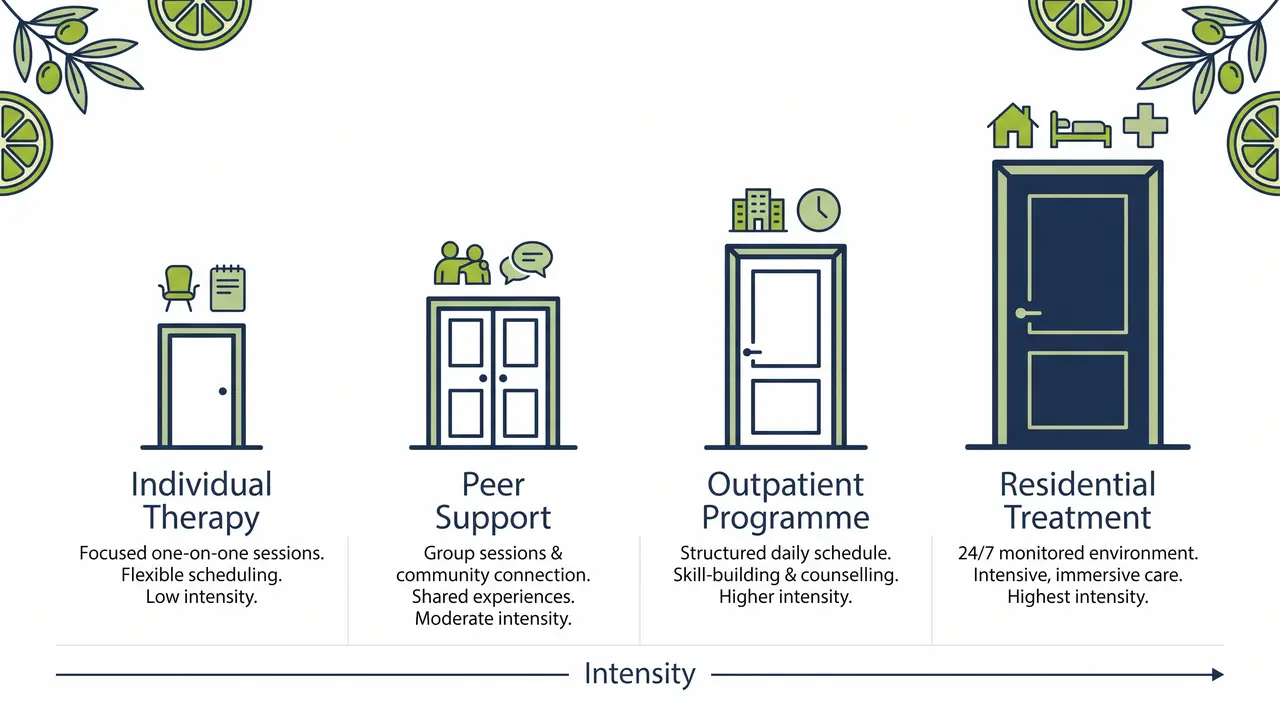
There is no single path, and any honest clinician will tell you that the research literature does not crown one winner for everyone. What exists is a spectrum of intensity, and the skill lies in matching the intensity to the actual situation. Below is a comparison we use in our own conversations with families.
| Option | What it involves | Suits whom | Where it reaches its limit |
|---|---|---|---|
| Individual therapy (CBT or motivational interviewing) | Weekly sessions, usually outpatient, identifying triggers, building coping skills, resolving ambivalence | Mild to moderate dependence, stable life, supportive home, no serious mental health history | When every evening still ends in the same room with the same access to the substance |
| Peer support groups | Free, ongoing fellowship with others in recovery, no clinical component | People who need accountability and community alongside other treatment, or after it | As a sole intervention for dependence with co-occurring anxiety, depression, or trauma |
| Day or intensive outpatient programmes | Several sessions per week, structured group work, living at home | Moderate dependence, strong motivation, home environment free of the substance | When the home environment is the primary trigger, or when previous attempts have repeatedly failed |
| Residential treatment | Full-time stay in a therapeutic community, typically 4 to 12 weeks, with therapy, structure, and 24/7 support | Repeated relapse, heavy daily use, co-occurring mental health conditions, an environment that makes abstinence impossible | When cost or life obligations make an extended absence unworkable, though shorter stays and staged options exist |
Two of these deserve a fuller word, because they are the doors people know least about.
What the evidence says actually works, and what does not
Here is a finding that surprises most people. There is no medication approved for cannabis dependence. None. Systematic reviews of pharmacotherapy have examined one candidate after another, and the honest conclusion is that no drug reliably treats this condition. Medication has a role, but a modest and supportive one. A psychiatrist may temporarily ease severe insomnia or acute anxiety during the first weeks of abstinence, under supervision. Anyone offering a pill that cures cannabis addiction is selling something.
What does work, repeatedly, in trial after trial, is psychosocial treatment. Cognitive behavioural therapy, which teaches you to see the automatic thought chain that ends in smoking and to break it earlier each time. Motivational interviewing, which works with the internal conflict, the part of you that wants to stop and the part that reaches for the lighter, without taking sides. And contingency management, the practice of rewarding verified abstinence, which sounds unglamorous and produces some of the strongest effect sizes in the field.
The catch, and it is a serious one, is that all of these therapies assume you can stay abstinent long enough to practise them. That assumption fails exactly where dependence is deepest.
The withdrawal fortnight, the reason so many solo attempts collapse on day three
Nobody warns you properly about cannabis withdrawal, because the culture insists cannabis has none. Then the person stops, and by the second night they are sweating through the sheets. Sleep becomes shallow and strange, then filled with dreams so vivid they feel like another life. Appetite disappears for a week. Irritability arrives that the family feels more than the person does. The typical course, well mapped in the clinical literature, is onset within one to two days, a peak around days two to six, and gradual resolution over roughly two to four weeks.
Two weeks does not sound long. It is long. It is long enough for sleep deprivation to erode every good intention, and by day five, with the brain’s reward system still recalibrating, the reasoning goes that one night of sleep is all that is needed, and the attempt will start again tomorrow. Almost every person we have ever admitted tells a version of that story. That is not weakness. That is the predictable behaviour of a nervous system in deficit, and it is precisely why the contained environment of residential care exists. Not because people lack willpower, but because willpower was never the right tool for that specific fortnight.
When outpatient is genuinely enough, and when it is a polite fiction
Outpatient therapy has genuine value, and we recommend it often. If your use is moderate, your home is calm, your partner or family is supportive, and you can honestly picture yourself declining the substance in your own kitchen on a bad evening, weekly therapy with a skilled CBT practitioner is a proportionate response, and it succeeds regularly.
But there is a moment when recommending outpatient to a dependent daily user becomes a polite fiction, a way of prescribing something cheap and calling it care. The tell-tale signs are consistent. The environment itself is saturated, everyone you know smokes, or the dealer’s number is the most reliable contact in your phone. There have been three, four, five serious attempts to stop, each ending the same way. There is a mental health condition underneath, anxiety, depression, an unprocessed trauma, that flares the moment the anaesthetic wears off. Or motivation itself has eroded so far that the machinery of attending weekly appointments never quite engages.
In those situations, the mechanism of residential treatment is not luxury, and it is not punishment. It is subtraction. Remove the substance, remove the access, remove the social circle for a while, place the person somewhere with open sky and a structured day, and the nervous system gets something it has not had in years, an uninterrupted stretch of time to recalibrate. A four-week stay allows that recalibration to begin. Eight to twelve weeks allows the new patterns to actually hold, to be rehearsed, stress-tested, and internalised. That difference in duration is not marketing, it is the difference between a nervous system that has rested and one that has reorganised.
What a therapeutic community adds that a clinic cannot
Residential programmes are not interchangeable, and the model matters more than the brochure. The clinical facility model, corridors, appointments, a patient identity, suits some people. But for cannabis dependence, which so often carries shame, secrecy, and isolation at its core, we have seen the therapeutic community model do something a clinic structurally cannot.
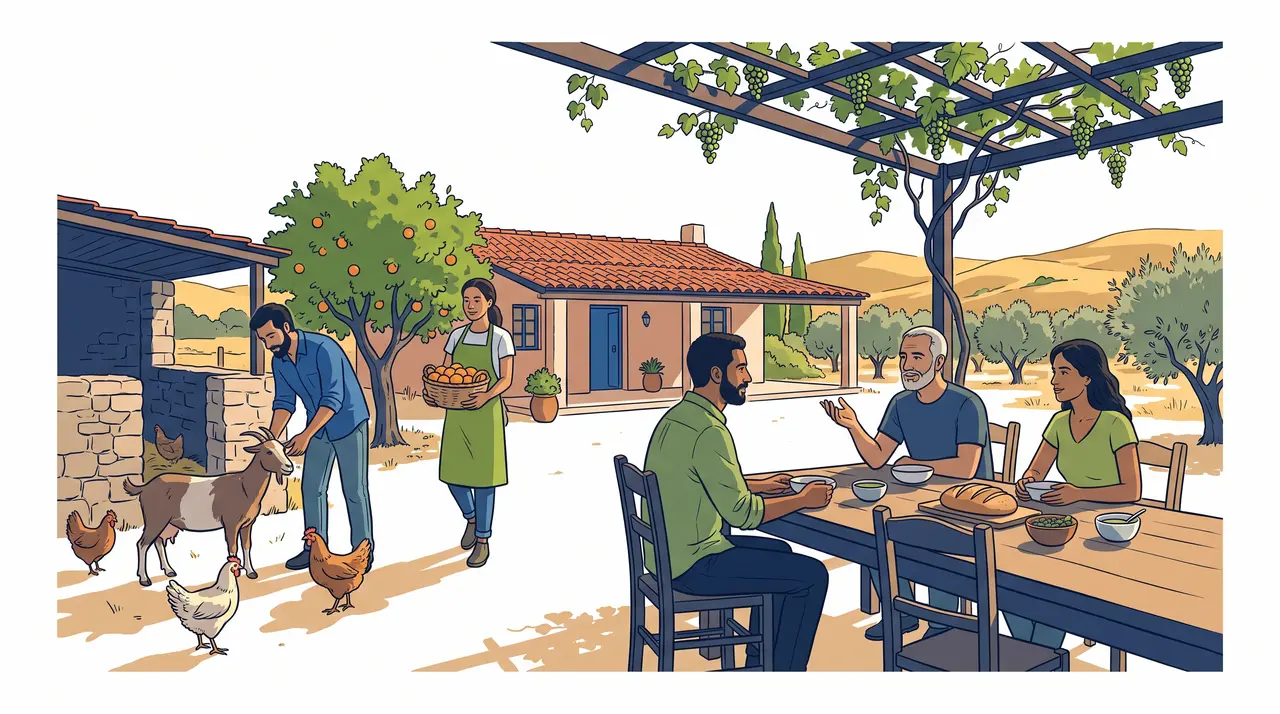
A therapeutic community is exactly what it says. A group of people living alongside each other, sharing the work of daily life, cooking, tending animals, keeping the place running, and doing their psychological work together in the same rooms where they eat breakfast. The mechanism is the relational substrate. Recovery stops being a private project and becomes something you do with others, visible, accountable, and, for the first time in years, honest. The setting matters too. Our own programme runs on a working farm among orchards in Achnas, and we chose that deliberately, because it feels nothing like a clinical facility. Nobody flourishes in a corridor. Many people begin to flourish, cautiously, around horses and vegetable beds and an unhurried evening. You can read more about how we structure this on our programme page, and meet the clinical team who run it.
The part underneath, why treating only the smoking usually fails
Here is the thing we would most want a reader to take from this article. In our experience, the large majority of people dependent on cannabis are not chasing a high. They are anaesthetising something. Social anxiety that made every room painful. A mind that would not stop replaying an old event. Grief that was never allowed to finish. Insomnia that began as a symptom and became a reason.
This is called self-medication, and it explains a pattern families find baffling, why someone would return to the thing that is visibly ruining their life. Because when the underlying pain is left untreated, the person is asked to live with it raw, and most people cannot, not for long. Treatment that addresses only the stopping, without addressing the reason a person needed to blur things, removes the coping mechanism and leaves the wound. The relapse that follows is not a moral failure. It is arithmetic.
Any help you seek, outpatient, residential, or both, should therefore include proper assessment for co-occurring conditions and a trauma-informed approach. Ask this question of any provider, what will you treat besides the cannabis. If the answer is nothing, keep looking.
For the family reading this at midnight
Perhaps you are not the one smoking. Perhaps you are the parent or partner, reading in the next room, and the question you typed was slightly different, where can they get help, and what do I do if they refuse.
A few things we have learned from hundreds of these conversations. Support and enabling are different things, and the line between them is whether your behaviour makes the using easier or harder. Money that becomes cannabis is enabling. A meal, a conversation, a ride to an appointment is not. Boundaries set in anger do not work, while boundaries set calmly, explained once, and held consistently sometimes do. And the conversation that opens a door is almost never the confrontational one. It is the quiet one, held when the person is sober and the house is calm, that begins with what you have noticed and what you fear, rather than with what they are doing wrong. Saying that you miss them lands. Telling them they are ruining their life closes the door for another year.
And you deserve support too. Families who receive their own guidance, whether through a therapist, a support group, or the family liaison work a good programme provides, consistently do better, whatever their loved one decides. If you are the family member and want a confidential conversation about the situation before anyone has agreed to anything, you can contact our admissions team directly. Most families who reach us arrive tired and unsure, and the first conversation is simply that, a conversation, with no obligation attached.
After the programme, the part that decides everything
Whoever you choose, whatever route you take, ask one question early, what happens afterwards. Because the pattern is predictable. A person stops, stabilises, feels genuinely well for the first weeks, and then returns to the same flat, the same friends, the same evenings. Re-entry, not the withdrawal fortnight, is where most cannabis recoveries are actually decided.
A serious treatment plan treats discharge as the beginning of a second phase, not the end of the first. Weekly therapy continues. Support groups continue. A mentor or recovery contact exists for the bad Tuesday. Family members know their role. And a daily structure, work, study, sport, something the hands and the mind can occupy, is built deliberately, because an empty evening is the most dangerous object in recovery. At our end this is not an afterthought. The aftercare plan is drafted from the first week, precisely so that the last week does not carry the whole weight of the future.
A confidential conversation, when you are ready
If repeated attempts to stop have not held, or the environment at home makes abstinence feel impossible, residential care may be the honest answer. Speaking with us involves no pressure and no obligation, just an honest conversation about the situation and the options.
Arrange a confidential conversation with our admissions team
Frequently asked questions about getting help for cannabis addiction
Do I need residential treatment for cannabis addiction?
Is cannabis withdrawal real, and how long does it last?
Is there a medication that treats cannabis addiction?
What can I do if a loved one refuses help?
How long does residential treatment for cannabis take?
A quiet closing, and a practical one
We said at the start that we would not push you toward any single door, and we meant it. If your dependence is moderate and your life is stable, a good therapist may be everything you need. If you have tried that door twice and it closed, or if you already know, reading this, that your home environment makes abstinence impossible, then residential care is the honest answer. If you are in the United States and want to survey local options first, the FindTreatment.gov national treatment locator offers a confidential, government-run directory of substance use services near you.
What we would leave you with is smaller than a decision. The hardest part of seeking help for cannabis is not the withdrawal, and it is not the cost. It is the admission, to yourself, on a night when nobody is watching, that the thing you control has started controlling you back. If you have already crossed that line in your own mind, the hardest sentence has been written. Everything after it is logistics. And logistics, as it turns out, can be arranged, one honest conversation at a time. If you would like that conversation with us, you can reach our admissions team through the contact page, in confidence, with no pressure and no obligation.
Yossi Zubari
CEO & Founder
Director and Senior Therapist working with addiction for over 25 years, and in personal recovery for almost 30 years.