The evening has a shape to it. The person you are worried about, or the person you are, got through work, ate something, said the right things to the right people. Then the door closed. The phone went quiet. And the first thing that happened next has been the first thing that happens next for two years, or five, or ten.
If you have arrived at this page, you have probably already read the standard articles. You already know the signs. You already know that cannabis use disorder is real, that roughly one in ten people who use regularly develops dependence, and that among those who start young the number climbs higher. The American research literature on this is not ambiguous, and the National Institute on Drug Abuse research report on marijuana lays it out plainly. So this article will not repeat that skeleton. Instead, we want to answer the question families actually whisper on the phone to us. Is it worth it? Is residential rehab, with all its cost and disruption, actually worth doing for cannabis, of all substances?
Our answer, after years of doing this work on our farm in Achnas, is a careful yes. But the yes needs explaining, because the reasons it is worth it are not the reasons most people expect.
Reading time: 5 minutes
Key points
- Residential rehab for cannabis is not a medical detox. It is a deliberate, temporary change of environment, which matters because cannabis dependence is largely environmental and psychological.
- The people who need residential care are usually those who have already tried and failed to stop repeatedly, often with anxiety, depression or unprocessed trauma underneath the use.
- Cannabis withdrawal typically peaks within the first three to seven days and mostly resolves within two weeks, which is precisely the window most home attempts fail in.
- What residential care offers is not immunity from relapse but a far better starting position and the self-knowledge to recognise early warning signs.
Table of contents
What rehab for cannabis addiction is, and what it almost never is
The argument that says no, and why it fails
Why the twentieth attempt at stopping fails the same way as the first
Residential versus outpatient, an honest comparison
What actually happens in the first two weeks
The therapies that carry the change
The part underneath
What the setting itself does
What four weeks buys, and what twelve buys
And after, the part that decides everything
What rehab for cannabis addiction is, and what it almost never is
Let us define it by what it is not. Rehab for cannabis addiction is not a medical procedure performed on a passive patient. There is no detox bed in the alcohol sense, no tapering protocol, no pharmacological treatment the way there is for opioids. Anyone who tells you cannabis recovery requires dramatic medical intervention is selling you something.
What it actually is a contained space where the psychological machinery of dependence can be taken apart slowly, with other people watching, in an environment that does not reward the old pattern. Cannabis dependence lives in the evening, in the flat, in the friendship group, in the sentence “just to sleep.” It is environmental as much as chemical. Which is precisely why changing the environment, temporarily and deliberately, has clinical value that willpower at home cannot replicate.
Think of it less as treatment for a substance and more as a reset of the conditions the substance grew in.
The argument that says no, and why it fails
We should be fair to it. The argument against residential treatment for cannabis goes like this. Cannabis withdrawal is not dangerous, dependence is usually milder than alcohol or opioid dependence, and most people recover through outpatient therapy, family support, or simple maturation. All of that is true.
But here is what that argument leaves out. The people who end up in residential care for cannabis are almost never the average case. They are the ones who have already tried to stop, sometimes a dozen times. They are the ones whose outpatient therapist did good work for six months while the evening joint quietly continued. They are the ones whose use sits on top of anxiety, depression, a trauma nobody has named yet, or a life that has narrowed down to work, screen, smoke, sleep.
In our experience, by the time someone calls us about cannabis, the question is no longer “is this person dependent?” It is “why has every other attempt failed?” And that question has an answer. It usually has several.
Why the twentieth attempt at stopping fails the same way as the first
Here is the mechanism nobody explains properly. When someone tries to stop using cannabis in the same environment where they used it, their nervous system is being asked to do something enormously difficult, which is to feel everything, unmedicated, inside the exact room, the exact routine, and often the exact relationships where the medicating happened. The sofa is a trigger. The playlist is a trigger. Ten at night is a trigger. The brain has spent years learning that certain cues mean relief is coming, and those cues do not disappear because a person decided on a Tuesday to be stronger.
Then withdrawal arrives and makes everything worse. Sleep becomes difficult exactly when sleep matters most. Vivid, exhausting dreams return within days, because THC suppresses REM sleep and the nervous system takes a few weeks to rebalance. Irritability, low mood, night sweats, lost appetite. The prospective research on cannabis withdrawal, including the well-known study on its time course and significance, shows symptoms typically peak within the first three to seven days and mostly resolve within two weeks, though sleep can take longer to settle.
Two weeks. Most home attempts fail on day four, and the person concludes they are weak rather than informed. That conclusion is not just painful. It is wrong.
A residential setting removes the failure mechanism itself. No access to the substance during the vulnerable window. No triggering sofa. No well-meaning friend arriving with “just a little one to help you sleep.” The nervous system gets the two weeks it needs, held, before anyone asks it to make good decisions under pressure.
Residential versus outpatient, an honest comparison
We run a residential programme, so you are entitled to some scepticism about our objectivity. So let us put the comparison on the table honestly, including the row where outpatient wins.
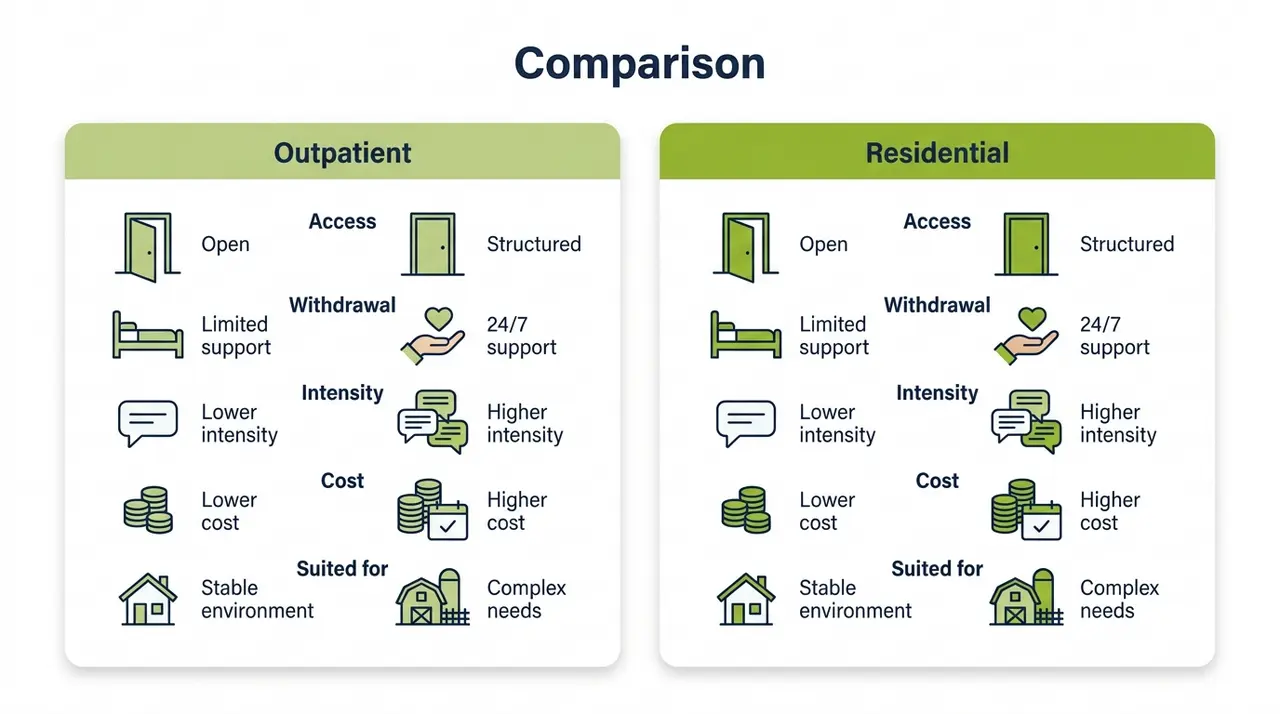
A residential setting removes access to the substance during the weeks when willpower alone is least reliable.
Notice the fourth row. We are not pretending residential care is cheap or convenient. It is neither. The honest question is not “which is better in the abstract” but “which matches the situation in front of me.” If someone has tried stopping once and has a solid support network, outpatient is a reasonable first step. If they have run that experiment repeatedly and watched it fail the same way each time, running it a twenty-first time is not a plan. It is a hope.
What actually happens in the first two weeks
Families ask us this more than any other question, usually quietly, because they are frightened of the answer. So here is the realistic version. The video below follows a resident’s recovery journey with us, from arrival through the early weeks, and may give you a clearer sense of what that actually looks and feels like.
The settling-in period
The first week is rarely the hardest in the way people fear, but it is uncomfortable in ways people do not expect. Emotions that were routinely switched off at ten each night arrive unedited. Some people cry for what feels like no reason. Some people feel almost nothing for days, a flatness that itself can be frightening until it is explained as normal. Sleep is broken, then strange, then, somewhere in week two or three, simply sleep again. Many residents describe the first proper night of unmedicated sleep as the first moment they believed the process was working.
What matters clinically in those days is not heroism. It is containment. There are people around, staff and peers, whose only job is to make sure the discomfort is tolerated rather than escaped. That is the entire therapeutic function of the early period, and it is why attempting it alone fails so often. Not because the person lacks character. Because nobody is holding the container.
The therapies that carry the change
Once the nervous system has settled enough to think clearly, the actual work begins. Cannabis recovery therapy is not one thing. It is a small set of evidence-based approaches used together, and the US Department of Veterans Affairs overview of evidence-based substance use treatments describes most of them in accessible terms if you want to read further.
Cognitive behavioural therapy does the plumbing work, identifying the automatic thoughts that license use. “I can’t sleep without it.” “I can’t socialise like this.” “It’s the only thing that stops the noise.” These sentences feel like facts to the person holding them. CBT treats them as hypotheses, tests them, and builds concrete alternatives for the moments when they get loud. Motivational interviewing addresses something quieter and more important, which is the ambivalence. Almost everyone who arrives at residential treatment wants to stop and does not want to stop, simultaneously, and that contradiction is not a character flaw. It is the ordinary starting position of recovery. Working through it, at the person’s own pace, reconnects the decision to their own values rather than to family pressure.
Around both sit the skills work, the regulation practices, the body. People who have smoked every evening for a decade have often forgotten that their body can settle itself. It can. It takes weeks of consistent practice, movement, and sleep, but it does come back, and residents describe that return as something close to relief.
The part underneath: why cannabis, specifically, for this person, now
This is the section that matters most, and it is the one almost no generic article addresses. Chronic heavy cannabis use is rarely a free-standing problem. In our community it is most often a solution, someone’s best available answer to anxiety they could not name, a depression that hid behind functionality, a memory or a loss that was never processed. The joint worked. That is the uncomfortable truth families have to sit with. It worked, for a while, for something real.
Which means treatment that only removes the substance has failed before it starts. Within weeks, whatever the cannabis was managing comes back, unmedicated and unaddressed, and the relapse writes itself. This is why we treat trauma and emotional health alongside the addiction rather than sequentially, and why every resident gets a full assessment in their first days with us rather than a standard protocol. The person is not a diagnosis with a bed number. You can read more about how we structure this on our adult treatment programme page, and about the people who deliver it on our clinical team page.
If any of this is landing for you, if you recognise your own evening or your child’s evening in these paragraphs, that recognition is worth more than any checklist. It is the raw material of an honest conversation.
What the setting itself does
One more thing, because families are often surprised by it. Holina Village is a working farm among orchards outside Achnas. It feels nothing like a hospital and deliberately nothing like an institution. Residents get up, eat together, work the land sometimes, move their bodies daily, and spend their weeks inside a rhythm rather than inside a corridor. There is open sky.
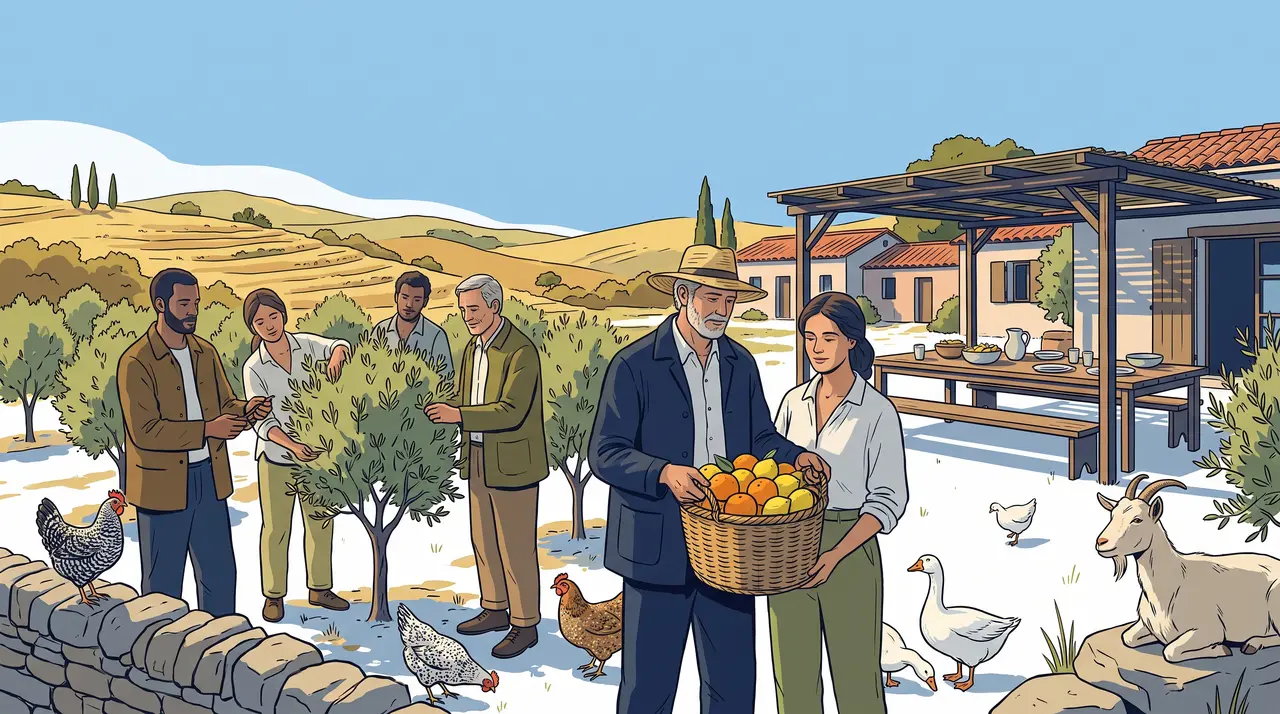
A rural setting supports the therapeutic community model in a way a clinical building cannot.
This is not decoration. The therapeutic community model works through relationships, through the experience of being known by twenty other people who are doing the same hard thing, and a rural setting supports that in a way a clinical building cannot. Recovery stops being an abstract programme and becomes a way of living that a body can remember. When someone asks us what they are paying for, part of the honest answer is this. It is weeks of lived proof that an ordinary day can be tolerable, and then genuinely good, without the substance. Not a lecture about that. The thing itself.
If you recognise your own evening, or someone else’s, in this article, a calm conversation is the natural next step.
No pressure, no obligation, just an honest look at what is happening and whether our programme is the right fit. Sometimes it is not, and we will say so.
What four weeks buys, and what twelve buys
Duration is a real decision with real trade-offs, so here is how we frame it.
A four-week stay allows the nervous system to recalibrate. Twelve weeks lets the new patterns set. Neither is a cure, and any honest clinician will tell you that. What residential care offers is not immunity from relapse. It is a starting position dramatically better than the one most people create for themselves at home, and enough self-knowledge to recognise early warning rather than being ambushed by it.
And after: the part that decides everything
The stay ends. That is guaranteed. What is not guaranteed is what happens next, and this is where weak programmes quietly fail people. The transition home is the highest-risk window in the entire recovery, because the old environment is still there, still patient, still holding every cue the brain spent years learning.
So the work of re-entry starts on day one of treatment, not in the final week. A personal relapse-prevention plan written in the resident’s own words. Ongoing individual support after the return. Guidance for the family, because a family that has spent years bracing for the next relapse does not automatically know how to support recovery instead. A defined plan for the first dangerous evening, the first stressful week, the first invitation. Not a pamphlet. A plan the person has rehearsed.
If you are weighing all of this, the cost, the weeks away, the question of whether it is proportionate to “just weed,” we would say this. The proportionality question was answered long before the phone call to us, by the years of attempts and the narrowing of a life. What is being decided now is not whether the problem is serious enough. It is whether the next attempt will have better conditions than the last twenty.
Frequently asked questions
Is cannabis withdrawal dangerous enough to need medical supervision?
No, cannabis withdrawal is not medically dangerous in the way alcohol or benzodiazepine withdrawal can be. The difficulty is psychological rather than physical, which is exactly why a supported environment matters. Sleep disruption, irritability, vivid dreams and low mood typically peak in the first week and settle within two weeks, and having people around to help tolerate that discomfort, rather than escape it, is what carries most people through.
How long does residential treatment for cannabis usually last?
Most stays run between four and twelve weeks. Four weeks covers the full withdrawal window and the first layers of therapeutic work. Eight weeks allows new routines to become habitual. Twelve weeks is generally recommended when trauma or a significant co-occurring condition such as anxiety or depression sits underneath the use, because the new patterns need time to hold under stress before the return home.
Can residential rehab work if the person does not fully want to stop yet?
Yes, and this is one of the most common starting positions. Almost everyone arrives wanting to stop and not wanting to stop at the same time. That ambivalence is not a character flaw, and motivational interviewing, one of the core therapies we use, is designed specifically to work through it at the person’s own pace, reconnecting the decision to their own values rather than to family pressure.
What happens after the stay ends?
The transition home is the highest-risk window in recovery, so re-entry planning starts on day one of treatment rather than in the final week. Each resident leaves with a personal relapse-prevention plan written in their own words, ongoing individual support after the return, guidance for the family, and a rehearsed plan for the first dangerous evening, the first stressful week, the first invitation.
Residential rehab for cannabis is worth it when the situation in front of you matches the evidence. Repeated failed attempts, withdrawal symptoms that always win in the first week, use sitting on top of anxiety, depression or unnamed trauma, and a life quietly narrowing around the next evening. In those situations, the honest answer is not more willpower at home. It is better conditions, held by people who know how to hold them.
If the answer might be yes for you or someone you love, we are happy to have a calm, unhurried conversation through our contact page. No pressure, no urgency, no assessment disguised as a sales call. Just an honest look at what is happening, and whether our therapeutic community in Cyprus is the right fit. Sometimes it is not, and we will say so. When it is, what we ask of a person is simple and difficult, which is the willingness to be met.
About the Author
Yossi Zubari – CEO & Founder
Director and Senior Therapist working with addiction for over 25 years, and in personal recovery for almost 30 years.