The kettle has boiled twice. Nobody has made tea. A phone on the counter lights up face down, then lights up again, and the woman sitting at the kitchen table decides, for the third evening running, not to turn it over.
Nothing dramatic is happening. That is the part people rarely describe. There is no ambulance, no scene at the front door. There is a man of thirty-one upstairs who has been asleep since two in the afternoon, and a family that has quietly reorganised its entire week around the question of what mood he will be in when he wakes.
If you have arrived at this page, you probably already know how the story goes from the outside. What follows is an attempt to describe how it goes from the inside of a treatment programme, including the parts that are slow, unglamorous, and easy to underestimate.
Reading time: 11 minutes
Key points in this article
- Detox stabilises the body within days. It does not touch the psychological reasons cocaine use started, which is why detox alone rarely holds.
- Craving rises, peaks, and falls within twenty to thirty minutes whether or not anything is done about it, a fact that changes how it is managed.
- A residential stay removes supply, social circle, and the unstructured hours after midnight, which is where most relapses are actually decided.
- Length of stay matters more than most families expect. Short stays produce short results, and lasting change is usually measured in weeks rather than days.
Contents of this article
- What cocaine addiction rehab is actually treating
- The mistake almost every family makes in the first fortnight
- The crash is a psychiatric event dressed as exhaustion
- One question that usually settles the outpatient argument
- What twenty people living together do that one therapist cannot
- Craving has a shape, and it is shorter than it feels
- When the cocaine was doing a job
- Why nothing is enjoyable for a while, and what brings it back
- A day, from six in the morning
- What Holina Village is, and what it deliberately is not
- What we ask families to stop doing
- How long, honestly
- The re-entry plan is written in week two, not week ten
- What it costs and what the number includes
- Questions people ask on the first phone call
- If you are the one still awake at four in the morning
What cocaine addiction rehab is actually treating
Cocaine addiction rehab is not, in any meaningful sense, the removal of a drug from a bloodstream. The body handles that on its own within days. What remains afterwards is the thing that made the drug necessary in the first place, and it is still there on day nine, fully intact, waiting.
So the work is elsewhere. A proper assessment at the start, covering physical health, mental health, sleep, family history and what the use is actually doing for the person. Individual psychotherapy. Group work. Skills for tolerating stress that used to be resolved chemically within four minutes.
And underneath all of it, the slow reconstruction of an ordinary functioning day. Getting up. Eating. Being somewhere at a set time. The unglamorous scaffolding that stimulant use quietly dismantles first.
The mistake almost every family makes in the first fortnight
A detox bed is booked. Seven days, maybe ten. Everyone exhales. He comes home clear-eyed, apologetic, sleeping properly, and for about three weeks the household believes it is over.
We see the aftermath of this often enough to name it plainly. Detoxification stabilises a body. It does not touch the reason a person reaches for a stimulant at nine on a Thursday night, and cocaine rehab that stops at stabilisation leaves the entire psychological architecture untouched.
The relapse that follows is not a failure of willpower. It is the predictable result of treating one week of physiology as though it were treatment for a condition that took years to build.
Detox is a doorway. Nobody lives in a doorway.
The crash is a psychiatric event dressed as exhaustion
Withdrawal from cocaine looks, from across a room, like flu without the fever. Flattened mood. Enormous fatigue. Hunger. Sleep that goes on for fourteen hours and restores nothing. Vivid, unpleasant dreams. Restlessness sitting oddly alongside the exhaustion.
The danger is not physical, which is exactly why it gets missed. As the MedlinePlus entry on cocaine withdrawal sets out, the acute period carries a real risk of severe low mood, and low mood in an empty flat with a dealer’s number still in the phone is a specific kind of emergency.
Most people begin to feel human again somewhere between the second and fourth week. Craving arrives in waves for considerably longer than that. Round-the-clock presence during this stretch is not fussiness. It is the whole point.
One question that usually settles the outpatient argument
Outpatient therapy has genuine value, and for a good number of people it is the correct level of care. The question we ask on the phone is simpler than it sounds. Between sessions, does the person go home to a life that supports the work, or to the life that produced the problem?
If the answer is the second, weekly therapy is being asked to win an argument it is outnumbered in. Residential cocaine rehab changes the arithmetic. It removes the supply chain, the social circle, the flat with its associations, and the two unstructured hours after midnight when almost every relapse we hear about was decided.
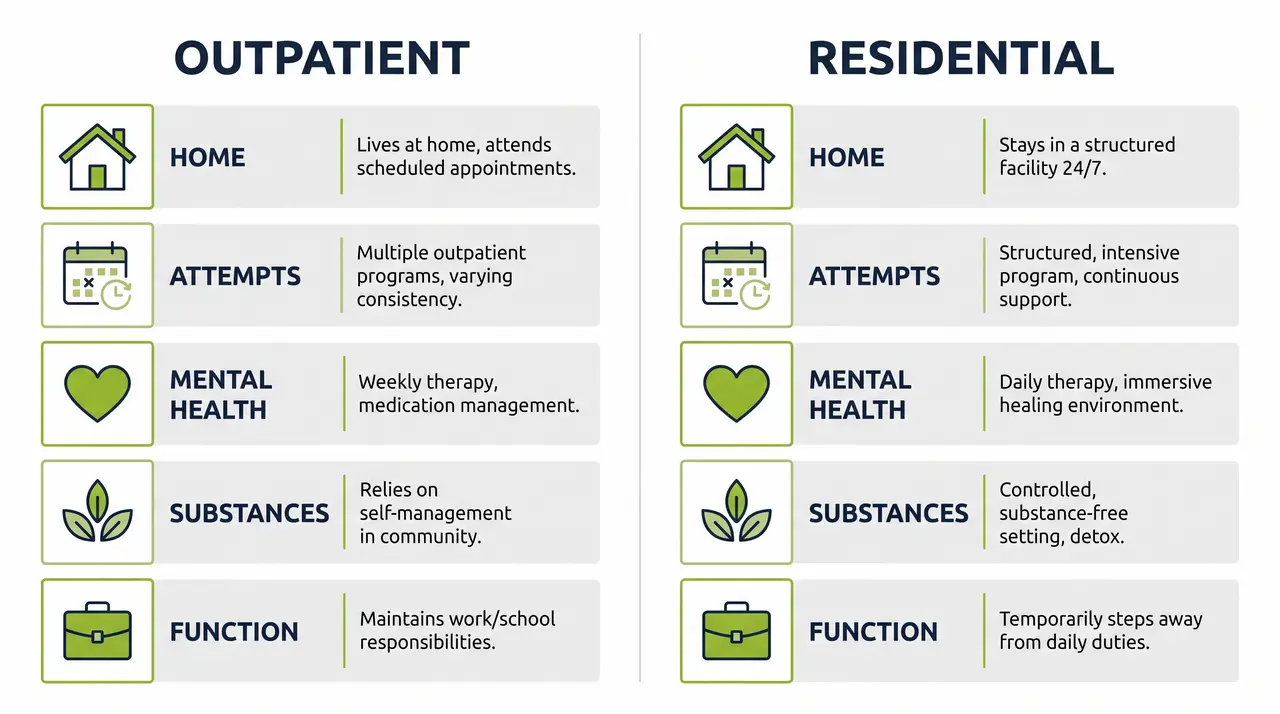
| Clinical picture | Outpatient is usually reasonable | Residential is usually indicated |
|---|---|---|
| Home environment | Stable, no use in the household | Use, supply or heavy drinking present at home |
| Previous attempts | First structured attempt | Two or more relapses after outpatient work |
| Mental health | Mood and anxiety manageable between sessions | Severe depression, panic, or self-neglect |
| Other substances | Cocaine only, intermittent | Cocaine with alcohol, benzodiazepines or opioids |
| Daily function | Work or study largely intact | Job lost, debts mounting, legal matters pending |
Signals that tend to end the debate
Money disappearing with explanations that keep changing. Phone kept face down, always. Whole weekends unaccounted for. A person who used to be reliable now missing Monday mornings, then Monday and Tuesday.
On the psychological side, watch for the swing rather than the state. Elation on Saturday, immovable blackness by Tuesday afternoon. Panic attacks that arrive without an obvious trigger. Alcohol brought in to soften the comedown, which is the point at which the risk profile changes sharply.
None of these on its own proves anything. Three or four of them together, running for months, usually means the family already knows and has been waiting for permission to say so.
What twenty people living together do that one therapist cannot
In a therapeutic community, the community itself is the instrument. Not an add-on to the clinical work. The instrument.
Here is why that matters for stimulant use specifically. Cocaine use is sustained by concealment, and concealment cannot survive shared meals, shared chores and shared mornings. Someone notices you are quiet. Someone notices you skipped the walk. You are held to a small daily agreement in front of people who made the same agreement and will say something if you break it.
Shame loses most of its grip in that setting, because everyone in the room has a version of the same story. Our residential programme structure builds the day around that principle deliberately, with individual therapy sitting inside the community rather than replacing it.
Craving has a shape, and it is shorter than it feels
People expect craving to be a straight line that rises until they give in. It is not. It rises, peaks, and falls, usually inside twenty to thirty minutes, and the falling happens whether or not anything is done about it.
That single piece of information changes behaviour more than most insights we teach. Cognitive behavioural work builds on it. You learn to name the trigger, catch the thought that follows it, and put something between the urge and the hand. Motivational work handles the other half, the ambivalence nobody admits to, the part that still misses it.
The SAMHSA guidance on treating stimulant use disorders is clear that behavioural and psychosocial interventions carry the load here. There is no injection that does this work for you.
When the cocaine was doing a job
Ask a quiet man why he started and he will often say it made parties bearable. Ask again in week five and the answer changes. It made him bearable to himself.
Social anxiety, long depression, a low grinding sense of not being enough, unprocessed trauma that surfaces mainly at night. Stimulants answer all of these briefly and expensively. The NIMH overview of co-occurring substance use and mental disorders describes how commonly these conditions travel together and why treating them separately tends to fail both.
Trauma work in particular requires a floor under it. Nobody should be opening the worst year of their life on a Tuesday afternoon and then driving home alone. That is precisely what the held container of a residential setting provides.
A confidential conversation, whenever you are ready
If you recognise your own household in any of this, our admissions team can talk it through with you plainly. No pressure, no obligation, just an honest conversation about what would actually help.
Why nothing is enjoyable for a while, and what brings it back
Six weeks in, a man told us that the coffee was fine, the sea was fine, his brother’s phone call was fine, and that fine had become the ceiling of everything. He was not depressed in the ordinary sense. His reward system had been repeatedly flooded and was, for the moment, refusing to respond to normal life.
It does come back. Not through insight. Through the body.
Physical work in daylight. Long walks. Animals that need feeding whether or not you feel like it. Sleep at consistent hours, food that is not eaten standing up, muscles that ache from something honest. Our outdoor and adventure work exists for this reason rather than as recreation. Anticipation returns before pleasure does, and both take weeks, not days.

A day, from six in the morning
Early start, because the first thing stimulant use destroys is the shape of a day and the shape has to be rebuilt from the outside in.
Morning means movement before thought. A walk, work on the land, breakfast eaten sitting down with other people. Then a community meeting where the day is opened and anyone struggling says so before it becomes a private emergency at eleven at night.
Midday and afternoon carry the clinical weight. Individual psychotherapy, focused groups, practical skills sessions, shared tasks that require cooperating with someone you may find irritating, which is itself therapeutic.
Evenings soften. Reflective writing, social time, a close to the day, lights out at a fixed hour. Repeated for weeks, this stops being a timetable and becomes a second nature that competes with the old one.
What Holina Village is, and what it deliberately is not
It is not a clinic with a garden attached. Holina Village sits on land in Achnas, and the first thing most arrivals notice is the absence of corridors, wristbands and the particular institutional smell people brace themselves for.
What it is, a contained space where the setting itself does clinical work. Orchards, animals, open sky, a small resident community, and a clinical team that lives close to the daily texture of the place rather than visiting it for appointments. Tracks are separated for younger residents and for adults, because a twenty-two-year-old rebuilding an identity and a forty-five-year-old rebuilding a marriage need different rooms and different conversations.
You can read the backgrounds of the clinical team here. We would rather you interrogate the credentials than take the setting on atmosphere alone.
What we ask families to stop doing
Addiction reorganises a household. One person becomes the monitor, another the peacemaker, a third stops mentioning it at all. Everyone is exhausted and nobody is doing anything wrong on purpose.
The hardest instruction we give is usually about rescue. Paying the debt, smoothing the employer, collecting him from the place he should not have been. Each act is loving and each one removes a consequence that was doing more persuasive work than any conversation could.
Family sessions are not about assigning blame for the past. They are about learning a way of speaking that neither attacks nor collapses, and agreeing on boundaries that hold when tested at midnight. Families who do this work are noticeably better prepared for the week their son comes home, which is the week that matters most.
How long, honestly
Nobody wants this answer, so we give it early. Short stays produce short results, and the difference between a person who is clear-headed and a person whose life has changed is mostly measured in weeks.
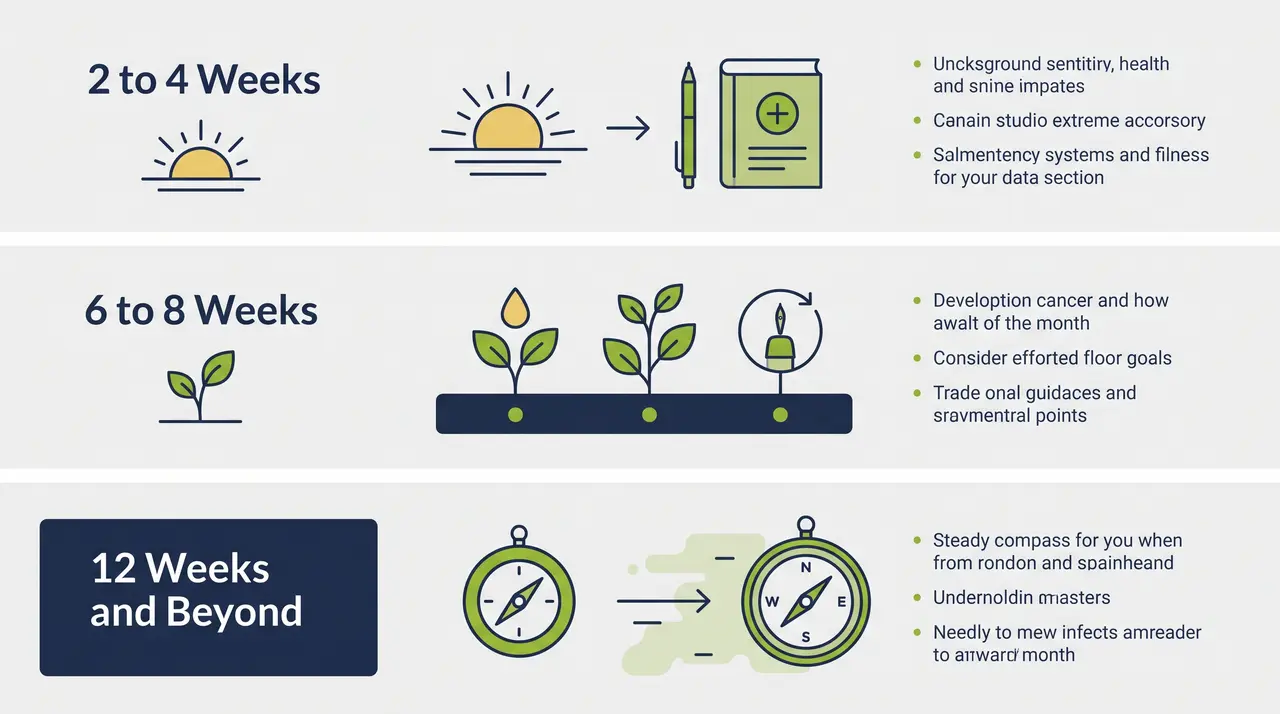
| Length of stay | What it realistically achieves |
|---|---|
| 2 to 4 weeks | Physical stabilisation, sleep and appetite returning, the settling-in period, first honest conversation about what the use was for |
| 6 to 8 weeks | Craving becomes manageable rather than overwhelming, core therapeutic work underway, community role established, family sessions begun |
| 12 weeks and beyond | New routines hold under pressure, mood and reward system noticeably steadier, re-entry plan tested rather than theoretical |
Length is agreed individually and reviewed as we go. Severity, co-occurring conditions and what waits at home all change the calculation.
The re-entry plan is written in week two, not week ten
The riskiest fortnight of any residential stay happens after it ends. Structure disappears overnight, the old street reappears, and nobody is asking at breakfast how the night went.
So the plan starts early and gets tested while there is still support around it. Fixed anchors for the week, meaning work or study, a standing physical activity, weekly therapy, and a support group with a named person to call. Not aspirations. Diary entries with times.
Families are taught the early signals too, because they see them first. Withdrawal from meals. Sleep sliding. Irritability arriving with no cause. Secrecy about small things, which is almost always the rehearsal for secrecy about large ones. A signal spotted on a Tuesday is a phone call. Spotted three weeks later it is a crisis.
What it costs and what the number includes
Families in distress deserve a straight figure rather than a consultation to find out the figure. All three options below are all-inclusive, covering accommodation, meals, individual and group clinical sessions, adventure and farm activities, and airport transfers. Personal spending money is the only additional cost.
| Accommodation | From (per month) | Suits |
|---|---|---|
| Shared room | €7,950 | Those who benefit from company early on and from the accountability of a roommate |
| Single room, shared bathroom | €10,950 | Those needing private space to decompress while staying inside community rhythm |
| Single room, private bathroom | €12,950 | Longer stays, older residents, and those for whom privacy is a condition of engaging at all |
The clinical programme is identical across all three. The room affects where you sleep, not what you receive.
Questions people ask on the first phone call
Is there a medication for cocaine dependence?
No single medication removes it. Psychotherapy and behavioural work carry the treatment. Medication is used where it helps with sleep, anxiety or depression alongside that work, prescribed and reviewed properly.
Will anyone find out?
Confidentiality is absolute, and for many of the families who contact us it is the deciding factor. We do not confirm attendance to anyone the resident has not authorised.
He refuses to go. What now?
Then the first piece of work is with you, not him. Guided conversations, consistent boundaries and a clear offer tend to move people. Ultimatums delivered in anger rarely do. This is ordinary and we are used to it.
Can study continue?
Yes. Education and treatment are not an either-or here.
If you are the one still awake at four in the morning
You have probably read six articles tonight and they have all said roughly the same thing. Here is the part that is harder to put in an article.
The turn rarely comes from a speech. It comes from a person being placed somewhere quiet enough, and structured enough, that the noise drops for long enough to hear themselves think. That takes a contained space, other people who are not impressed or frightened by the story, and a stretch of time longer than anyone wants to give it.

If that sounds like what is needed, you can start with a direct conversation with our admissions team. No script, no pressure. Most people who call are not ready to decide anything, and that is a perfectly reasonable place to begin.
Not sure what to say yet
That is fine. You do not need a plan before you call, only a willingness to describe what is happening. We will help you work out what comes next.
Detox clears the body in a matter of days. What keeps someone using, and what eventually helps them stop, is a much slower matter of psychology, routine, and honest company, which is why the length and structure of treatment matter as much as the decision to begin it. If any part of this article matched what your household is living through, the next reasonable step is simply a conversation, not a commitment.

About the Author
Yossi Zubari, CEO & Founder
Director and Senior Therapist working with addiction for over 25 years, and in personal recovery for almost 30 years.