It is Sunday afternoon and the bedroom door has been shut since Friday night. Nobody in the house is worried about noise. The worry, if anyone said it aloud, is about the silence, and about the fact that this is the third Sunday in a row. Families rarely catch the drug in the act. What they notice, for months and sometimes years, is the wreckage of the day after. This article sets out the signs families actually see, the ones that take longer to appear, and what to do with what you have noticed.
Reading time: 13 minutes
Key points in this article
The clearest early signs are behavioural and financial, not physical. Physical signs such as nosebleeds tend to appear later.
Addiction is defined by continued use despite cost, failed attempts to stop, and a growing preoccupation with the substance, not by quantity or frequency.
The crash after cocaine use is not the same as clinical withdrawal. The second and third week after stopping is often the most psychologically difficult period.
Some symptoms, including chest pain, seizures, or sudden weakness on one side, require emergency medical care rather than observation.
Contents of this article
You Are Probably Watching the Wrong Evening
What Addiction Means Here, and What It Does Not
Occasional Use and Dependence Look Identical on a Friday
The Behaviour Shifts Before the Body Does
The Arithmetic Is the Least Deniable Sign
Two Good Weeks, Then One Lost Day
What the Nose, Jaw and Mouth Give Away
Is This Him, or Is This the Drug?
When Suspicion Hardens Into Paranoia
When to Stop Observing and Call an Ambulance
Craving Is a Reflex, Not a Character Weakness
The Crash Is Not the Withdrawal
Why the Second Week Is the One That Decides Things
The Household Learns to Walk Quietly
Functioning Is Not the Same as Being Well
How to Raise It Without Losing the Conversation
What Actually Happens When You Make the First Call
Why the Setting Matters More Than It Should
What a Month Costs, and What It Includes
If You Have Read This Far
You Are Probably Watching the Wrong Evening
Families brace for Friday. They listen for the front door, they read the eyes, they wait to see whether the person comes home too talkative or too bright.
Cocaine does not oblige. Its effects are short, and someone using it socially can look like a person who has had two coffees and a good week. The visible cost lands later, on Monday, on Tuesday, as flatness, irritability, a headache that will not lift, twelve hours of sleep that fixes nothing. If you want to know what is happening in a household, stop studying the nights out. Study the recovery days, and how many of them the week now needs.
What Addiction Means Here, and What It Does Not
It is not a quantity. It is not a frequency you could write on a form. Two grams a weekend proves nothing on its own, and neither does once a month.
Addiction is a loss of control over a decision the person keeps making anyway. Three things sit at its centre. Use continues after it has already cost something that mattered, money, a job, a relationship, sleep. Attempts to stop or cut back do not hold, even when the intention was sincere. And a growing share of mental life goes to arranging, anticipating, or recovering from use.
Note what is absent from that description. No moral failure. No character flaw. A reward system that has been taught, very efficiently, that one substance outranks everything else it used to want.
Occasional Use and Dependence Look Identical on a Friday
The useful comparison is not intensity. It is context. A person using occasionally uses in company, at a specific kind of event, and stops when the event ends. A person who has crossed into dependence starts using in circumstances that have nothing to do with celebration.
| What you are looking at | Occasional pattern | Pattern that has moved |
|---|---|---|
| Timing | Weekends, planned social events | Weeknights, mornings, before work |
| Company | With the same group, socially | Alone, in the bathroom, in the car |
| Purpose | Part of a night out | To function, to stop feeling flat, to keep going |
| Stopping | Ends when the night ends | Ends when the supply or the money ends |
| Promises | Not needed | Made often, broken quietly |
The Behaviour Shifts Before the Body Does
Ask anyone who has lived with this and they describe the same drift. Reliability goes first. Small arrangements collapse. The person is two hours late with an explanation that does not quite fit the timeline, and then annoyed at being asked.
Other markers of changed behaviour appear alongside it. Unexplained absences of an hour or a whole night. New friends whose surnames nobody knows, and old friends who have stopped calling. A phone that is now face down, always. Bursts of enormous energy and warmth, plans made at midnight, followed by two days of a closed door.
None of this is proof. All of it is worth writing down. Families who keep a plain private record of dates and absences stop arguing about whether they are imagining things.
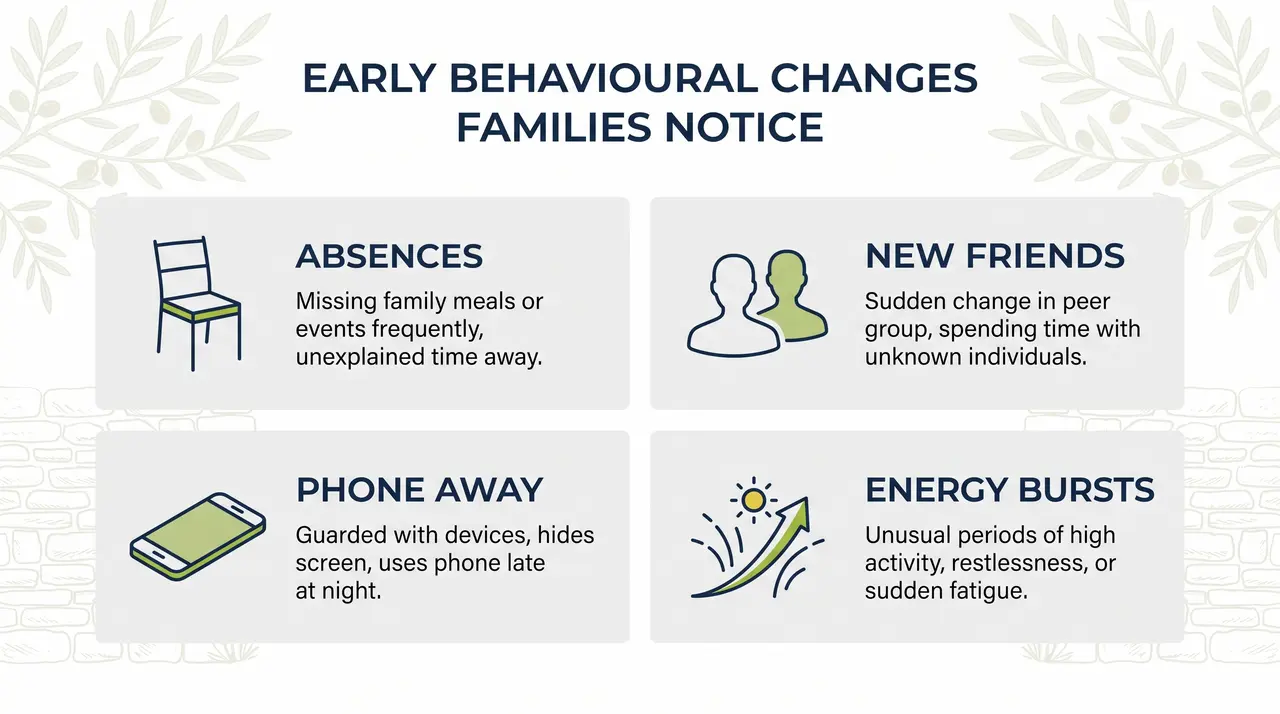
Behavioural changes, not physical ones, are usually the first sign a family notices.
The Arithmetic Is the Least Deniable Sign
Feelings can be disputed. Bank statements cannot.
Cocaine is expensive and it demands cash. So the money leaves visible tracks even when the person does not. Cash withdrawals late at night, several in a week. Small borrowings that stack up, always with a reason. A salary that vanishes by the fourteenth with nothing to show for it. Items that go missing from the house and are said to be lent out. Loans, credit cards opened quietly, a car sold under value.
Work tells the same story in a different currency. Monday absence becoming a pattern. Performance that swings from brilliant to absent. A resignation offered before a dismissal arrives, described afterwards as a choice.
Two Good Weeks, Then One Lost Day
The cycle matters more than any single symptom, because the cycle is what erodes a life.
During use, appetite disappears and sleep becomes unnecessary. Someone may go a night and a day without either and feel, for a while, capable. What follows is the crash, and it is not subtle. Exhaustion that sleep does not repair, ravenous hunger, low mood, an inability to care about anything that mattered on Thursday. Weight comes off across a few months in a way that friends comment on.
Watch the shape of a month. High function, then collapse, then apology, then reconstruction, then high function again. When the good stretches shorten and the collapses lengthen, the pattern is progressing, whatever anyone says about having it under control.
What the Nose, Jaw and Mouth Give Away, and Why They Give It Away Late
Snorting irritates the lining of the nose. Over months that shows as a blocked nose that never clears, frequent nosebleeds, a permanent sniff blamed on allergies, constant use of decongestant spray, a voice that sounds thick. Longer use can damage the septum and the sense of smell.
The jaw is often overlooked. Stimulants tighten it, so there is clenching, grinding at night, morning jaw ache, worn teeth, sores inside the cheek, and gum chewed continuously.
These are the later cocaine addiction symptoms, not the first ones. By the time the nose is bleeding regularly, the behaviour and the money have usually been saying it for a year.
Is This Him, or Is This the Drug?
This is the question that keeps parents and partners awake, and the honest answer is that both are true at once.
Cocaine borrows dopamine at a rate the brain cannot sustain. So the emotional signature is a wide swing. Confidence, generosity, big ideas, then anxiety, a short fuse, a strange thin-skinned sensitivity to any comment that sounds like criticism. Between episodes, and this is the part families rarely name, the person cannot feel ordinary pleasure. Food, sex, a good film, their own children, all of it registers faintly. That flatness is a symptom, not a personality. It is also, frequently, the reason use continues, because the substance briefly restores colour to a world that has gone grey. Many people we meet were already carrying grief or trauma before any of this began, and the drug arrived as the only reliable anaesthetic.

Mood swings and flatness between episodes are symptoms of the drug’s effect on the brain, not evidence of a changed character.
When Suspicion Hardens Into Paranoia
Heavy or prolonged use can push someone past irritability into genuine persecutory thinking. Certainty that they are being followed, that a partner is reading their messages, that colleagues are discussing them. Agitation, sudden aggression, reactions that are wildly out of proportion to what triggered them. Clinical reviews of cocaine toxicity and its psychiatric presentations describe paranoia, agitation and psychosis as recognised features rather than rarities.
If you find yourself in one of these episodes, do not argue with the content of the belief. You will not win, and winning is not the goal. Lower your voice, reduce the number of people in the room, leave an exit clear, and postpone every serious conversation. Safety first. Truth on Wednesday.
When to Stop Observing and Call an Ambulance
Some signs are not signs. They are emergencies, and cocaine’s cardiac and neurological risks are real at any dose, including a first one.
Chest pain, pressure or pain spreading to the arm or jaw. Severe breathlessness. A racing or irregular heartbeat. A pounding headache of sudden onset. Seizures. Very high body temperature with heavy sweating and confusion. Weakness or slurred speech on one side. Collapse or unresponsiveness. Guidance on cocaine intoxication from MedlinePlus lists these among the features requiring urgent medical assessment.
Call emergency services and say what was taken. Nobody in a Cypriot or European emergency department is interested in prosecuting your son. They are interested in his heart rhythm.
If you are frightened by what you have just read
Our clinical team can talk through what you have noticed, what it might mean, and what the options are. There is no pressure, no obligation, just an honest conversation, and it commits you to nothing.
Craving Is a Reflex, Not a Character Weakness
People describe craving as if it were a thought. It is closer to a startle response.
The brain learns the whole scene, not just the substance. A particular street. A specific ringtone. The first drink of the evening, which is why alcohol undoes so many good intentions. Payday. A row at home. Any of these can produce an urge that arrives fully formed, physical, and unreasonable, in someone who genuinely decided that morning not to use.
This is why willpower alone fails so consistently, and why the failure is not informative about the person. It also explains a specific sign families misread. Restlessness. Someone who suddenly cannot sit in the room, who has to go out for something trivial, who becomes irritable in a way that resolves the moment they leave.
The Crash Is Not the Withdrawal
Cocaine withdrawal is rarely dangerous to the body in the way alcohol or benzodiazepine withdrawal can be. That fact has done real harm, because it convinces people that stopping should therefore be easy. It is not. The danger in cocaine withdrawal is psychiatric, and reviews of stimulant withdrawal syndromes describe the picture clearly enough.
| Stage | Typical duration | What tends to dominate | What the person needs |
|---|---|---|---|
| Crash | 1 to 4 days | Exhaustion, heavy sleep, hunger, low mood, vivid dreams | Rest, food, someone present, medical review |
| Early abstinence | 1 to 4 weeks | Energy returning while craving peaks, anxiety, irritability, flatness | Structure, supervision, honest daily contact |
| Extended adjustment | 1 to 6 months | Intermittent craving, poor concentration, low pleasure, sleep still unsettled | Therapy, routine, work on what preceded the use |
Low mood in the first fortnight can become genuinely dangerous. If suicidal thoughts appear, that is a medical situation, not a phase to be waited out.
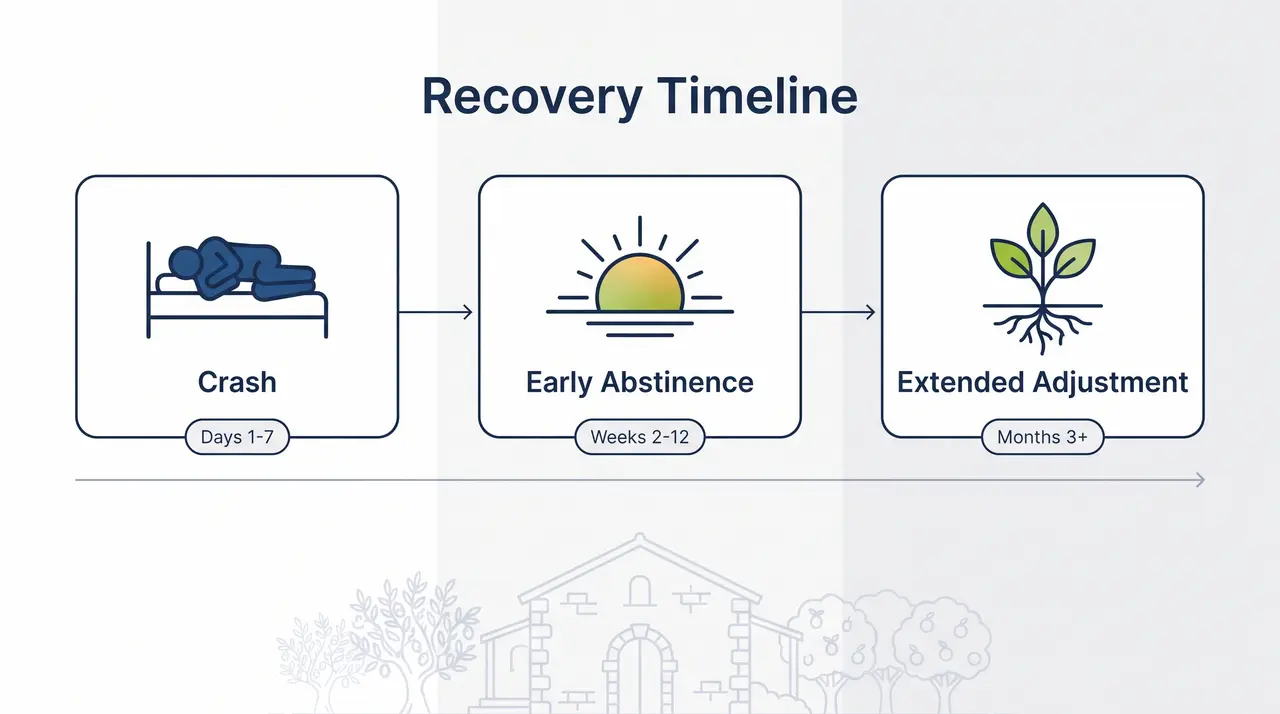
The crash lasts days. The psychological adjustment that follows can last months.
Why the Second Week Is the One That Decides Things
People assume the hardest days are the first ones. Clinically, it is usually the stretch between day eight and day twenty-five.
By then the body has recovered enough energy to act, the household has relaxed, and the person feels almost normal. Craving, meanwhile, has not gone anywhere. Sleep is still broken. Nothing is enjoyable yet. This is the point at which someone decides they have proved they can stop and can therefore be trusted with one controlled evening.
Which is the whole argument for a contained space during that window. Not because adults cannot be trusted, but because nobody should have to rely on willpower during the precise fortnight when the brain’s reward system is at its least reliable. Duration matters here. Four weeks steadies the system. Twelve weeks lets new patterns hold.
The Household Learns to Walk Quietly
There is a particular kind of tiredness that belongs to the people who are not using.
It comes from managing. Paying the overdraft off before anyone notices. Telling the employer he has a stomach bug. Choosing which version of the truth to give the grandparents. Rehearsing sentences for twenty minutes before saying them, then saying nothing. Sleeping lightly, listening for the door.
Families often ask whether covering for someone made things worse. The honest answer is that it usually delayed the moment of reckoning, and that it was also completely understandable. You were protecting someone you love from consequences you could not bear to watch. That is not stupidity. It is loyalty pointed in an unhelpful direction, and it can be redirected. Families need support of their own, separately, and often before the person using accepts any.
Functioning Is Not the Same as Being Well
Some of the people we meet have never missed a deadline. They run companies. They fly a lot. They are the ones colleagues describe as intense and impressive.
High function delays help for years, because the usual evidence never arrives. No arrest, no lost job, no ruined marriage, not yet. What does arrive is quieter. Chronic anxiety with no obvious cause. Increasing isolation dressed up as being busy. A partner who no longer expects intimacy. A sense, privately, of running a life on an engine that is overheating.
If you recognise yourself there, the relevant question is not whether things have collapsed. It is how much of your attention now goes to managing this, and what you would be if that attention were returned to you.
How to Raise It Without Losing the Conversation
Choose the time deliberately. Never while someone is using or high, never during the crash, when everything sounds like an attack. Mid-morning, two or three days in, when the person is tired but present.
Speak about what you have observed and what you feel, and stop there. Do not present evidence like a prosecutor. Do not demand admission. Your aim in the first conversation is not agreement. It is to be someone this person can come back to when they are ready to say something true.
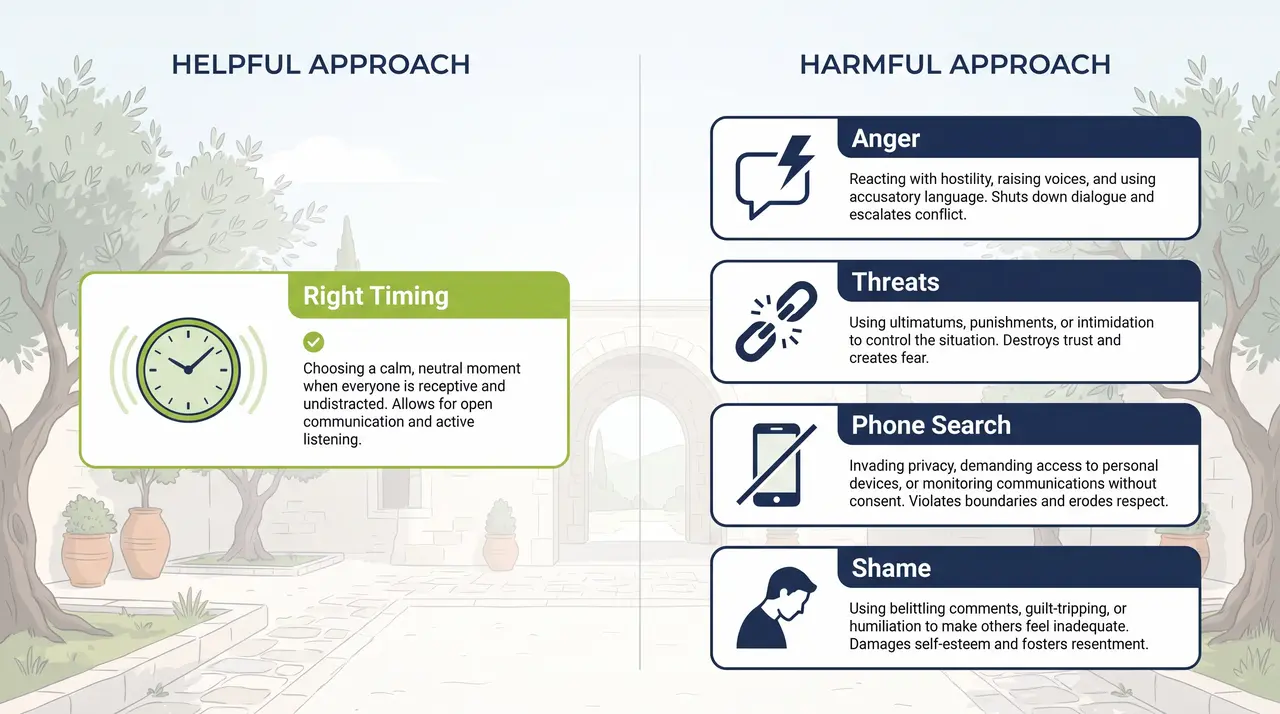
The goal of a first conversation is not agreement. It is to remain someone the person can return to.
Openings That Tend to Land
“I have noticed you have been exhausted for weeks and I have been worried about you. I am not here to have an argument. I just want to know how you actually are.” Or, simply, “I love you and I am frightened. Tell me what is going on.”
Moves That Harden the Wall
Confronting in anger, or with an audience. Threats you have no intention of carrying out, because the next threat will mean nothing. Going through pockets and phones and then leading with what you found. Shame in any form, including the sighing kind. And the long recitation of everything that has been lost, which teaches the person only that they are already beyond help.
What Actually Happens When You Make the First Call
Less than people fear. A conversation, usually forty minutes or so, in which someone asks what has been happening, how long, what else is going on, and what has already been tried. Nobody is admitted on the phone.
The assessment matters because cocaine is rarely the only thing in the room. Alcohol is often woven through it. Trauma, grief, undiagnosed ADHD and depression turn up regularly. Treating the drug and ignoring what it was solving is how people relapse in month four. Our residential programme in Achnas combines individual therapy, group work, a structured daily routine and round-the-clock support, and the clinical team will tell you plainly if we are not the right fit for a particular case.
Why the Setting Matters More Than It Should
People resist residential treatment because they picture a corridor, a locked door, a plastic chair. Fair enough. Nobody heals in a waiting room.
Holina Village is a farm. There are orchards, animals to feed, open sky, work to do with your hands before the sun gets high. That is not decoration. Early abstinence is a period of flatness in which nothing feels good, and a body that has been moving, sweating and useful all morning sleeps better and craves less than a body that has been sitting. The outdoor challenges serve the same purpose, which is to give the nervous system real evidence that difficulty can be survived without a substance. Recovery happens in a community of people doing this alongside you. That relational substrate is the part no outpatient hour can replicate.
A short overview of what residential treatment and daily structure look like in practice.
What a Month Costs, and What It Includes
Families in crisis deserve figures rather than a form to fill in. All of our accommodation is all-inclusive. The only additional cost is personal spending money.
| Room | From, per month | Included |
|---|---|---|
| Shared room | €7,950 | Accommodation, all meals, clinical and group sessions, farm and adventure activities, airport transfers |
| Single room, shared bathroom | €10,950 | As above, with private sleeping space |
| Single room, private bathroom | €12,950 | As above, with full privacy |
Clinically, the room tier is the least important decision anyone makes here. Length of stay is the one that changes outcomes.
If You Have Read This Far
You did not arrive here casually. Somebody has been counting Sundays.
You may be wrong about all of it. That happens, and it is a good day when it does. But suspicion that has lasted more than a few weeks is usually picking up something real, and the cost of asking is far lower than the cost of another six months of watching. An honest conversation with our admissions team commits nobody to anything.
What we look for, when someone comes to us, is not certainty or readiness or a well-formed plan. Most people arrive without any of those. What matters is a small willingness to be met, on a Tuesday, by people who will not flinch at what you tell them.
Common Questions
Is occasional cocaine use the same as addiction?
No. Occasional use tends to stay tied to specific social events and stops when those events end. Addiction is defined by continued use despite cost, failed attempts to stop, and a growing share of daily thought going toward the substance. The distinction is behavioural, not about the amount used.
What are the earliest signs families usually notice?
Behavioural and financial changes come first. Missed arrangements, weekday absences, cash withdrawn late at night, and a widening gap between good weeks and lost days. Physical signs such as nosebleeds or jaw clenching tend to appear much later, often after a year or more.
Is cocaine withdrawal medically dangerous?
Cocaine withdrawal is rarely dangerous to the body in the way alcohol withdrawal can be, but the psychiatric risk is real. Low mood in the first two weeks can become severe, and any suicidal thoughts during this period need medical attention rather than waiting it out.
Should I confront the person directly about what I have found?
A calm, private conversation held when the person is neither using nor in the crash period tends to work better than a confrontation with evidence in hand. The goal of a first conversation is to remain someone the person can return to, not to secure an admission.
What does treatment at Holina Village Cyprus actually include?
Accommodation is fully inclusive, covering meals, clinical and group therapy sessions, farm and adventure activities, and airport transfers. Monthly rates start from €7,950 for a shared room, with the only additional cost being personal spending money.
Cocaine addiction rarely announces itself. It shows up first in missed arrangements, disappearing money, and a widening gap between good weeks and lost days, with the more recognisable physical signs arriving only much later. Understanding that timeline is what allows a family to act on suspicion rather than wait for proof. If what you have read here matches what you have been watching, a confidential conversation with our team costs you nothing and commits you to nothing further.
An honest conversation, whenever you are ready
If you would like to talk through what you have noticed, our clinical team is available to listen and answer questions plainly. No pressure, no obligation, just a conversation with people who understand what you are carrying.

About the Author
Yossi Zubari, CEO & Founder
Director and Senior Therapist working with addiction for over 25 years, and in personal recovery for almost 30 years.