Emotional dysregulation is one of the more widely searched phrases in mental health, and also one of the more misunderstood. It describes a specific difficulty with returning to an even emotional state after disturbance – not the presence of strong feelings, but the loss of the mechanism that brings them back down. This article explains what the term actually means clinically, how it relates to formal diagnoses, what drives it biologically, and what kinds of treatment are shown to help when weekly outpatient support is no longer enough.
Reading time: 5 minutes
Key Points
- Emotional dysregulation is not a standalone diagnosis – it is a functional difficulty that sits at the centre of several well-defined conditions including ADHD, PTSD, and borderline personality disorder.
- Its causes are biological and environmental, not a failure of character or parenting.
- DBT, trauma-focused therapy, and consistent family involvement form the core of evidence-based treatment.
- When outpatient support reaches its ceiling, a structured residential environment can provide the round-the-clock scaffolding that allows regulation skills to take root.
Table of Contents
What people are really searching for when they type “emotional dysregulation disorder”
Emotional dysregulation is the loss of the ordinary ability to bring a feeling back down to size – not the feeling itself, but the return. Most people have a baseline they drift back toward after a fright or an insult, often within minutes. Someone who is dysregulated does not have that quiet undertow pulling them back. A small provocation produces a large wave, and the wave does not recede on schedule. It can take hours.
The phrase searched into Google tends to describe a broad functional difficulty rather than one closed entry in a diagnostic manual. Researchers themselves struggle to measure emotion dysregulation consistently in young people, precisely because it cuts across so many conditions. That is not a failure of the science. It is a clue about what you are looking at.
Is it a real diagnosis, or a symptom of something else?
This is the question families actually want answered. Did we just get the name of an illness, or the name of a problem?
In the DSM-5, “emotional dysregulation” is not a standalone disorder. It is a core feature – a behavioural signature that shows up inside several different conditions. That sounds like bad news. It is the opposite.
If dysregulation is a symptom, then there is an engine underneath it, and the engine can be found. A careful differential assessment asks what is driving the storms. Attention difficulties. Anxiety. Unprocessed trauma. A particular personality structure. Naming the engine is what lets a treatment plan touch the root instead of swatting at the surface. Any honest clinician will tell you that treating the visible explosion without finding its source tends to buy a few quiet weeks and very little more.
The shapes it takes, so you can recognise it
Dysregulation rarely announces itself by name. It announces itself as a pattern that wears the household down.
High-intensity emotion and the long climb back
Mood swings that are fast and extreme. Reactions pitched at all-or-nothing. A constant sense of being flooded by things that, from the outside, look minor. And the part families notice most – the person cannot seem to self-soothe. They are not refusing to calm down. They have lost the route back.
Underneath the impulsivity sits the same flooding, translated into action. Rage that arrives before thought. Sometimes risk-taking, sometimes harmful substance use, sometimes self-harm as a desperate way to quiet an unbearable inner volume. Adolescent risk behaviour and substance use are tightly braided together, and the CDC’s data on substance use among young people shows how quickly one feeds the other. The relationships show it too – chronic conflict, a deep fear of being left, then sudden cutting-off. Bridges burned in an afternoon and grieved by morning.
EBD – the word the school uses for the same thing
Many parents meet this difficulty first not in a clinic but in a meeting room at school, where someone says the letters EBD. Emotional and Behavioural Disorders.
EBD is an educational and functional category, not a psychiatric one. It describes children and young people whose emotional and behavioural difficulties are persistent enough to interfere directly with learning, friendships, and family life. When a young person carries this label, it usually means the weekly hour of help is no longer bridging the gap. The setting itself has to change.
Why this is nobody’s fault, and the biology that proves it
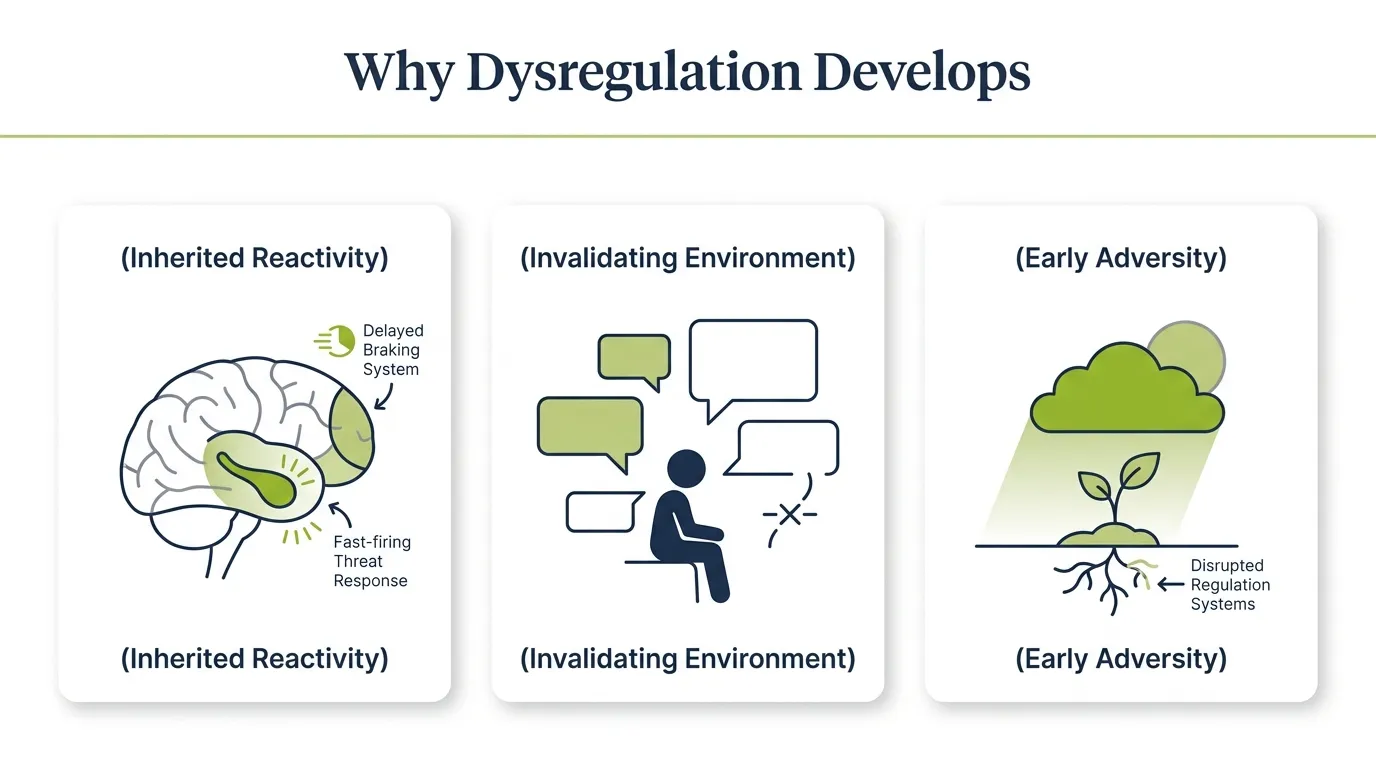
Parents arrive carrying guilt like a coat they cannot take off. The biology is worth knowing because it loosens the coat.
There is an inherited side. Some nervous systems are simply more reactive from the start. The amygdala – the brain’s threat and feeling centre – fires hard and fast, while the prefrontal cortex, the part that applies the brakes, struggles to keep up. The result is a foot on the accelerator and a brake that arrives late.
There is an environmental side too. A child raised in an invalidating environment learns a quiet, damaging lesson – that ordinary feelings get no answer, and only escalation gets noticed. And there is the weight of early adversity. Research on adverse childhood experiences and their long-term effects demonstrates how early harm can interfere with the normal development of the very regulation systems we are discussing. None of this is a verdict on a parent. It is a description of how a particular nervous system got built.
The conditions that live next door
Dysregulation almost never travels alone. Understanding its neighbours is how the picture stops being frightening and starts being workable.
Attention difficulties make it harder to pause between a feeling and an action, placing ADHD firmly in this terrain. Trauma keeps the body braced for danger long after the danger has passed, and recovery from post-traumatic stress disorder often hinges on teaching a vigilant nervous system that it is allowed to stand down. And in borderline personality disorder, emotional dysregulation is not one feature among many – it is the defining one. Families who recognise the pattern in someone they love will find the clinical picture described clearly in the NIMH’s published guidance. The label of emotional dysregulation disorder, in practice, is usually pointing at one of these underlying conditions.
How DMDD differs from general emotional dysregulation
Some parents are handed a more specific term – DMDD. Disruptive Mood Dysregulation Disorder. It is worth drawing the line clearly, because the two are not interchangeable.
| Feature | General emotional dysregulation | DMDD |
|---|---|---|
| Status | A pattern, not a single diagnosis | A formal DSM-5 diagnosis |
| Age | Any age, many causes | First diagnosed between 6 and 18 |
| Mood between outbursts | Variable | Persistent, severe irritability |
| Outbursts | Present, variable | Frequent, intense, out of proportion to developmental age |
DMDD describes a child who is not just stormy in the moment but chronically irritable in the long gaps between storms. The strict diagnostic criteria separate it from ordinary – if exhausting – childhood difficulty, and a clear clinical picture is essential before any treatment plan is formed.
The piece almost everyone treats last – sleep
Here is a metric that reorders priorities. When researchers restricted adolescents’ sleep, their mood and their capacity to regulate negative emotion measurably worsened, fast.
The mechanism is unkind in its symmetry. Lost sleep directly weakens the frontal-lobe machinery that does the regulating, and it sharpens sensitivity to stress the very next morning. Meanwhile, the dysregulated mind is exactly the mind that lies awake at midnight with a racing internal commentary, unable to land. So the loop closes on itself. A poor night feeds a hard day, and the hard day feeds another poor night. The published finding that sleep restriction worsens mood and emotion regulation in adolescents is one reason a residential rhythm – with real lights-out and real mornings – can do quiet work that talking alone cannot.
Building a treatment plan that teaches, not just talks
Good emotional dysregulation treatment is less a conversation and more an apprenticeship. The aim is a set of usable skills, practised until they hold under pressure.
DBT, family work, and medication in their right order
Dialectical behaviour therapy is the front-line approach for severe dysregulation for a reason. It teaches four concrete capacities – mindfulness, distress tolerance, emotion regulation, and interpersonal effectiveness. Its track record is real, supported by randomised clinical trials showing meaningful reductions in self-harm and crisis behaviour. But skills learned in a room collapse if the home stays a battlefield, which is why families have to learn the same dialectical language of validation. Medication, where it is indicated, is not the treatment. It lowers the physiological noise so the person can actually hear the skills being taught.
A confidential conversation costs nothing
If you are trying to work out whether residential support is the right level of care – for yourself or for someone you care about – we are here to talk it through honestly. No pressure, no obligation.
When the weekly hour stops being enough
Outpatient therapy has genuine value. For a great many people it is the right and sufficient level of care. The difficulty is recognising the point where it has reached its ceiling.
The warning signs are not subtle once you name them. A steady worsening despite faithful attendance at every session. Falling out of school or work entirely. Retreating into a bedroom for days. Repeated crisis presentations that stabilise nothing for long. And the family detail clinicians hear most – the house has become a place where everyone walks carefully, and those closest to the person are simply spent. The problem here is not the client and not the therapist. It is the level of care. Some nervous systems need round-the-clock support to relearn safety, not fifty minutes a week.
What a residential setting changes that an office cannot
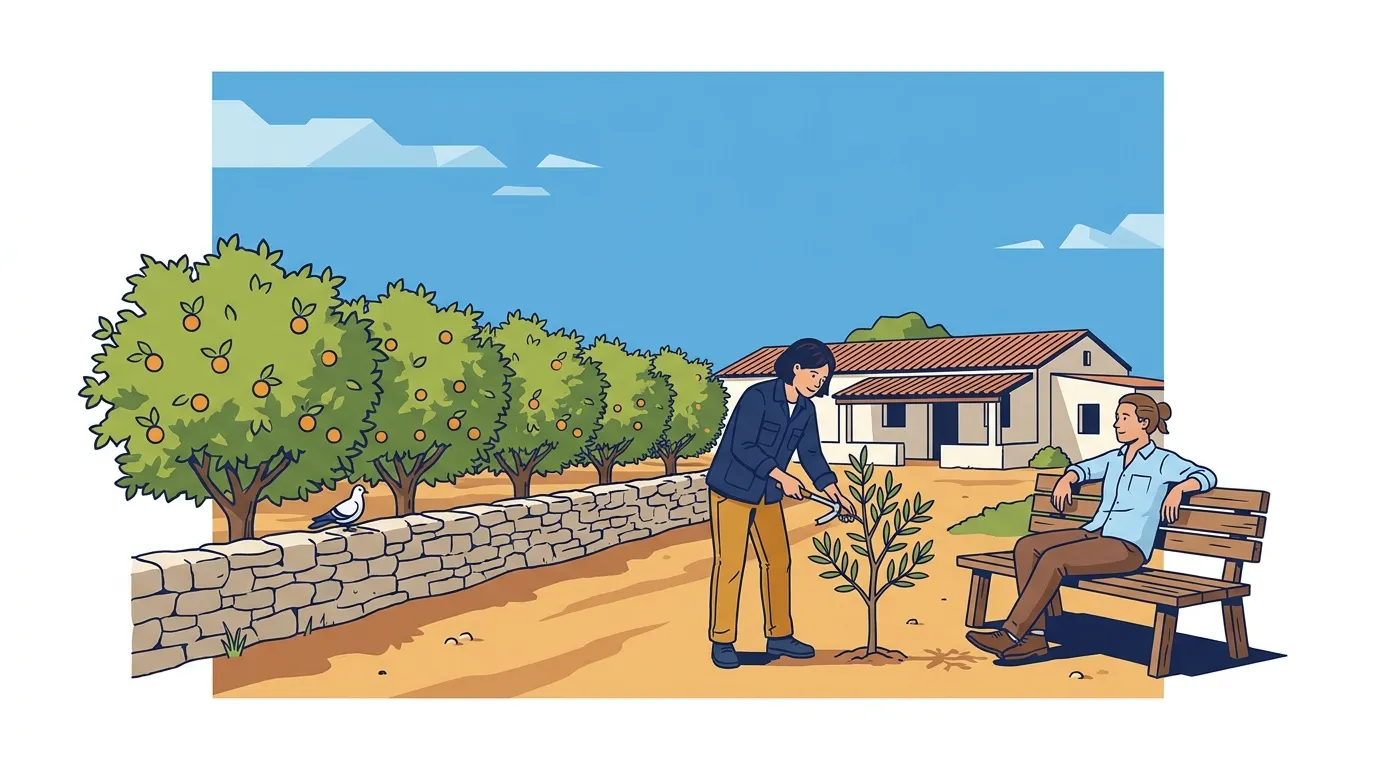
Moving someone into a contained space is not about removal. It is about giving regulation a fair chance to take root.
An environmental reset, and a steady scaffold for the day
A temporary move lifts a person out of the exact contexts that were maintaining the pattern. The worn-down household dynamic where every exchange has become a flashpoint. The pressures that reliably trigger the next collapse. In their place comes structure that is firm without being cold – regular meals, protected sleep, movement, and skills practised several times a day in real situations rather than rehearsed once a week and forgotten.
At Holina, that scaffold is built on a working farm in Cyprus, where the orchards, the animals, and the open sky feel nothing like a clinical facility – which matters more than it sounds. You can read how this structure is built across the full residential programme, and the same logic shapes the adventure and challenge work that builds tolerance for discomfort outside a therapy room.
In the short video below, Holina’s founder and senior therapist Yossi Zubari explains how personalised treatment, on-site clinical support, and somatic therapies work together in the residential setting.
How the model works at Holina Village
Holina Village is a boutique therapeutic community in Achnas, Cyprus, for adults living with complex mental-health difficulties and serious emotional dysregulation. Its position is part of the point. A short flight from the UK, Israel, and the Middle East – far enough from the familiar pressures of home that the nervous system can finally stop bracing – in a quiet, rural setting that does the unglamorous work of helping a person settle.
The week is intensive without being relentless. Daily individual therapy, practical DBT groups, trauma-focused work including EMDR, body-based and mindfulness practice, and the steady rhythm of farm and life-skills activity. What holds it together is the relational quality between residents and a team with genuine depth of experience. You can read about the people behind the work on the clinical team page. The work is delivered as proper clinical care, not as a retreat dressed up as therapy.
| Room tier | From (per month, all-inclusive) | What it includes |
|---|---|---|
| Shared Room | €7,950 | Accommodation, meals, clinical and group sessions, farm and adventure activities, airport transfers |
| Single Room, Shared Bathroom | €10,950 | As above, with a private bedroom |
| Single Room, Private Bathroom | €12,950 | As above, with a private bathroom |
Every tier is all-inclusive. Personal spending money is the only extra.
What happens on the day after
Families carry a private fear they rarely say aloud – that the calm will evaporate the moment the front door at home closes again. It is a fair fear, and the answer to it is built in from the start, not bolted on at the end.
The real test of residential work is not measured inside the walls. It is measured in re-entry. A proper discharge plan is graded, not abrupt – a paced return home, continued therapeutic contact, and coordination with professionals in the person’s own community so the thread is never dropped. With skills that have actually been practised, a family that has learned the same language, and a steadier base underneath, a great many people do break the loop. Not into a perfect life. Into a workable one, with their own hand back on the brake.
Frequently Asked Questions
Emotional dysregulation is not a character flaw and it is not untreatable. It is a measurable difficulty in a specific set of neural and learned processes – and those processes can be changed, with the right support and enough time to practise. For many people, weekly outpatient therapy is that support. For some, the pattern is too entrenched, the environment too maintaining, or the risk too present for fifty minutes a week to be sufficient. A residential setting – structured, relational, and built around daily practice rather than occasional sessions – can provide the conditions that genuine change requires.
If you are sitting with that question – for yourself or someone close to you – the next step is simply a conversation. You can reach the team through the contact page whenever you feel ready.
Speak with the team at Holina Village
An honest, confidential conversation about what is happening and whether residential support could help. No obligation, no sales process – just a straightforward exchange with people who understand this territory.
About the Author

Yossi Zubari
CEO & Founder
Director and Senior Therapist working with addiction for over 25 years, and in personal recovery for almost 30 years.