The diary still has appointments in it. The job is still there, most weeks. From the outside, the structure of a life is intact, and that is part of what makes ketamine so easy to misread. It does not knock the door down. It moves in quietly, and the person notices the rooms emptying long before anyone else does.
By the time someone reaches a page like this one, they have usually already tried to stop on their own – more than once. This is not a piece about willpower. It is a piece about what the substance actually does to a person, and what a serious response to that looks like.
Reading time: 9 minutes
Key points from this article
- Ketamine withdrawal is not life-threatening in the way some substances are, but the psychological distress – low mood, craving, broken sleep – is severe enough that most people cannot manage it alone.
- Detox alone is not treatment. Without residential work that addresses the reasons behind use, relapse is likely and often swift.
- Heavy or prolonged ketamine use causes bladder damage that can become permanent. Stopping early gives the best chance of recovery from that physical harm.
- A residential programme in Cyprus offers both the clinical depth and the distance from daily triggers that outpatient care cannot provide for most people with serious ketamine dependence.
Table of contents
- What ketamine addiction treatment actually is
- How do you know it is rehab you need, not cutting down
- The signs, as they actually show up
- Is ketamine withdrawal dangerous, and do you need detox
- How long does it take
- What residential ketamine treatment is, and why the setting matters
- What a day in ketamine rehab actually looks like
- The therapies that earn their place
- Ketamine bladder syndrome, and whether it heals
- Rehab versus ketamine therapy for depression
- Inpatient or outpatient – a clearer comparison
- Why some people recover better away from home, in Cyprus
- What to ask before choosing a centre
- What it costs, and what moves the number
- What happens after – re-entry and aftercare
- How to start if you are not ready to commit
- Frequently asked questions
What ketamine addiction treatment actually is
Ketamine addiction treatment is a structured, staged process – not a single act of stopping. It begins with a proper clinical assessment, moves through physical and emotional stabilisation, and then does the slower work: building coping mechanisms, treating what sits underneath the use, and rehearsing the skills that hold when the pull returns.
The aim is to restore an equilibrium that chronic use has worn down, in the body and in the mind. Dissociation that once felt like relief stops being available as a reflex, and something steadier has to be built in its place.
The principles here are not improvised. The framework drawn from the NIDA principles of effective drug addiction treatment is consistent: assessment first, an adequate length of stay, behavioural therapy at the centre, and a plan that adjusts as the person changes. No single component carries the work alone.
How do you know it is rehab you need, not cutting down
Cutting down has a particular failure pattern with ketamine, and it is worth naming honestly. The drug’s dissociative effect is precisely what makes a measured reduction so hard to hold. The state it produces is the state a struggling person most wants when things get heavy, so the plan to use less tends to collapse at exactly the moment it is tested.
So ask plainly. Has your day-to-day functioning slipped, at work or at home, in ways you have started to hide? Have you stopped and started again more than once, each time meaning it? Are most of your thoughts and money quietly organised around the next supply?
The clinical markers of a substance use disorder – described in plain language by MedlinePlus on substance use disorder – point the same way: an inability to reduce despite trying, secrecy, and use that has become the thing that lets you function at all.
The signs, as they actually show up
Tolerance is usually the first thing the person notices and the first thing they explain away. The amount that once did the job stops doing it. The dose climbs to chase a fading effect.
The behavioural signs gather after that. Use becomes compulsive, reached for as an exit from a feeling rather than a choice made freely. Interests thin out. Friendships that asked anything of the person fall away, replaced by ones organised around using or by no one at all. Mood swings sharpen, and decisions that used to be straightforward start to wobble.
Families feel this before they can name it. Conversations get shorter. Plans get cancelled. A reliable person becomes hard to reach in a way that is difficult to put into words. The NIDA overview of ketamine’s effects and dependency describes how the dissociative pull and the climbing tolerance work together: the substance quietly takes over the role of regulating a life it is steadily dismantling.
Is ketamine withdrawal dangerous, and do you need detox
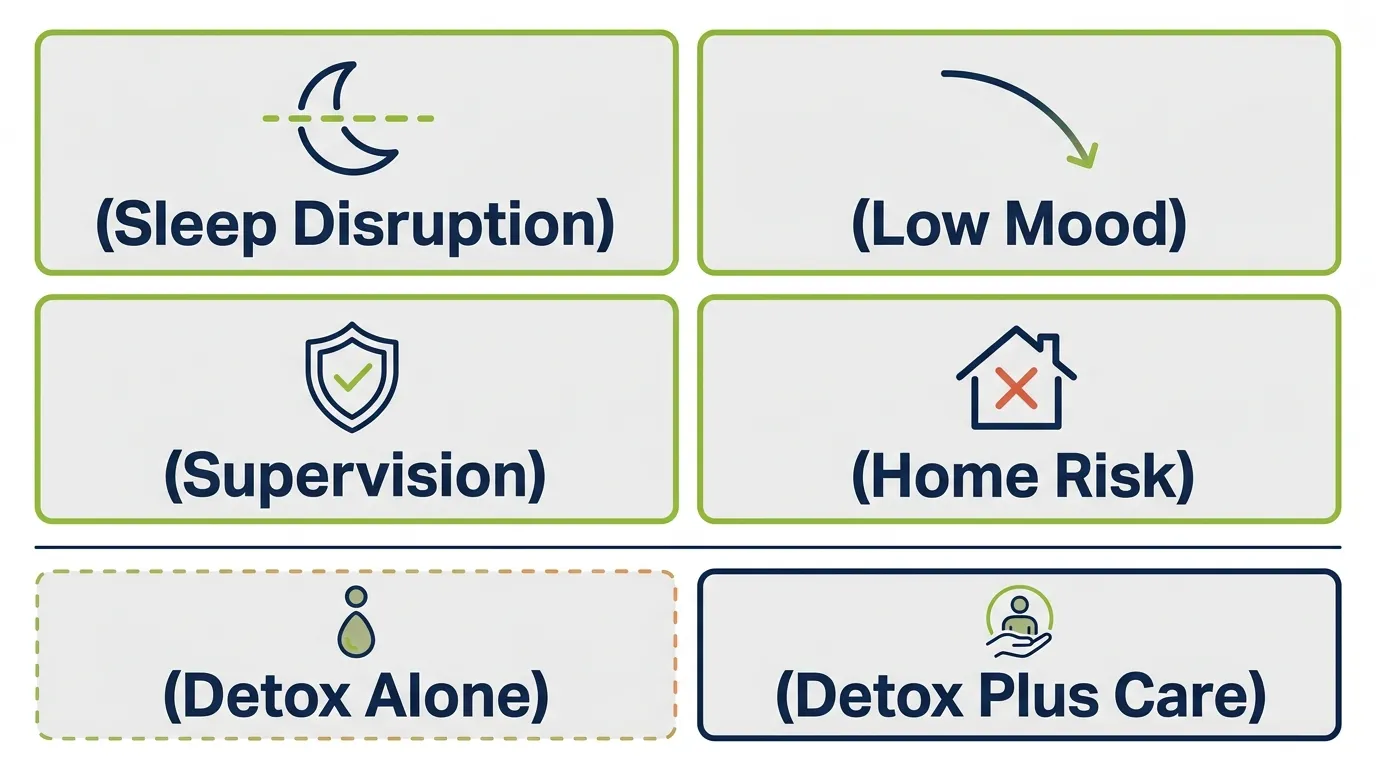
Here the honest answer is reassuring in one direction and not in the other. The physical withdrawal from ketamine is not life-threatening in the way alcohol or benzodiazepine withdrawal can be. Nobody should hear that and relax.
What comes instead is psychological, and it is severe. Deep low mood. Sharp anxiety. Sleep that breaks apart. And a craving that is both physical and mental, insistent enough that most people cannot sit with it alone for long. The published research on dependence and rebound in central nervous system drugs documents this pattern of low mood, anxiety and craving clearly. That distress, untended, is the most common reason a person returns to use within days. Supervision and steady company through that window are not luxuries – they are the thing that keeps the early days from undoing themselves.
When detox is strongly recommended
Some situations move detox from optional to necessary. Heavy daily use is one. Polysubstance use – where ketamine sits alongside other drugs – is another, because the combined withdrawal becomes harder to predict. A psychiatric history in the background raises the stakes again, since the low mood of withdrawal can press on existing wounds.
And there is the simple matter of home. A person withdrawing in a flat where the substance is a phone call away, with no one watching the harder hours, is being asked to do something most people cannot do unaided.
What detox does, and what it does not
Detox clears the body and brings a basic physiological steadiness back. That is real, and it is worth having. It is also where a great many people stop, and that is the costly mistake families repeat.
Detox does not touch the reasons. The patterns that built the use, the feelings it was managing, the relationships it grew around – all of that is still there when the body is clear. Without residential ketamine treatment to follow it, detox tends to become a clean slate that gets written over within weeks. The NIDA account of treatment and recovery is direct about this: detoxification alone is not treatment.
How long does it take – longer than the brochures suggest
There is no clean answer measured in days, and anyone offering one is selling something. The honest range depends on how long the use ran, how severe it became, how many previous attempts ended in relapse, and what else is in the picture – depression, anxiety, trauma.
The brain is the reason for the patience. The pathways that use carved take time to settle, and new habits need repetition before they hold under pressure rather than only in calm. In our experience the difference between a stay that stabilises and a stay that changes something is largely a difference of weeks – not because longer is automatically better, but because the held container of the residential setting needs time to do more than interrupt.
30, 60 or 90 days – and who each fits
| Length | What it realistically achieves | Who it tends to suit |
|---|---|---|
| 30 days | Initial stabilisation, a controlled physical break, first contact with the basic tools | Shorter use, strong support waiting at home, lower severity |
| 60 days | Real work on emotional patterns, identifying triggers, practising regulation skills until they feel familiar | Longer use, a history of stopping and restarting, some co-occurring difficulty |
| 90 days and beyond | New patterns embedded rather than rehearsed, focused work on root trauma, a proper re-entry plan, sharply lower relapse risk | Heavy or long use, previous relapses, trauma or dual diagnosis in the picture |
We tend to recommend ninety days where it is possible. A four-week stay lets the nervous system recalibrate. Twelve weeks lets the new patterns hold long enough to survive the journey home.
What residential ketamine treatment is, and why the setting matters
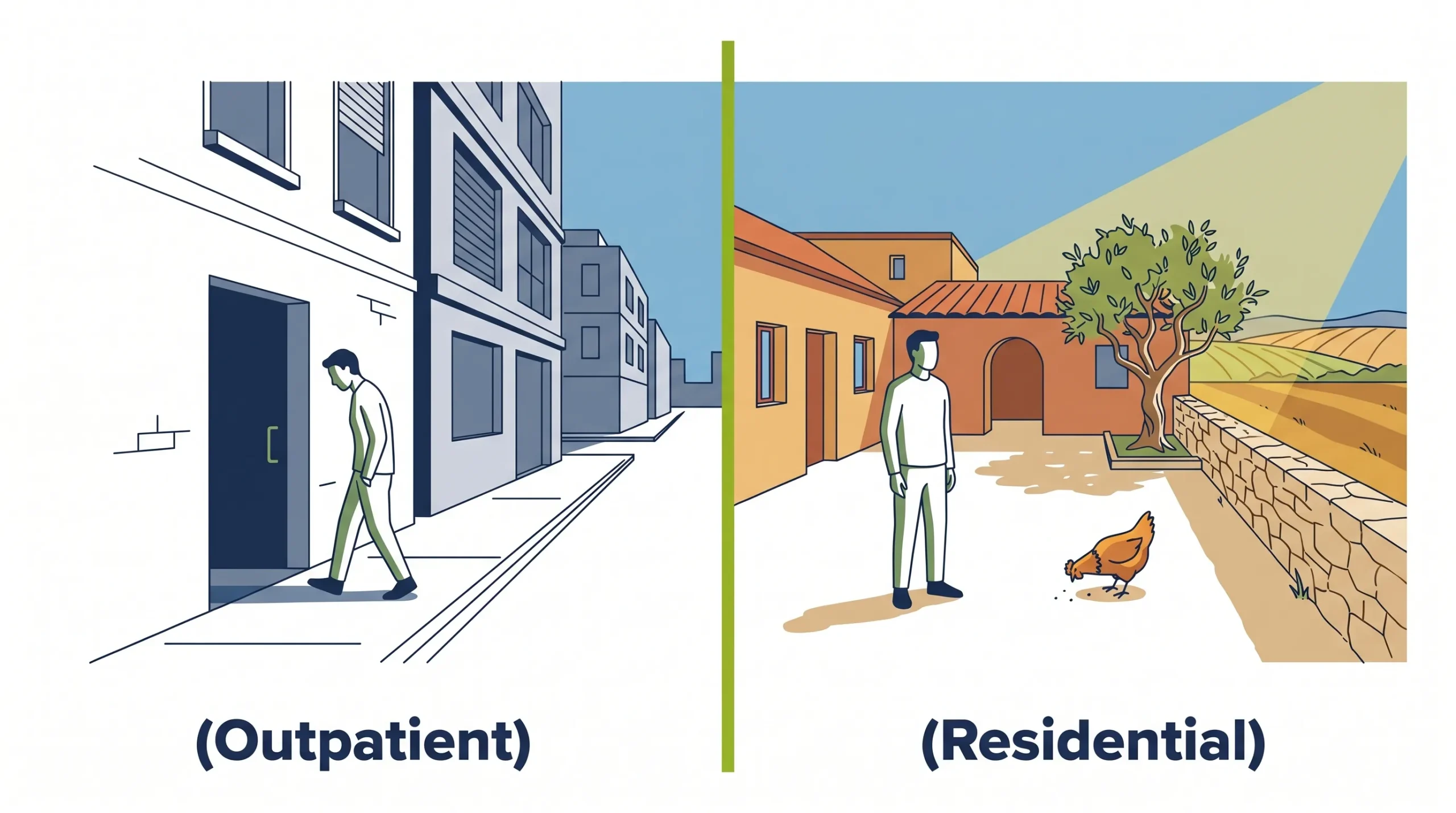
Outpatient therapy has genuine value, and for some people it is the right level of care. It also has a limit that ketamine finds quickly. An hour of good work twice a week sends the person back, the same evening, to the flat and the contacts and the pressures that the use grew around.
Residential ketamine treatment removes that variable entirely. The person lives, round-the-clock, inside a contained space where the physical access to ketamine is gone and the immediate environmental triggers – using friends, work stress, late nights – are simply not present. That is not avoidance. It is the condition under which deeper work becomes possible.
In a setting like the residential treatment programme at Holina Village, physical, psychological and emotional health are treated under one roof, in a place that feels nothing like a clinical facility – so that the person has genuinely safe ground from which to recover.
A confidential conversation costs nothing
If you are thinking about treatment – for yourself or someone close to you – the team at Holina Village is available for a completely confidential conversation. No pressure, no obligation. Just an honest discussion about what would actually help.
What a day in ketamine rehab actually looks like
People arriving for ketamine rehab often picture something institutional. The reality is closer to a working rhythm than a waiting room.
A day holds individual therapy, where the private work gets done, and group sessions, where the isolation that use builds starts to break. There is movement: physical activity, time outdoors, work with the farm and the animals. There is mindfulness, yoga or meditation for the slow relearning of how to be in a body without numbing it. Meals are planned and shared. There is space left deliberately for rest and for the person’s own reflection.
The adventure and challenge activities at Holina are part of this rhythm – not decoration, but a way of rebuilding confidence, tolerance for discomfort, and the experience of doing something hard and getting through it.
What this structure quietly replaces is the chaos. Use organises a life around unpredictability. A steady day, repeated, offers the nervous system a different template – and for many people that ordinariness is itself part of the medicine.
The therapies that earn their place
The evidence here is not exotic. Behavioural therapies do the heavy lifting. Cognitive behavioural therapy gives the person a way to see the chain from trigger to craving to use, and to interrupt it. Dialectical behaviour therapy adds the skills for sitting with intense feeling without reaching for an exit – which matters enormously for a drug used precisely to escape feeling.
Where trauma is present, trauma-focused work – including EMDR where it is appropriate – addresses the body-mind split that use both exploited and deepened. A systematic review of managing ketamine use disorder underlines that no single medication resolves this; the durable work is psychological and relational.
Treating the underlying reasons for use
Ketamine is very often self-medication. People reach for it to quieten severe depression, to dull post-traumatic distress, to make social fear bearable, to fill a flat emptiness that has no obvious cause. The dissociation does, briefly, what nothing else seemed to.
If that underlying condition goes untreated – the dual diagnosis left unaddressed – the relapse risk after discharge is high, and it is high for an understandable reason. The person has been given back a clear head and the same pain it was clouding. Treating both at once is not an optional refinement. It is the difference between a pause and a recovery.
Ketamine bladder syndrome, and whether it heals
This is the physical harm that frightens people most once they understand it, and it deserves plain description. Heavy ketamine use damages the bladder. The clinical name is ketamine-induced cystitis.
It shows up as severe pain in the pelvis when passing urine, an urgency and frequency that can drive someone to the toilet dozens of times a day, and blood in the urine. People often hide it for a long time, which is exactly the wrong instinct – because the most important fact about this condition is about timing.
The damage can improve. A comprehensive review of ketamine-induced cystitis and urological effects describes meaningful recovery of bladder function in many people who stop early. Continued use is the danger. Pushed far enough, the scarring becomes permanent, and the outcome can be complex surgery on a bladder that no longer holds.
Stopping is not only about the mind. For the bladder, it is the single thing that decides whether this is reversible.
Rehab versus ketamine therapy for depression – not the same thing
This confuses people constantly, and the confusion matters. Medically supervised ketamine, given in controlled low doses in a clinic for treatment-resistant depression, is a legitimate treatment with monitoring built around it. It bears almost no relation to compulsive use of street ketamine.
Someone who has developed dependence does not need a course of the substance they are trying to escape. They need ketamine rehab – a path oriented toward freedom from the drug and toward repairing what its use damaged. The two share a molecule and nothing else that matters here.
Inpatient or outpatient – a clearer comparison
Choosing the right level of care is the decision that most shapes the outcome, so it is worth being concrete rather than reassuring.
| Clinical indicator | Outpatient may fit | Residential is indicated |
|---|---|---|
| Severity of use | Mild to moderate, stable day-to-day | Heavy or daily, with functioning slipping |
| Home environment | Strong support, no easy access to supply | Using contacts present, supply close, little safety at home |
| Previous attempts | First serious attempt, high self-direction | Repeated relapses despite genuine effort |
| Co-occurring conditions | Manageable, already supported | Untreated depression, anxiety or trauma |
| Physical decline | None or minimal | Bladder symptoms, marked deterioration |
The honest reading of this table is that ketamine addiction treatment is most often residential precisely because the drug erodes the conditions outpatient care depends on.
Why some people recover better away from home, in Cyprus

Distance is not an escape from the problem. It is a way of giving the problem somewhere to be addressed without the daily pull of everything that fed it.
For people coming from the UK, Israel or mainland Europe, Cyprus is a short flight and a complete change of ground. The supplier’s number stops mattering when the supplier is in another country. The pub, the flat, the routine – all of it is left behind for the length of the stay, and so is the exhausting performance of seeming fine to people who know you. The warm Mediterranean climate and the quiet of the recovery setting at Holina Village offer the kind of stillness that lets a person come back to themselves.
Travelling abroad for care does carry its own considerations, and the CDC guidance on receiving medical care abroad is sensible reading: check the credentials, plan the follow-up, keep the records. Done well, the discretion and the distance work in the person’s favour.
The team who deliver the care is the other part of this. It is worth understanding the people as well as the place. You can read about the clinical team at Holina Village to get a sense of the experience and background behind the programme.
What to ask before choosing a centre
Families arrive at this point frightened and short on time, which is exactly when good questions get skipped. A few are worth insisting on.
Ask what professional qualifications the clinical team actually hold, and ask to understand the people – not just the brochure. Ask whether the programme genuinely combines physical and psychological treatment, or whether one is decorative. Ask how they handle dual diagnosis and trauma, because the answer reveals how seriously they take relapse. Ask what medical support is on hand, and whether the family is involved.
And ask the question most centres dislike: what happens if there is a setback or a crisis, and what does the plan for after discharge look like in detail. The quality of that last answer tells you most.
What it costs, and what moves the number
It is fair to talk about money plainly. The total for ketamine rehab is shaped by a few real variables: the length of stay, the standard of accommodation, whether the room is shared or private, the clinical and medical intensity the person needs, and the support around the stay.
At Holina, the published tiers are all-inclusive, covering accommodation, meals, clinical and group sessions, the adventure and farm activities, and airport transfers. Personal spending money is the only real extra.
| Room tier | From (per month) | What is included |
|---|---|---|
| Shared room | €7,950 | All clinical care, meals, activities, transfers |
| Single room, shared bathroom | €10,950 | The same, with more private space |
| Single room, private bathroom | €12,950 | The same, with full privacy |
The cost drivers you can actually control
Some of the number is not fixed. Choosing a shared room rather than a private one lowers the monthly figure meaningfully. Matching the length of stay precisely to clinical need, rather than over- or under-committing, keeps the total honest. And longer programmes sometimes carry their own arrangements worth asking about directly. None of this changes the care. It changes the bill.
What happens after – re-entry and aftercare
The day someone goes home is not the finish line. In a real sense it is the test the whole stay was preparing for, and recovery that ignores it tends not to last.
A serious aftercare plan is built before discharge, not improvised after it. It means regular sessions with a therapist in the person’s own city. It means ongoing support – whether twelve-step or an alternative that fits them better – so that the relational substrate built in residential care does not simply vanish. It means a worked-out relapse prevention plan, written for their actual triggers. And it means doing something about the home environment, so the person is not returning to the precise conditions the use grew in.
Re-entry handled with care is the bridge that lets months of work hold.
How to start if you are not ready to commit
If you have read this far and the prospect of travelling abroad for treatment feels like too much to agree to today, that is not a failure of resolve. It is a reasonable response to a large decision made under pressure.
The first step is not a commitment. It is a conversation. A confidential clinical assessment, an honest discussion about where things actually are, and a clear picture of which routes exist. No one is asked to sign anything to begin thinking out loud with someone who does this for a living. You can reach the Holina team to talk it through – for yourself or for someone you love – and the only thing being asked of you at that point is the willingness to be met.
Frequently asked questions
Ketamine dependence is a serious condition with serious physical and psychological consequences – and it is one that a properly structured, long enough programme can address at its roots. Detox opens a door. Residential treatment walks through it. Aftercare keeps it from closing again.
If anything in this article has landed close to home, the most useful next step is a straightforward conversation. Not a commitment to anything. Just honesty, with someone experienced enough to help you think through what is actually going on and what would genuinely help.
No pressure. No obligation. Just an honest conversation.
The team at Holina Village Cyprus is available for a completely confidential conversation – by phone or in writing – about ketamine addiction treatment and what the right path forward might look like for you or someone you care about.
About the Author

Yossi Zubari
CEO & Founder
Director and Senior Therapist working with addiction for over 25 years, and in personal recovery for almost 30 years.