The bedroom door is shut, which is not unusual. The job is still there, more or less. The phone still lights up with the same names it always did. Nothing has collapsed. And yet someone in the house has been standing in the kitchen at odd hours, not quite present, looking at the kettle as though it had asked a difficult question. Families rarely arrive at the word “addiction” first. They arrive at a feeling that someone they love has gone slightly out of reach. With ketamine, that drift is the early warning, and it is easy to talk yourself out of it. This article looks honestly at what ketamine does, how dependence forms, what families can actually observe, and what the work of recovery genuinely involves.
Reading time: 5 minutes
Key points from this article
- Ketamine is addictive, primarily through psychological and behavioural dependence rather than dramatic physical withdrawal.
- Tolerance builds rapidly, often within weeks, driving dose escalation and deepening harm to health and relationships.
- Long-term use carries serious, sometimes irreversible consequences for cognitive function and bladder health.
- Lasting recovery addresses what the substance was covering, not just the chemical itself, and a structured therapeutic setting significantly improves the odds.
Table of Contents
The short answer, and where it gets complicated
Yes. Ketamine is addictive. Not in the way alcohol or opioids announce themselves, with shaking hands and a body in obvious revolt, which is precisely why so many people miss it.
The pull of ketamine is mostly psychological and behavioural. The brain learns that one substance reliably switches off distress, and it files that lesson somewhere deep. The US National Institute on Drug Abuse describes how repeated use reshapes the reward circuitry that governs motivation and craving, in its overview of ketamine and its effects on the brain. The question worth asking is not whether ketamine is addictive on paper, but whether someone has lost the freedom to leave it alone.
What the substance actually does, and why people reach for it
Ketamine is a dissociative anaesthetic. In a hospital it allows surgery without the patient feeling the body being worked on. That is the medical version. The recreational version uses the same property for a different purpose.
Dissociation is a particular kind of distance. It is not relaxation. It is the sensation of stepping back from your own thoughts, your own body, the room you are sitting in, as if watching it all through slightly thick glass. For someone carrying trauma, loneliness, or a low hum of dread they cannot name, that distance can feel like mercy.
The pattern we see most often starts socially. A club, a party, other people. Then, quietly, it migrates home. The substance stops being about the night out and starts being about getting through Tuesday.
Psychological addiction – the part that does the real damage
When people picture addiction, they picture withdrawal. The body in crisis. With ketamine, the heaviest weight sits elsewhere, in the mind.
A psychological addiction is the state in which a person no longer believes they can rest, sleep, feel any pleasure, or sit still inside their own life without the substance. The loop is recognisable once you have seen it a few times. Unresolved distress arrives. Ketamine supplies a few hours of distance. The distance fades and the original feeling returns, now carrying shame on top of it. The craving sharpens. The use repeats.
Over weeks, the budget bends around it. The week bends around it. A person starts arranging their hours, quietly, around when they can next disappear.
Dependence is the body agreeing to the arrangement
Tolerance and craving are one thing. Dependence is the next floor down.
Ketamine dependence describes the point where the central nervous system has adjusted to the substance being routinely present, and treats its absence as a problem to be solved. Stop, and the internal weather turns. Restlessness arrives first. Then anxiety with a sharp edge, low mood, a sense that something is wrong that the next dose conveniently silences. These rebound symptoms are part of why people conclude, wrongly, that the substance is keeping them well. A clinical and neuroimaging review of ketamine use disorder and its proposed neurological mechanisms traces how this dependence and the craving that accompanies it take hold.
The speed problem – why doses climb so fast
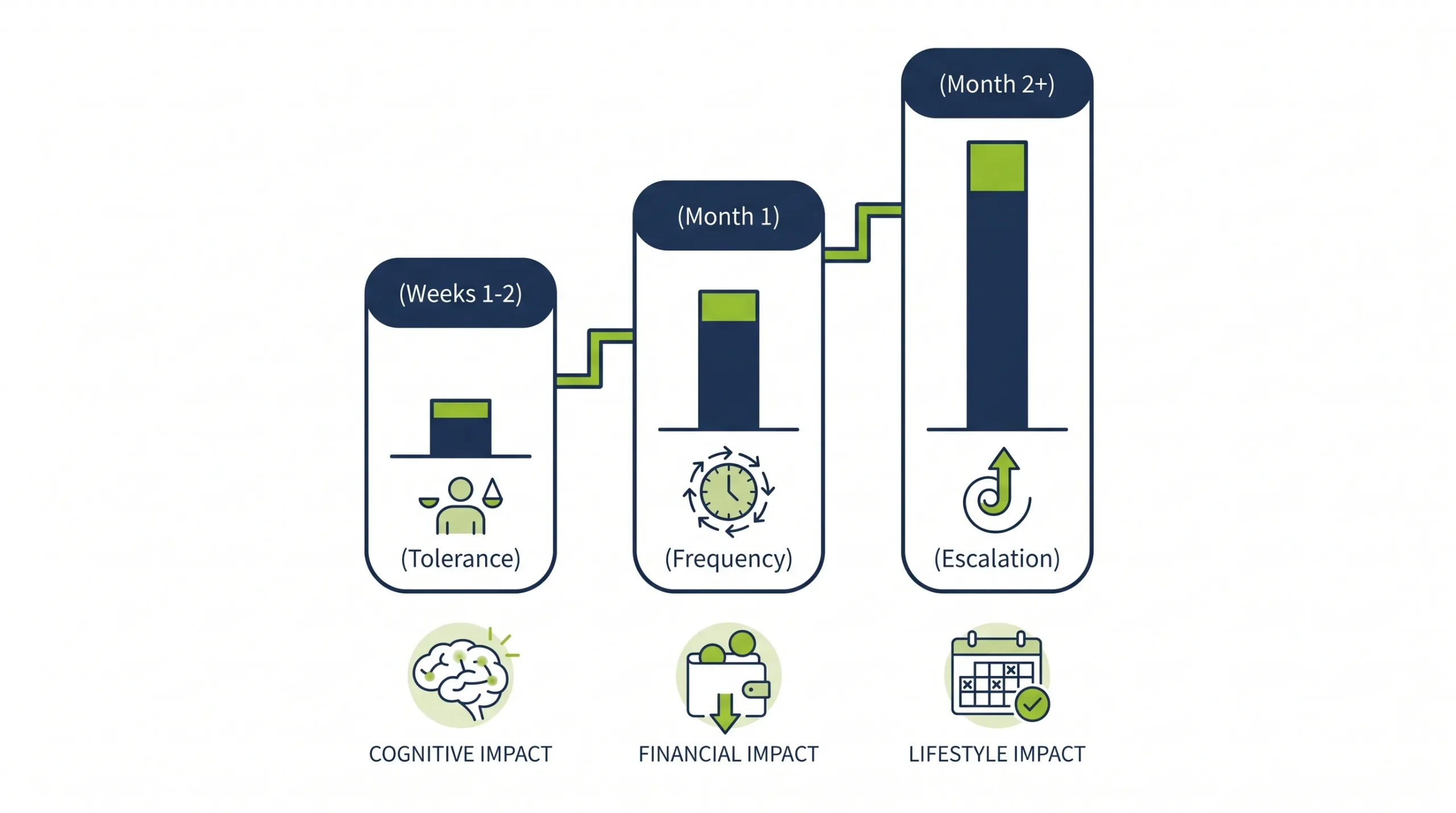
Ketamine tolerance rises steeply, often within weeks of regular use.
How quickly does ketamine tolerance build?
Faster than most expect. Regular users frequently find, within a matter of weeks, that the amount which once delivered the desired distance now does almost nothing. Ketamine tolerance rises steeply, and the brain quietly resets the baseline. What felt like plenty in March feels like a starting point by April.
So the dose climbs. The frequency climbs. And every increase pushes harder on the bladder, the kidneys, the memory, and the bank account, while deepening the secrecy that already surrounds the whole arrangement. The escalation is not a failure of willpower. It is the predictable result of how the substance behaves in the body.
“But there’s no real withdrawal, so it can’t be addictive”
This is the sentence we hear most from younger users, usually with real conviction. Because ketamine does not produce the dramatic, dangerous physical withdrawal of alcohol or opioids, people conclude it is essentially harmless to stop.
The absence of seizures or violent tremor tells you something about the type of withdrawal. It tells you nothing about whether someone is free.
The honest measure of addiction was never the severity of the shakes. It is the loss of choice. Continuing despite clear harm to your relationships, your work, your health. Promising yourself a break and not managing to hold it. NIDA frames the warning signs of a developing problem plainly in its guide to recognising when drug use has become a problem, and not one of them is a convulsion.
What a parent or partner can actually see
You will not see the substance. You will see the shape it leaves in someone’s behaviour.
| Area | What tends to show up |
|---|---|
| Behaviour | Sudden retreat from old friends, neglect of studies or work, recurring lies and vagueness about where they have been |
| Money | Urgent requests for cash, items quietly disappearing, withdrawals that do not add up to anything you can name |
| Body and mind | Patchy short-term memory, steep mood swings, slurred or unsteady moments soon after coming home, dilated pupils |
Any one of these can be something else entirely. The pattern, repeated and tightening over months, is what deserves an honest conversation rather than reassurance.
What stopping actually feels like
It helps to be plain about this, because people who try to stop alone are often ambushed by the size of it.
When the artificial distance is removed, everything it was holding off comes back at once. This is the drop. Acute anxiety, a heavy low mood, exhaustion that does not lift even with rest, all of it tangled up with a physical restlessness that makes sleep refuse to come. Nights fill with broken sleep and bad dreams.
And underneath it, the craving. Not a polite wish, a loud insistent pull toward the one thing that reliably makes the discomfort stop. That craving is the wall most home attempts run into. It is also the reason a held setting matters, because the craving passes faster when someone is not alone with it.
A rough timeline, so the days have shape
Recovery is not linear, and any honest clinician will tell you that. But it does have stages, and naming them gives the early days an edge to hold.
| Phase | Roughly when | What it asks of the person |
|---|---|---|
| Acute | First days to two weeks | Re-establishing sleep, physical recovery, riding out sharp mental instability |
| Extended recovery | First several months | The slower work as brain chemistry rebalances, with a real risk of slipping if the underlying pain is left untouched |
That second phase is the one people underestimate. The acute storm passes and they assume the work is done, just as the quieter, longer task is beginning.
Why willpower alone keeps failing here
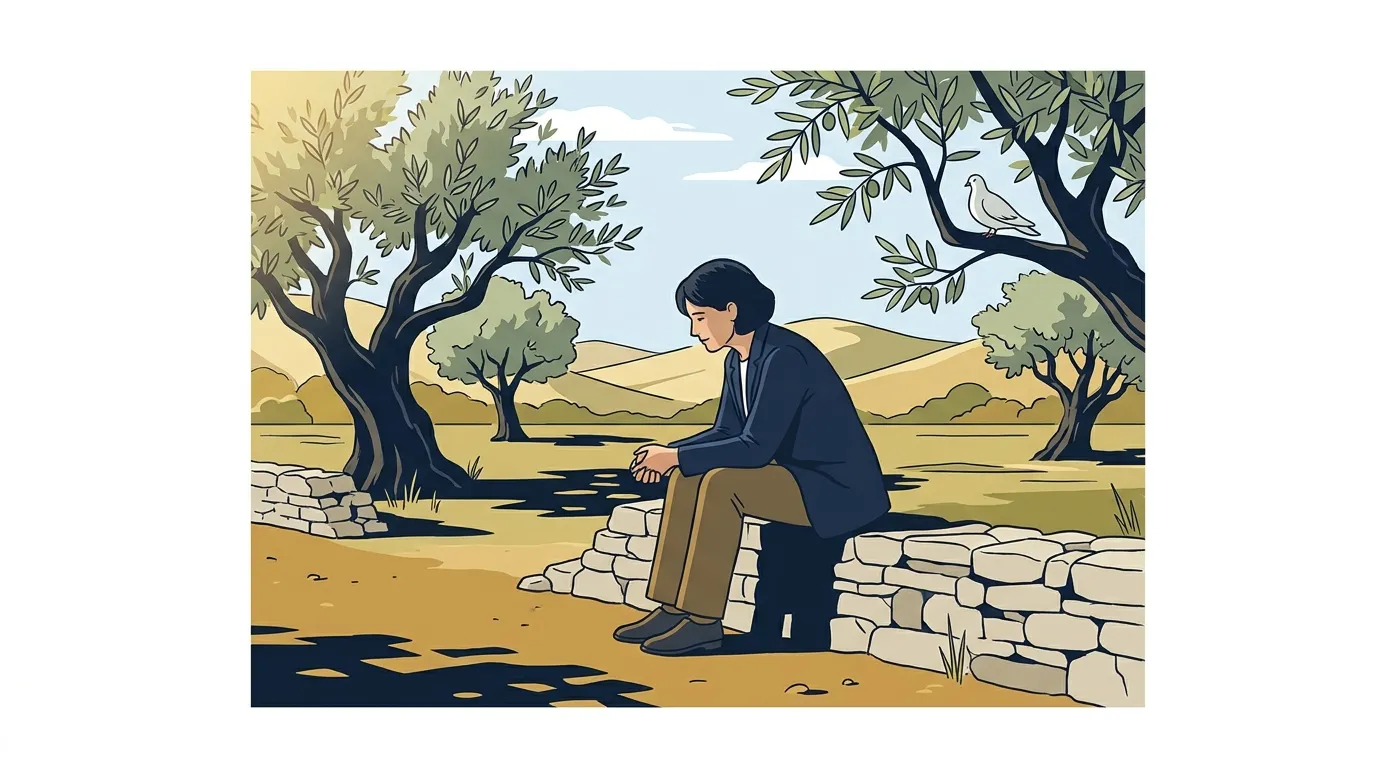
Removing the substance without addressing what it was covering tends to leave people without the tools they need.
Ketamine was doing a job. It was muting something. Grief, social fear, intrusive memories, a loneliness with no obvious cause.
Take the substance away and leave the job undone, and the muted thing comes back at full volume, often louder than before. At which point returning to use is not weakness. It is a frightened person reaching for the only tool that has reliably worked. This is why removing the chemical without tending to the wound underneath tends to fail, and why the work that lasts looks more like the slow rebuilding of felt connection than a detox. For some people that wound is recent and specific, the kind we explore in our writing on grief in early adulthood and how it intersects with recovery.
A quiet conversation costs nothing
If you are wondering whether what you are seeing in yourself or someone you love is serious enough to talk about, it is. Our team is available for a confidential, no-pressure conversation – no obligation, just an honest exchange about what is happening and what might help.
The medical version, kept separate
None of this should frighten someone receiving ketamine under proper care. The distinction is real and it matters.
In a supervised clinical setting, for treatment-resistant depression, ketamine or esketamine is given in measured doses by a team that monitors the patient and controls everything about the encounter. That structure keeps the addiction risk low. The patient-facing information on esketamine nasal spray and its clinical monitoring requirements shows how much oversight that kind of treatment carries.
The danger lives in unsupervised use. Anyone with a personal or family history of addiction should say so to their prescriber, and no one should be sourcing and dosing ketamine privately on the strength of having once read it treats depression.
What chronic use costs the body
The long-term harms are not abstract, and two of them are worth naming clearly.
The first is cognitive. Heavy, sustained use is associated with poorer concentration, learning difficulty, short-term memory problems, and measurable structural changes in brain tissue.
The second is the bladder. Ketamine-induced cystitis is brutal and, for some, irreversible. Chronic inflammation, severe pain on urination, bleeding, a bladder that shrinks until it can barely hold anything, occasionally requiring surgery. It is one of the cruellest features of heavy use because it tends to arrive in young people who never imagined a recreational substance could damage an organ this way.
The K-hole, described without glamour
Some users chase a state they call the K-hole. It deserves a clear, unromantic description.
At high doses, ketamine can produce near-total physical immobility, complex hallucinations, and a sense of the mind being severed completely from the body. People who pursue this are pursuing the deepest version of the distance the substance offers.
The immediate dangers are stark. Someone unable to move or respond cannot protect themselves. There are real risks of injury, of choking if vomiting occurs, of drowning, of panic and paranoia tipping into genuine terror. And because tolerance keeps rising, the state grows harder to reach, which pushes the doses, and the danger, higher.
Why this lands differently on younger people
For a teenager or young adult, the cost is not only medical. It is developmental.
Adolescence is when a person is meant to learn how to sit with discomfort, to feel a hard emotion and survive it without an exit. A substance that switches the feeling off removes the practice. The coping skills that should be forming simply do not form, and avoidance gets wired in as the default.
It corrodes the family too. The secrecy breeds distance, the distance breeds conflict, and the lies wear down trust until parents stop knowing which version of events to believe. By the time families reach us, that erosion of trust is often the wound they most want help repairing.
When it is time to ask for an outside opinion
Not every use becomes a disorder. So how do you tell?
A few honest questions
Am I using ketamine to get away from loneliness or sadness, rather than for any pleasure in it? Am I hiding how often I use, or how much it costs? Have I tried to stop or cut down, and not managed to hold the line? A clear yes to any of these is not a verdict. It is a reason to talk to someone.
The next two or three days
Start by ending the secrecy. Tell one person you trust, a friend or a family member, out loud. Avoid mixing substances, especially ketamine with alcohol, which compounds the risk to your breathing. Then make contact with a professional service. If you are looking for a structured setting with people who do this work daily, the team at the residential community at Holina Village in Cyprus can talk it through without pressure.
What actually works for the psychological grip
Holina Village is set on a working farm in Achnas, Cyprus – a deliberate contrast to clinical environments.
The thing that fails is treating ketamine as a chemical to be flushed out and nothing more. The thing that works treats the substance as a symptom and goes after what it was covering.
Why a contained setting changes the odds
Stepping out of the everyday environment, away from the triggers and the people and the routines that surround use, is not a luxury. For deep dependence it is often the difference. Our setting is a working farm in Achnas, with orchards, animals, and open sky. It feels nothing like a clinical facility, and that is deliberate, because the relational substrate of a therapeutic community is what does the slow repair. Our residential programme and its daily structure is built around round-the-clock support, trauma work, emotional regulation, real routine, and time spent outdoors and alongside others.
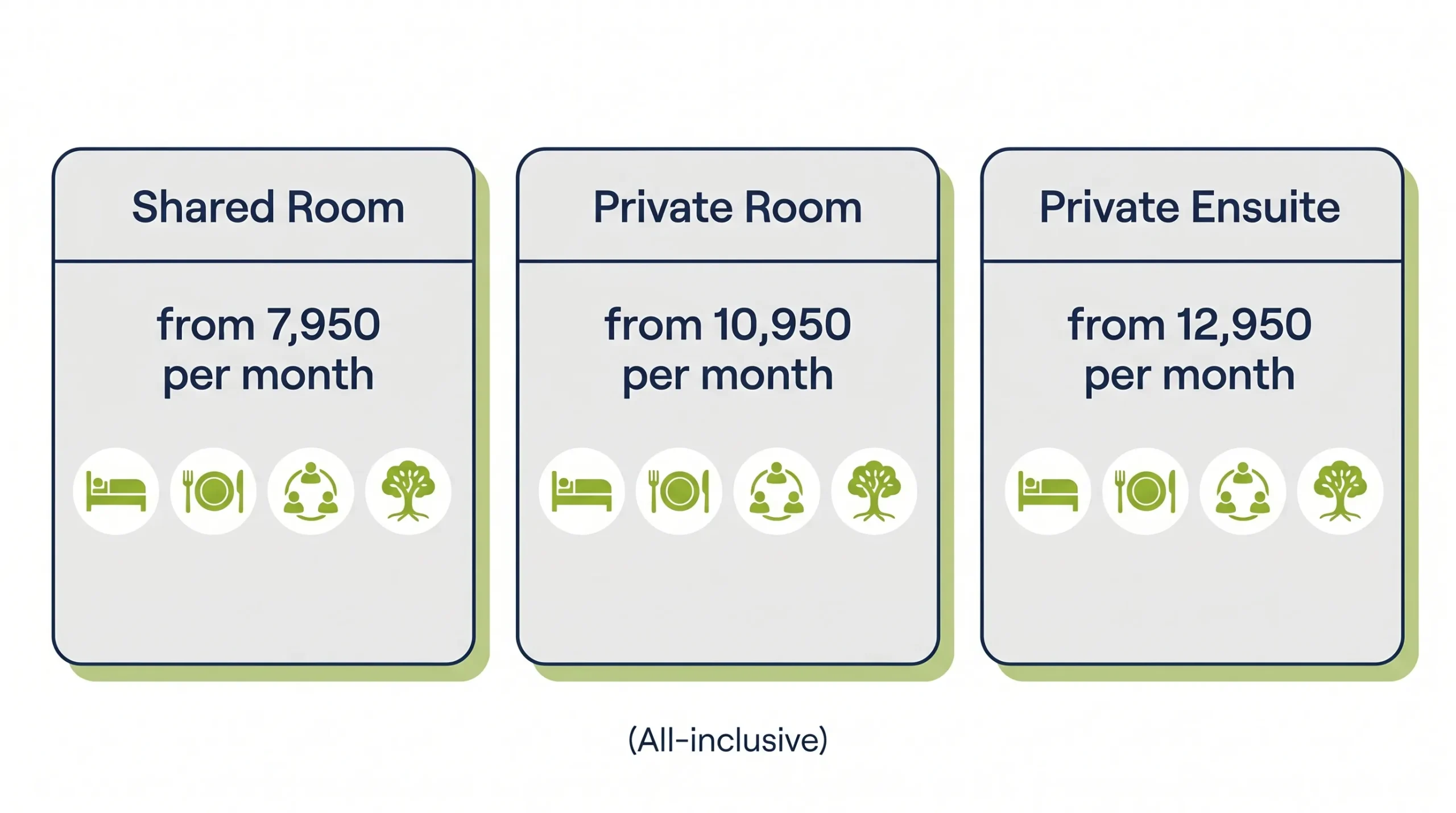
Holina’s room tiers are all-inclusive, so families are comparing like with like.
| Room | From (per month) | Included |
|---|---|---|
| Shared Room | €7,950 | Accommodation, meals, clinical and group sessions, farm and adventure activities, airport transfers |
| Single, Shared Bathroom | €10,950 | As above, with a private room |
| Single, Private Bathroom | €12,950 | As above, with private bathroom |
Personal spending money is the only thing not covered.
Frequently asked questions
Is ketamine addictive the first time you try it?
A single use does not create physical dependence. But the strength of the dissociative experience can light an immediate wish to repeat it, especially in someone who happened to be in real emotional pain when they tried it. The risk lives in why someone reaches for it, not just how often.
How quickly can ketamine addiction develop?
It varies from person to person. Because tolerance builds so fast, regular unsupervised use can tip into deep psychological dependence and noticeable damage to daily functioning within a few weeks rather than years.
Is ketamine more psychologically addictive than physically addictive?
Distinctly so. The physical withdrawal is mild compared with many other substances. The psychological dependence and the craving are among the most stubborn and persistent obstacles people face in recovery, which is exactly why the work has to reach the feelings underneath, not just the chemical.
What makes ketamine use harder to spot than alcohol or opioid use?
The absence of dramatic physical withdrawal means nothing appears to be wrong in the way families or employers expect. The person may still hold their life together on the surface for a considerable time. The signs tend to be behavioural and relational rather than medical, which is why the pattern over months matters more than any single incident.
Does the setting of treatment genuinely matter, or is the therapy the same anywhere?
Setting matters considerably. Removing a person from the environment that surrounds and sustains use – the routines, the people, the geography – reduces exposure to triggers during the most fragile phase of recovery. A residential therapeutic community also provides relational continuity around the clock, which outpatient work cannot offer. The therapeutic relationship, and the community itself, are active ingredients in the process, not just a backdrop to it.
Ketamine does not behave the way most people expect an addictive substance to behave, which is part of why it causes the harm it does before anyone has found a name for it. The dependence forms quietly. The tolerance rises fast. The harms to cognition, bladder health, and the fabric of family life are real and, in some cases, permanent. And the psychological grip it takes is among the most resistant to willpower alone precisely because it was always doing a job that something else needs to do instead.
If you have read this far, you are probably not looking for reassurance. You are looking for somewhere honest to start. That is the willingness to be met, and it is enough to begin.
No pressure. No obligation. Just an honest conversation.
The team at Holina Village Cyprus is available to speak confidentially with adults who are concerned about their own use, and with families trying to understand what is happening. A call is simply a conversation – nothing is decided, nothing is committed to, until you are ready.
About the Author

Yossi Zubari
CEO & Founder
Director and Senior Therapist working with addiction for over 25 years, and in personal recovery for almost 30 years.