The messages are still in the phone. Someone has read them back three times and still cannot say, with any confidence, whether that conversation happened yesterday or last week. The name of a colleague they have worked beside for a year sits just out of reach. Nothing dramatic has happened. No collapse, no emergency. Just a slow, private noticing that something in the machinery of remembering is not running the way it used to.
That quiet noticing is often the first honest signal. It arrives before anyone would use the word “problem.” If you have arrived at this page for yourself, or because you have watched it happen to someone you love, this is written for you, in the plainest terms we can manage. It sets out what long-term ketamine use does to the brain, what recovers, and what a supported path back looks like.
Reading time: 9 minutes
Key points
- Chronic ketamine use is linked to reduced cortical thickness and gray matter volume, but plasticity means substantial function can return once use stops.
- Memory and concentration problems come from disrupted NMDA receptor signalling in the hippocampus, not a single dramatic event.
- Executive function, planning, impulse control, mental flexibility, tends to fray earlier and more quietly than obvious memory loss.
- Recovery timelines vary widely and respond to what happens next, particularly safe cessation, nutrition, sleep, and structured psychological support.
Table of contents
- What ketamine does to the brain over months and years
- Does ketamine cause permanent brain damage
- Supervised medical ketamine versus street ketamine
- How ketamine erodes memory
- The fog that does not lift
- Cognitive functions that quietly go first
- Early warning signs
- Anxiety, depression, and paranoia
- Assessments worth considering
- When this becomes an emergency
- How the rebuilding actually starts
- Frequently asked questions
What ketamine actually does to the brain over months and years
When people ask about ketamine’s long-term effects on the brain, they are usually asking two different questions at once. One is about what happens tonight. The other is about what accumulates.
The acute effect is temporary. Ketamine blocks NMDA receptors, part of the glutamate system the brain uses for learning and for laying down new memories. During and shortly after use, encoding falters, attention thins, perception loosens from the body. Most of this lifts as the drug clears.
Chronic effects are a different thing. They are what builds when high, unregulated doses are taken often, across months and years. Clinical reviews of ketamine toxicity describe dependence, tolerance, urinary tract damage, and neuropsychiatric harms that do not simply switch off when the last dose wears off. Severity is not uniform. It tracks with how often, how much, what else was in the mix, and how vulnerable the brain was to begin with, a picture set out clearly in a clinical overview of ketamine toxicity.
Does ketamine cause permanent brain damage?
This is the question that keeps families awake. Is it burned in, or can it come back?
Careful language matters here, because the honest answer is not a single word. Ketamine does not destroy neurons in the crude way people fear. What the imaging studies show is subtler and, in its own way, more sobering. Research on chronic users has found reduced gray matter volume in prefrontal regions linked to lifetime exposure. A more recent imaging study reported widespread reductions in cortical thickness among people with ketamine use disorder, most pronounced in the frontal and parietal regions, findings detailed in an imaging study of cortical thickness in chronic ketamine users.
So some structural change is real. But these are cross-sectional findings, and they are not the whole story. The brain retains plasticity. When the toxic load is removed and supported recovery begins, a substantial amount of function can return. The talk of brain damage is neither a myth nor a life sentence. It is a warning with a door still open in it.
Supervised medical ketamine is not the same drug as street ketamine
A reader who has read about ketamine clinics for depression may be confused. If doctors are using this, how can it be doing harm?
The difference is almost everything. Supervised treatment for depression or chronic pain uses low, carefully measured doses, spaced out over weeks, with clinical monitoring around every session. Unregulated use inverts each of those safeguards. Doses climb as tolerance builds. Purity is unknown. Frequency creeps from weekend to daily. And the drug is taken in exactly the state, alone and distressed, where its dissociative pull is strongest.
That is the escalation ladder. Daily grams, no monitoring, growing compulsion. This is where recreational use begins to resemble the physical and psychological grip of the structured treatment we build for people caught in dependence, and where the same processes that drive other severe addictions take hold. The label on the drug did not change. The way it is being taken did.
How ketamine erodes memory, and why the holes feel so specific
People describe it the same way, again and again. Names slip. A conversation from two days ago has no anchor. New information will not stay put.
The mechanism is not mysterious. The hippocampus, the region that consolidates new memories, depends on the NMDA receptors ketamine blocks. When that signalling is disrupted, the brain struggles to lay memory down in the first place. It is less like erasing a hard drive and more like writing in disappearing ink.
A longitudinal study of heavy users found spatial memory impairment alongside altered hippocampal activation. This is what ketamine memory difficulty looks like from the inside. Not forgetting your childhood. Losing the last few days as they happen.

The fog that does not lift on the days you don’t use
There is a particular complaint that unsettles regular users more than the acute effects ever did. The slowness stays. Thinking feels padded. Moving between tasks takes an effort it never used to. And it is there even on the clean days.
This is the brain fog. It is the glutamate system, the one ketamine keeps interfering with, failing to reset cleanly between episodes of use. Attention and mental sharpness draw on that same system for their baseline function. When it stays disrupted, concentration does not simply return when the drug leaves the body. The fog outlasts the high, which is precisely what makes it frightening. People start to wonder whether this is just who they are now.
The cognitive functions that quietly go first
Chronic ketamine use tends to spare the obvious and take the subtle. Reviews of its effects on human cognition point to the executive functions as the first to fray. These are the capacities you use to run your life without noticing you are using them.
In daily terms that shows up as trouble planning more than a day ahead, decisions that get harder rather than easier, difficulty switching mental gears, weaker impulse control, and problems holding a new procedure in mind long enough to learn it. A review of the acute and chronic effects on human memory maps how encoding and manipulation degrade over sustained use. The word for all of this is cognitive effects, and the reason it is dangerous is that it disables the very faculties a person would need to recognise the problem and act on it.
Why some people feel sharper, at first
Here is a paradox worth naming, because it traps people. Some users report feeling clearer, quicker, more themselves after ketamine, at least early on.
Often this is real, and it is not the drug improving cognition. Severe depression and anxiety are themselves cognitive blockers. They slow thought, flood attention, make recall unreliable. When ketamine briefly lifts that weight, what returns is the person’s own baseline, and it feels like enhancement.
The trouble is what the relief teaches. It reads as evidence that the drug helps the mind. With continued unsupervised use, the accumulating damage to memory and executive function overtakes any mood relief, and the same substance that once seemed to clear the fog becomes the source of it.
If this pattern sounds familiar, for yourself or someone you love, an honest conversation costs nothing.
Our clinical team can talk through what you are seeing and what a structured path back might look like. No pressure, no obligation, just a confidential conversation.
The early warning lights, for the user and the people around them
Families often sense something before they can name it. So can the person, in honest moments. These are the signals that the drug is beginning to cost more than it gives.
| What it looks like day to day | What it may be signalling |
|---|---|
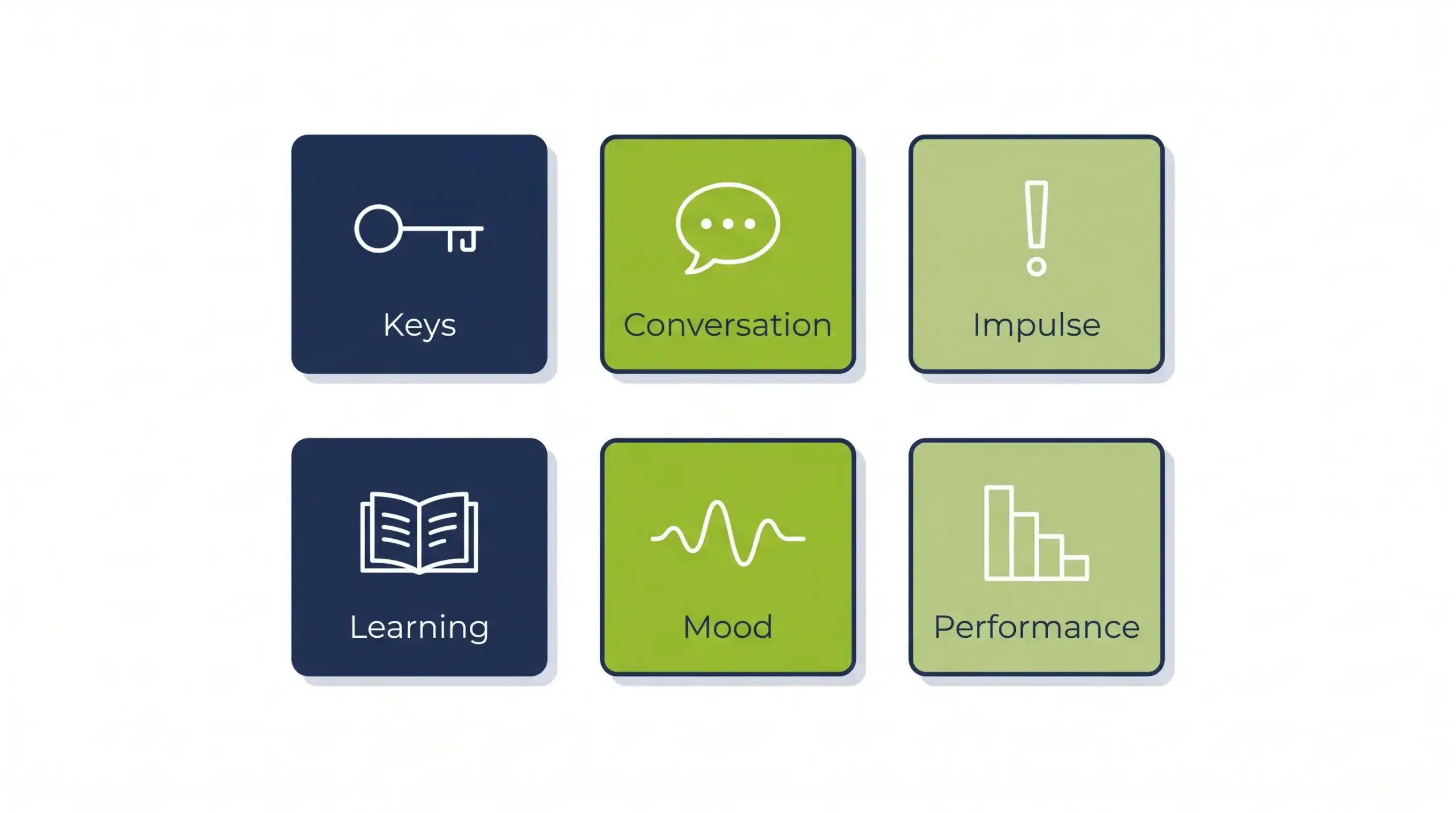
| Losing keys, phone, wallet with new frequency | Working memory and attention under strain |
| Losing the thread of ordinary conversations | Difficulty holding and updating information in real time |
| Decisions made on impulse, then regretted | Weakening of executive control |
| Struggling to learn something new at work | Impaired encoding of new material |
| Sharper mood swings, shorter fuse | Disrupted emotional regulation |
| Slipping performance at work or in study | Cumulative cognitive load |
One of these on its own means little. Several together, appearing over the same stretch of months, is a pattern worth an honest conversation.
How long the memory problems last once you stop
People want a number, and the truthful answer is a range. Some of the milder difficulties begin to lift within weeks of full abstinence, as the glutamate system settles and sleep and nutrition recover.
For heavy users it is slower. A one-year longitudinal study following people who used frequently found poorer spatial working memory and pattern recognition memory over time, with the frequent-use group faring worst. Recovery of memory function in these cases can stretch across many months, and some people benefit from dedicated cognitive rehabilitation rather than waiting for it to return on its own. The timeline is not fixed. It responds to what you do next.
What actually reverses, and what recovery asks of you
This is the part built to hold some hope, honestly held. The brain that stops absorbing a neurotoxin does not stay frozen. Plasticity is not a slogan, it is the mechanism by which function comes back.
What the return depends on is unglamorous. Complete and safe cessation first, because nothing else works while the drug is still in the system. Then the ordinary supports the brain uses to rebuild, proper nutrition, real sleep, physical movement, and psychological work that addresses why the drug was needed in the first place. Most people cannot assemble all of that alone, in the same environment where the using happened. This is where a residential recovery setting earns its place, in a contained space that feels nothing like a clinical facility, with round-the-clock support while the nervous system recalibrates.
The clip below is a short conversation with Yossi Zubari on personalised treatment, on-site clinical support, and the somatic therapies used to help the nervous system settle during recovery.
Ketamine, dissociation, and the trap of using it to outrun trauma
There is a reason ketamine appeals so strongly to people carrying trauma. Its signature effect is dissociation, the sense of leaving the body, of watching from a distance. For someone in unbearable emotional pain, that distance can feel like mercy.
The cruelty is in the loop it creates. Use the drug to escape the pain. The escape deepens the emotional numbing. The numbing removes the very capacity needed to process the trauma. The unprocessed pain grows louder, and the only thing that quiets it is more of the drug. This is not weakness. It is a mechanism, and it runs the same way in most people who fall into it. Grief and unmetabolised loss often sit underneath, which is why the work of facing loss in early adulthood so often has to be part of the recovery, not an afterthought to it.
Anxiety, depression, and paranoia in the long shadow of use
Repeated ketamine use changes brain chemistry in ways that reach beyond memory. The glutamate, dopamine, and serotonin systems that regulate mood do not stay untouched by chronic disruption.
What follows can be an emergence or a worsening of clinical depression, severe anxiety, and, in some people, paranoid thinking. Sometimes this shows up during active use. Often it is loudest during withdrawal, when the chemistry is trying to rebalance and doing so unevenly. People who came to the drug for relief from low mood can find themselves, months on, more anxious and more depressed than when they started. The drug did not deliver on its early promise. It reshaped the ground underneath it.
When use tips into psychosis and a longer break from reality
At high doses, ketamine can trigger a substance-induced psychosis. Delusions, hallucinations of sound or sight, acute confusion, a loss of contact with what is real. For most people this resolves. For those with an underlying genetic vulnerability, it can act as a trigger for something more lasting.
The neurochemistry gives a clue as to why. A study of chronic users linked glutamate and N-acetyl aspartate differences to psychotic symptoms, with heavy users showing more subthreshold psychotic experiences than matched controls. Active psychosis is not something to manage at home. It is a medical situation, and the person in it usually cannot judge that for themselves.
What counts as heavy use, and what raises the risk
There is no clean line, but the clinical literature gives shape to it. Heavy, chronic use generally means daily or several-times-weekly use, often at doses of a gram or more across a day, sustained over months. That is the pattern most consistently linked to structural and cognitive harm.
Several factors sharpen the risk beyond frequency alone. Combining ketamine with alcohol or sedatives. A history of head injury. Existing neurological conditions. Poor nutrition, which strips the brain of what it needs to repair. An epidemiological review of recreational ketamine toxicity traces how these patterns compound. It is rarely one thing. It is the stack.
Why being under 25 changes the calculation
The human brain is not finished at eighteen. It keeps developing into the mid-twenties, and the last region to mature is the prefrontal cortex, the seat of judgement, planning, and impulse control. This is the same territory ketamine appears to affect most in heavy users.
The National Institute of Mental Health describes how the teen and young-adult brain is still under construction. Introducing a drug that interferes with those exact pathways, during the years they are being wired, risks deficits that are more stubborn and harder to walk back. Younger use is not simply earlier use. It lands on a brain that is still deciding what it will become.
“Cognitive impairment” and “brain damage” are not the same words
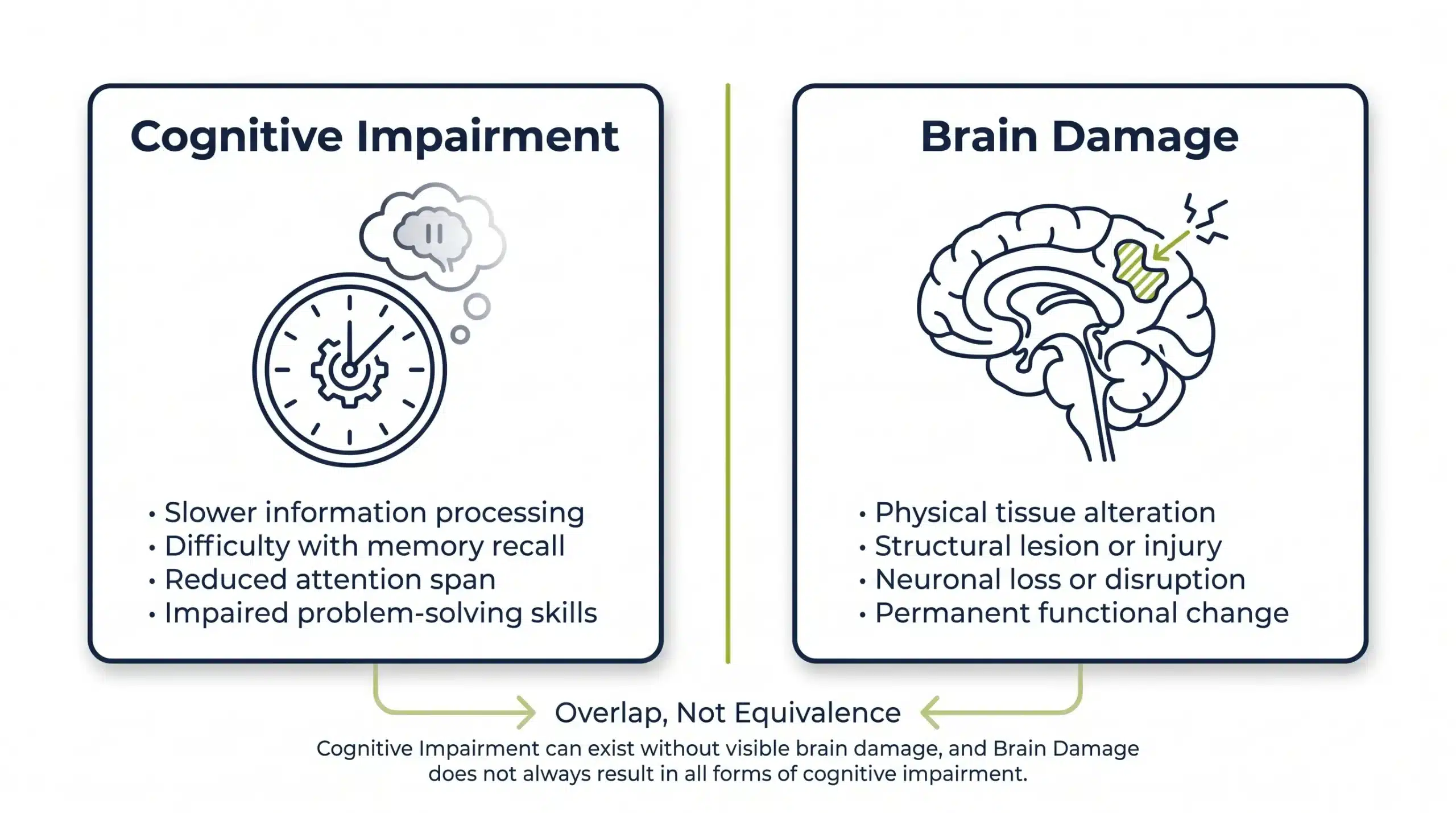
These two phrases get used interchangeably, and the confusion frightens people more than the facts warrant. It is worth separating them cleanly.
Cognitive impairment refers to how the brain is performing, slower thinking, trouble finding words, patchy recall. These are cognitive effects, and many of them shift with time and abstinence. Brain damage refers to physical, structural change in the tissue itself, some of which may persist. The two overlap but are not identical. A month of poor concentration is not proof of destroyed cells. When someone fears the worst about brain damage, part of the clinical task is simply to help them tell these two things apart, so the fear does not become its own obstacle to getting help.
The assessments worth considering
If the memory and concentration problems are real enough to worry about, they are real enough to measure. Guessing is the worst option, in either direction.
Clinical interview and use history
The first step is usually a conversation with a psychiatrist or addiction specialist about frequency, dose, combinations, and how the symptoms present. This is not paperwork. The history shapes everything that follows, and it often surfaces patterns the person had not connected.
Neuropsychological and cognitive testing
Formal neuropsychological assessment examines attention, learning and memory, executive function, and processing speed, mapping specific strengths and weaknesses rather than one crude score. Simpler cognitive testing can screen for problems and flag when a fuller evaluation is warranted. These tell you what is happening in practice, which is what recovery planning needs.
When brain imaging enters the picture
MRI or CT is not routine here. A neurologist tends to reach for imaging only when there are clear neurological signs or an extreme presentation that points to something structural needing to be ruled out.
When this becomes an emergency
Some situations do not wait. They need medical help the same day, not an appointment next month.
Call for urgent help for severe, unrelenting abdominal pain, sometimes called K-cramps. For blood in the urine or severe bladder pain, which can signal ketamine cystitis. For extreme confusion and disorientation, active psychosis, or acute suicidal thoughts. These are not signs to push through. They are the body and mind saying that the margin has run out.
How the rebuilding actually starts
The first and most important move to stop the damage is to stop the exposure, safely. That sentence is simple and the doing of it is not. Stopping ketamine after heavy use can bring deep depression, sharp anxiety, and a craving intense enough to undo good intentions on its own. Attempting it alone, in the same room where the using happened, is where many people come unstuck.
What changes the odds is a supported environment. A place where the physical clearing of the drug happens under care, and the emotional weather it stirs up is met by people rather than endured in private. The next step is a structured, monitored process of ketamine recovery that pairs medical care with psychological work, on a farm that feels nothing like a hospital, where the days have shape and the support does not clock off at five.
The brain that has been asking for the drug can learn, given time and the right conditions, to stop asking. That capacity was never lost. It has been waiting for the person to be met.
Speak with our clinical team, in confidence, about what recovery could look like.
This is a conversation, not a commitment. We will listen, ask honest questions, and explain what a structured recovery programme at Holina Village involves, if and when you are ready.
Frequently asked questions
Can the brain fully recover after long-term ketamine use?
Many functions do recover, particularly with sustained abstinence, nutrition, sleep, and structured psychological support. Some structural changes seen on imaging may not fully reverse, but they do not determine everything about how a person thinks and functions going forward. Recovery is gradual and individual, not instant.
How is ketamine memory loss different from ordinary forgetfulness?
Ordinary forgetfulness is inconsistent and usually tied to stress or fatigue. Ketamine-related memory difficulty tends to be persistent, affects recent events specifically, and often appears alongside other signs such as trouble concentrating or learning new tasks.
Is it dangerous to stop ketamine without medical support?
For heavy, long-term use, stopping can bring severe depression, anxiety, and intense cravings. It is safer and more sustainable to stop with medical and psychological support in place, rather than attempting it alone.
What is the first step if I am worried about someone else’s ketamine use?
A calm, honest conversation is usually the right starting point, followed by speaking with a clinician who understands ketamine use specifically. Acting from concern rather than crisis tends to lead to better outcomes for everyone involved.
Long-term ketamine use changes the brain in ways that are measurable, on scans and in daily life, through memory gaps, executive strain, and a fog that lingers past the high. None of that is the whole story. Plasticity means recovery is possible, and it responds directly to safe cessation, proper support, and time. If any of this has described your own experience, or someone you love, a confidential conversation with our team is a reasonable first step, with no pressure and no obligation attached.

About the Author
Yossi Zubari
CEO & Founder
Director and Senior Therapist working with addiction for over 25 years, and in personal recovery for almost 30 years.