The room is not particularly dark. The morning is not particularly demanding. There is coffee somewhere, an unopened message, a day that could begin. And yet the person sitting on the edge of the bed is already calculating how to get through the next few hours without the thing that makes the hours bearable. This is the part of ketamine use that rarely appears in the dramatic version of the story. There is often no collapse, no single ruinous night – instead, a slow narrowing, a life organised quietly around access to a substance whose entire promise is distance. If you have arrived here looking for someone in your family, or for yourself, you are probably not looking for drama. You are looking for plain information about what comes next.
Reading time: 8 minutes
Key points from this article
- Ketamine withdrawal is rarely a severe physical emergency, but the psychological risk – severe depression, anxiety, and suicidal thinking – can be serious and requires proper supervision.
- Detox clears the body; it does not address why someone started using. Without structured rehabilitation following detox, relapse is far more likely.
- Long-term ketamine use carries real physical consequences, particularly to the bladder and urinary tract, that can become irreversible if use continues.
- Trauma frequently underlies ketamine dependence. Treating the addiction without the underlying pain rarely produces lasting recovery.
Contents
- What ketamine detox is, and what it is not
- Is ketamine withdrawal dangerous
- The symptoms, divided honestly into body and mind
- How long does it take
- Can you do a ketamine detox at home
- What a supervised ketamine detox actually changes
- Are there medications for ketamine withdrawal
- Detox and rehab are not the same word
- What ketamine rehab is, in plain terms
- How to tell control from addiction
- Why it is so hard to stop without a fierce physical crash
- What long-term ketamine use does to the body
- Mixing ketamine with alcohol or sedatives
- Where trauma fits into all of this
- How families help without enabling
- Why some people recover better away from home
- What Holina Village offers, and what it costs
- The next step is smaller than it feels
What ketamine detox is, and what it is not
Ketamine is a dissociative anaesthetic. In medical settings it is used to separate a patient from pain and awareness, and that same separating quality is what makes it compelling outside of those settings. The drug interrupts the ordinary connection between a person and their own felt experience.
A ketamine detox is the period in which the body clears that substance and the nervous system begins, unsteadily, to function without it. It is not treatment for the reasons the person started using. It is not a cure, and any honest clinician will tell you that. It is the first and necessary stage – the part where the physical ground is made stable enough that the real work of recovery can stand on it. You can read the formal description of ketamine as a controlled dissociative agent in its prescribing and safety information.
Is ketamine withdrawal dangerous?
This is the question families ask first, and it deserves an honest, two-sided answer. Unlike alcohol or benzodiazepines, ketamine withdrawal does not usually produce a seizure or a directly life-threatening physical crisis. On that narrow point, the reassurance people offer is technically correct.
The danger sits elsewhere. When the dissociation lifts, what floods back is everything the dissociation was holding off. Severe anxiety. A depression that can feel bottomless. In some people, disordered thinking, paranoia, even episodes of psychosis. And with that, the real risk – active suicidal thinking in a person whose ordinary defences are gone. The physical detox is rarely the emergency. The psychological one can be.
When it becomes urgent
Certain signs mean this is no longer something to manage at home. Acute psychosis or a loss of contact with reality. Active suicidal thoughts, especially with a plan. An inability to communicate or be reached by the people in the room. Sudden, severe pain in the bladder, pelvis or lower back. The warning signs of a suicidal crisis, including hopelessness, withdrawal and unbearable pain, are described plainly by the National Institute of Mental Health guidance on suicide warning signs, and any of them is a reason to seek immediate help.
The symptoms, divided honestly into body and mind
People expect detox to be mostly physical. With ketamine it is mostly the reverse. The body has its complaints, but the mind does the heavy lifting.
On the physical side, disrupted sleep, tremor, a racing pulse, nausea, sweating, and abdominal pain are all common. These are uncomfortable and they pass. On the psychological side sits the real weight of it. An intense craving that arrives in waves. Mood that swings between agitation and flatness. A depression that researchers have specifically linked to the strength of that craving in patients going through inpatient ketamine withdrawal studies. Restlessness that won’t settle. A foggy, unreliable mind that struggles to hold a thought.
How long does it take?
Families want a date on the calendar. The honest answer is that there are two timelines, and confusing them is where a great deal of disappointment comes from.
The acute phase against the long tail
The acute phase usually occupies the first 24 to 72 hours. This is when craving and anxiety are at their loudest, when the person feels the absence most physically. It is intense and it is finite. The longer phase is the one nobody warns you about. Over the following weeks and into the months, mood keeps shifting, sleep stays unreliable, and certain triggers can reopen the whole thing without warning. This protracted stretch is precisely where relapse tends to happen, because by then the visible crisis has passed and everyone has assumed the danger is over.
Can you do a ketamine detox at home?
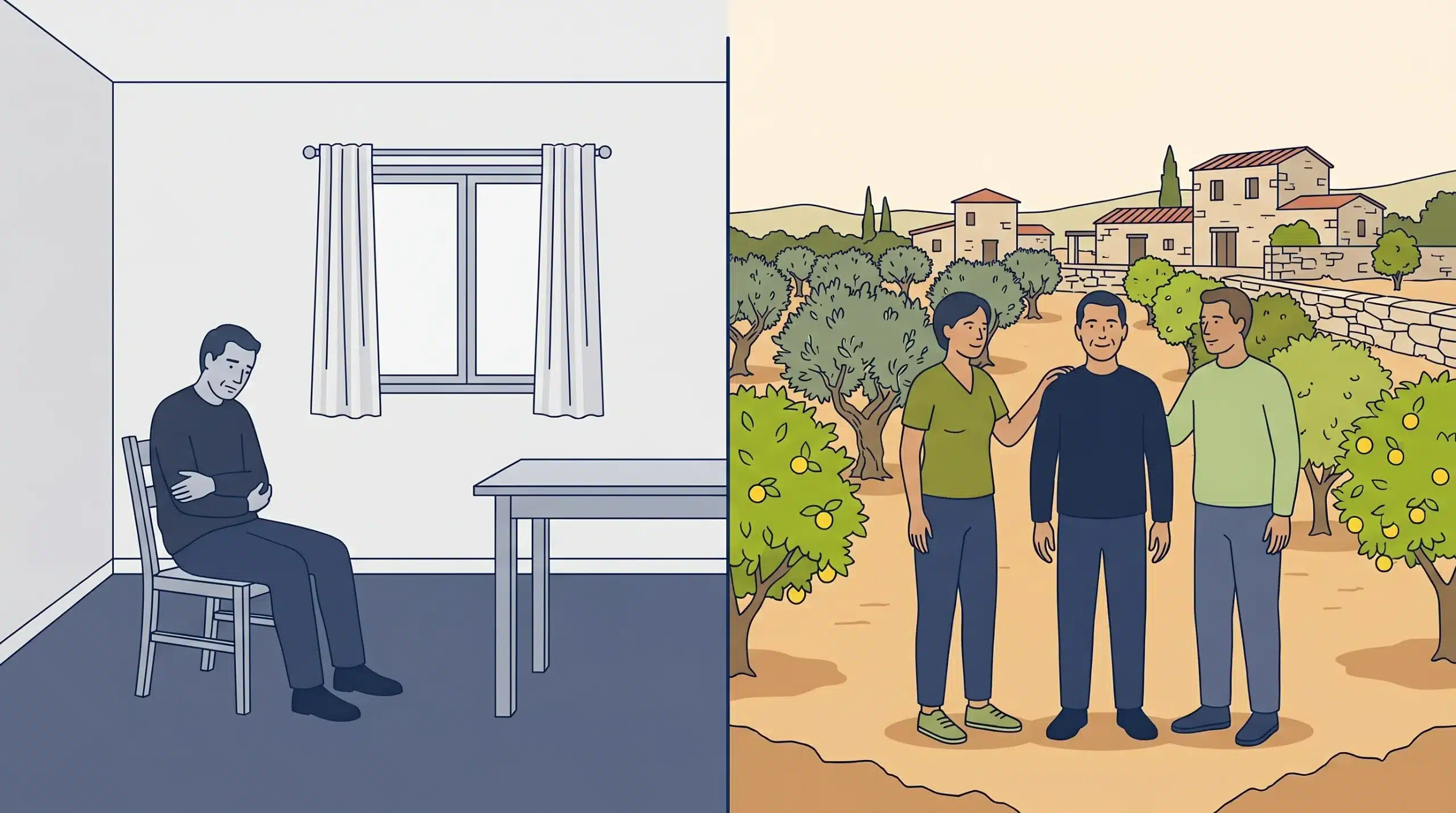
People try. It is the most natural thing in the world to want to handle this privately, quietly, without anyone knowing. And it fails far more often than it works, for reasons that have nothing to do with willpower.
At home, the substance is still reachable. When the craving peaks at hour forty, the only thing standing between the person and relief is their own depleted resolve – and depleted is the right word. There is no one to manage an anxiety spike that tips toward panic, no one watching for the slide into despair, no structure to a day that has lost all of its edges. The person who most needs holding is the person asked to hold themselves.
What a supervised ketamine detox actually changes
A supervised ketamine detox is not simply the same process in a different building. The supervision is the active ingredient. It removes the variable that sabotages home attempts – the moment of breaking – and it replaces solitude with a held container around the most disorienting days.
Residential, round-the-clock settings exist for exactly this reason, and clinical guidance on detox settings and levels of care describes why 24-hour staffing matters when withdrawal carries psychiatric risk. When the substance is genuinely unreachable and someone is awake and present at three in the morning, the calculation changes.
What supervision means in a therapeutic community
In practice it looks ordinary, which is the point. Staff present through the night. Monitoring of physical signs where the situation calls for it. Patient help rebuilding a sleep pattern that withdrawal has shredded. Calming techniques offered in the moment rather than recommended for later. And, almost immediately, other people. The relational substrate of a community – the felt sense of being among others who understand – does more for the acute days than most families expect.
Are there medications for ketamine withdrawal?
There is no pill that clears ketamine from the system or switches off the craving. Anyone offering one is selling something. A systematic review of the pharmacological management of ketamine use disorder found the evidence for any specific medication to be limited and low in quality.
What medicine can do is treat symptoms. A sleep aid for the worst of the insomnia. Something for acute anxiety, used carefully. Pain relief where it is needed. All of this under close medical supervision, and all of it with one rule held firmly – not to swap one dependence for another. The goal is comfort that does not build a new trap.
Detox and rehab are not the same word
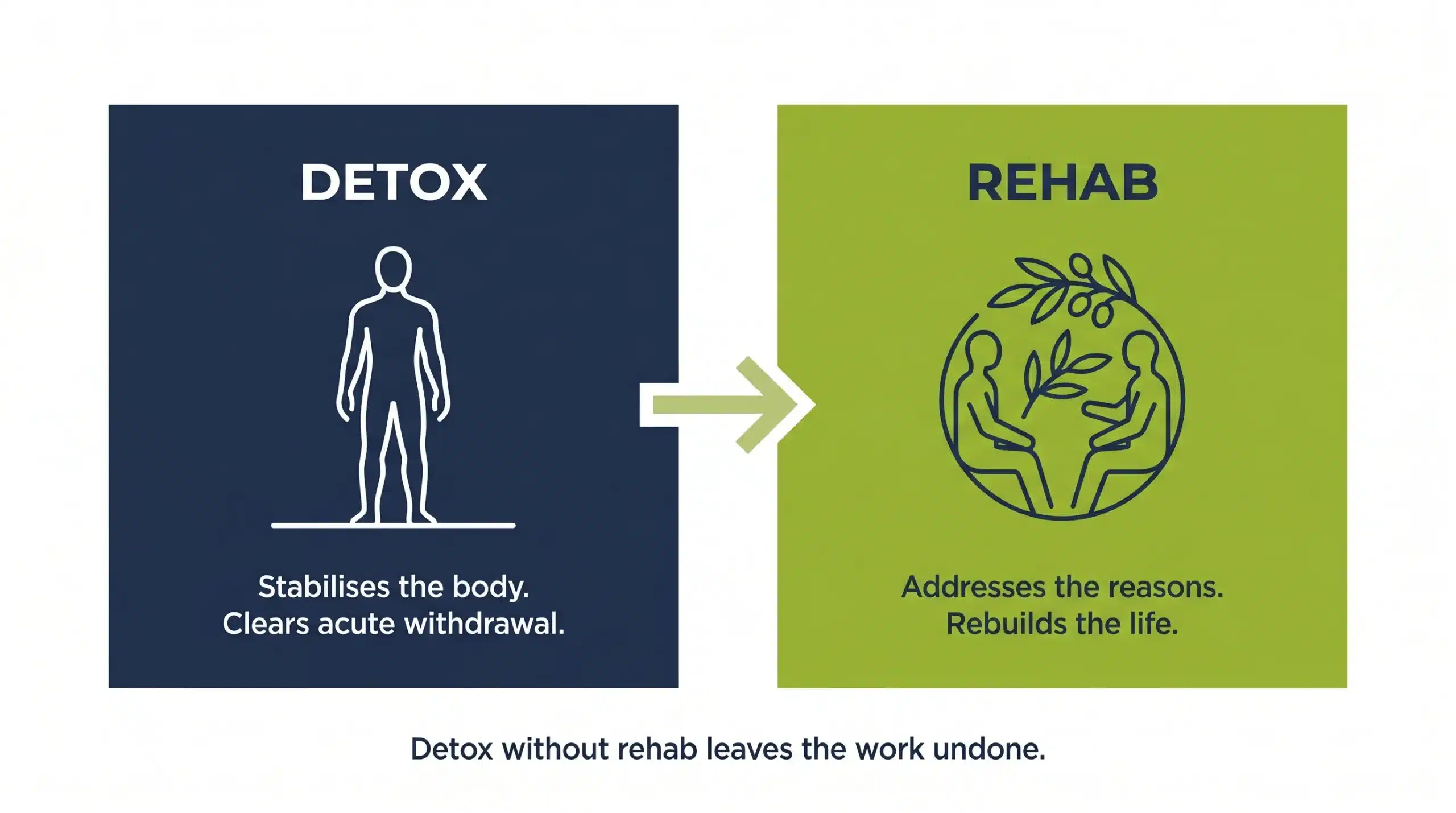
This distinction matters most to the family standing at the decision point, because the two are often sold as if they were interchangeable, and they are not.
Detox stabilises the body and carries the person through acute withdrawal. That is its whole job, and it is a real job. Rehab is what addresses why the using started – the patterns underneath it, the life that has to be rebuilt. Research on the principles of effective addiction treatment is blunt about this: detoxification on its own does not produce lasting change. A detox without what follows is a clean slate that nothing gets written on.
Not sure where to start?
A confidential conversation with our team costs nothing and commits you to nothing. We will listen, answer your questions honestly, and help you understand what the right next step looks like for your situation.
What ketamine rehab is, in plain terms
Rehab is where the person turns around and looks at the thing they were running from. With a dissociative drug this is especially direct, because the entire function of the substance was to not feel. Recovery asks for the opposite.
In our experience this is slower and quieter than people imagine. It happens in individual sessions and in groups, in the gradual relearning of how to sit with a feeling without escaping it. Our structured therapeutic programme builds these days deliberately, so that the work has a shape and the person has somewhere to put what surfaces.
What the therapeutic work tends to involve
Cognitive behavioural therapy to catch the thoughts that precede a craving. Group work, where being witnessed does something solitary effort cannot. Mindfulness skills for staying present when the old reflex is to leave. And, here, time spent on the land, with the animals and the open sky and the kind of physical challenge through adventure activity that returns a person to their own body. None of it feels like a clinical facility, and that is the design, not an accident.
How to tell control from addiction
The person using will almost always say they could stop. The honest test is not whether they could in theory. It is what is already happening.
Look for the functioning that has quietly eroded – work or relationships slipping. The dose that keeps climbing to reach the same place. The continued use despite physical harm the person can no longer deny. The need for it just to get through an ordinary day. The clinical criteria for a substance use disorder describe this shift formally, as impaired control, craving, and use that persists against clear consequences. When several of those are present, the word for it is no longer control.
Why it is so hard to stop without a fierce physical crash
This is the part that confuses families most. If there is no violent physical withdrawal, why can they not just stop? The answer is that the dependence was never mainly physical.
Ketamine disconnects a person from painful feeling, from intrusive memory, from a reality that presses too hard. While they use, all of that stays at a manageable distance. The moment they stop, it comes back – and it comes back at once and at full volume. The pull to use again is not weakness. It is the entirely understandable desire to return to the only quiet they had found. Understanding this is what separates real help from blame.
What long-term ketamine use does to the body
There is a physical truth to this drug that the early years of use conceal, and it is worth saying plainly because it changes how urgent recovery becomes.
Chronic ketamine use damages the urinary tract. The bladder shrinks and stiffens, the lining inflames, and the condition known as ketamine-induced cystitis can become severe and, in some cases, irreversible. A detailed review of these urologic effects documents bladder pain, drastically reduced capacity, and risk extending to the ureters and kidneys. This is not a rare edge case. It is one of the most common reasons heavy users finally seek help.
Signs that need a doctor now
Severe pain on passing urine. Needing to urinate constantly, every few minutes, with no relief. Sharp pain in the kidneys or lower back. Visible blood in the urine. Any of these warrants urgent medical assessment, not a wait-and-see. The cystitis can progress, and the single most important intervention is stopping the drug.
Mixing ketamine with alcohol or sedatives
One mistake carries a sharper risk than most people realise, and it deserves naming directly. Combining ketamine with alcohol or with sedative tablets is genuinely dangerous.
Each of these depresses the central nervous system, and stacked together they can suppress breathing, strain the heart, and shut down awareness faster than anyone expects. The danger is not only overdose in the abstract. It is losing consciousness in a way that leads to choking, to injury, to a body that stops protecting itself. This is one of the situations where saying less is wrong. Say it clearly – do not combine them.
Where trauma fits into all of this
Ask why someone reached for a drug whose whole purpose is disconnection, and you are usually asking about something older than the addiction.
The overlap between trauma and substance use is well established. People self-medicate to quiet a nervous system that learned, for good reason, to expect threat. The relationship between PTSD and substance use is documented closely enough that treating one without the other rarely holds. This is why a detox followed by nothing tends to unravel. If the original pain is left untouched, the reason to numb it is still standing there, waiting. Trauma-informed care is not a feature to advertise. It is the difference between recovery that lasts and recovery that does not.
How families help without enabling
This is the hardest line for the people who love someone in this. The instinct to protect is exactly the instinct that, followed too far, keeps the addiction comfortable.
Enabling is rescuing the person from the consequences of their use, again and again, so that the cost of using never quite lands. Real support looks different. It means clear, kept boundaries. It means understanding the mechanism of the illness rather than reading it as choice. And it means steadily, warmly pointing toward professional help while refusing to be the buffer that makes the using sustainable. You can love someone fully and still stop softening their fall.
Why some people recover better away from home

There is a practical argument for distance, and it is not about escape. It is about the simple fact that the environment a person uses in is full of cues that pull them back.
The same streets, the same friends who use, the same pressures that built up over years. Stepping out of all of that, even for a stretch of weeks, gives the nervous system a chance it does not get at home. For families in Israel, Cyprus offers something unusually workable – a flight of under an hour, full discretion, and a quiet that home cannot provide. Close enough to feel reachable. Far enough to break the pattern.
What Holina Village offers, and what it costs
In the rural, quiet, supervised setting of Holina Village in Cyprus, the detox and the recovery that follows happen inside a held container, with close professional oversight and a trauma-informed community alongside you at every step. The farm, the orchards, the animals and the open sky are not decoration. They are part of how the place feels nothing like a clinic, which is most of why people stay long enough for the work to take hold.
Admissions are deliberately calm, because most families reach us in the middle of a crisis and the last thing they need is pressure. Pricing is all-inclusive, so what you read is what it is.
The only extra is personal spending money. Everything that matters to the recovery is already inside the fee.
The next step is smaller than it feels
If you have read this far, you already know more than you wanted to about where this goes. You know the detox is the beginning and not the end. You know the danger is mostly in the mind, and mostly in being alone with it.
The first move is not a commitment to twelve weeks or a confession to the whole family. It is one honest conversation with someone who has sat with this many times before. If you want to start there, you can reach our admissions team at Holina Village, and the only thing asked of you on that call is the willingness to be met.
Frequently asked questions
How long does ketamine stay in the system?
Ketamine itself clears the bloodstream within a few hours, but its metabolites can remain detectable in urine for several days. More important than clearance time is the psychological timeline that follows – the acute withdrawal phase runs roughly 24 to 72 hours, with a much longer stabilisation period extending over weeks for regular or heavy users.
Can a GP supervise a ketamine detox?
A GP can provide general medical support and refer onward, but they are not able to provide the 24-hour psychiatric monitoring that ketamine withdrawal can require. The real risk in this detox is psychological – severe depression, suicidal thinking, or acute anxiety – and managing those safely requires round-the-clock clinical presence that outpatient settings cannot offer.
Is ketamine addiction as serious as heroin or alcohol addiction?
Comparisons between substances can be misleading and sometimes lead families to underestimate what is in front of them. Ketamine dependence carries its own serious risks – severe psychological disturbance during withdrawal, permanent physical damage to the bladder with continued use, and a relapse rate that is high without structured aftercare. Seriousness is not about which drug it is. It is about what it is doing to the person’s life and health.
How do I get someone to accept help when they deny they have a problem?
Denial is a feature of how the illness works, not a personality trait. Forcing the issue rarely helps and sometimes hardens the resistance. What tends to work is steady, honest communication that names the observable effects without accusation, clear limits held consistently rather than threatened and abandoned, and a warm but firm pointing toward the idea that help exists. Timing matters too – people are often most open to hearing about treatment in the immediate aftermath of a consequence they cannot explain away. Families at this stage often benefit from speaking with a clinician themselves before attempting a formal conversation.
What happens if the bladder damage is already severe?
Stopping use is the most important thing a person can do, and early enough it allows the bladder to recover substantially. Once the damage has progressed, recovery of function is less predictable – some people see significant improvement after stopping, others require ongoing urological treatment. In advanced cases, surgical intervention may be necessary. This is why the physical symptoms described earlier in this article should never be dismissed as something to monitor later.
Ketamine detox is the necessary beginning – not the whole of it. The physical clearing happens in days, but the recovery underneath it is a quieter, longer process that asks for structure, skilled support, and the company of people who understand what this actually takes. Done in the right setting, with the trauma work and the daily therapeutic rhythm that follows, it is a process that holds together. Attempted in isolation, it usually does not.
If this article has brought you closer to a conversation you have been putting off, our team at Holina Village is available for a confidential call – no pressure, no obligation, just an honest conversation about where things stand and what would help.
Ready to have an honest conversation?
Speak with someone who has seen this many times before. Confidential, unhurried, and at no cost to you. You are not committing to anything by reaching out.
About the Author

Yossi Zubari
CEO & Founder
Director and Senior Therapist working with addiction for over 25 years, and in personal recovery for almost 30 years.