The diary still fills up. The meetings happen, the emails get answered, the children get collected. From the outside, very little looks wrong. That is part of what makes it so hard to name. A great many people who arrive at the question of private alcohol rehab are not falling apart in any way a colleague would notice. They are functioning, often impressively, while something underneath has quietly become non-negotiable. The bottle that started as a way to unwind has become the thing the day is organised around. And the more capable the person, the longer this can go on, because competence hides a great deal.
Reading time: 8 minutes
Key Points
- Private alcohol rehab combines medically supervised detox with structured psychological and behavioural work – detox alone is a starting point, not a resolution.
- Residential treatment removes a person from the daily environment that sustains the drinking, giving the nervous system genuine room to settle and change to begin.
- Co-occurring mental health conditions – anxiety, depression, trauma – are present in close to half of people with alcohol use disorder, and need to be treated at the same time.
- Aftercare planning and an honest relationship with relapse are what carry gains forward once the structure of the centre falls away.
Table of Contents
- What private alcohol rehab is, and who keeps ending up here
- Why people step past public and community services
- Residential alcohol rehab and the thing that distance does
- A private clinic versus a general detox unit
- How to tell whether you need medical detox first
- Detox and residential rehab are not the same word
- How long is enough
- A day inside, hour by hour
- What if there is anxiety, depression, or trauma underneath
- Dual diagnosis, and why it should shape where you go
- Can it really stay private
- Does a private room actually matter
- Why some people choose to do this abroad
- What it costs, and what moves the number
- What the family is for, and what it is not
- After the centre, where recovery is really tested
What private alcohol rehab is, and who keeps ending up here
Private alcohol rehab is a residential treatment setting where a person lives at the centre for the duration of their care, away from the pressures and the supply lines of ordinary life, with clinical support available around the clock. That is the plain version.
The people who choose it tend to share a particular bind. They have a great deal to protect – a reputation, a company, a board seat, a family that depends on their steadiness. Exposure feels almost as frightening as the drinking itself. A private setting answers that fear directly, with discretion built into how it works rather than promised on a brochure.
It is not a luxury holiday with therapy attached. It is structured clinical care matched to one person’s physical state and emotional history. The National Institute on Alcohol Abuse and Alcoholism’s overview of alcohol use disorder and recovery is consistent on this point. Treatment tailored to severity, co-occurring conditions, and individual circumstance does meaningfully better than a single template applied to everyone.
Why people step past public and community services
Community and public addiction services do real, serious work, and for many people they are the right door. This is not an argument against them.
It is an honest account of where they reach a limit for a certain kind of patient. Waiting lists can run for weeks when the window of willingness is open for days. Groups are large. Medical and psychiatric oversight, when it exists, is rarely close or continuous. For someone holding a high-functioning life together by a thread, a six-week wait is not a delay. It is often the difference between getting in and talking themselves out of it.
A private residential setting removes the queue and the paperwork. Admission can be quick and quiet. The ratio of staff to residents is high, and the range of approaches available is wider. The NIAAA’s guidance on finding and choosing alcohol treatment is worth reading carefully before any decision. Speed of access is a real clinical variable, not a sales point.
Residential alcohol rehab and the thing that distance does
Consider what an ordinary Tuesday evening contains for someone trying to stop. The cupboard. The off-licence two streets over. The friend who always suggests one more. The argument that reliably ends in a drink.
Residential alcohol rehab means living inside the treatment centre for the whole of the programme, which does something outpatient care cannot. It takes the person out of that Tuesday entirely. Every trigger that has been wired into the daily routine is, for a while, simply not present. In our experience the first thing many residents report is not insight. It is sleep. The nervous system, finally out of range of the next decision about whether to drink, begins to settle.
That round-the-clock support also matters in the early days, when the body is loudest and the resolve is thinnest. The held container of the residential setting carries the person through the hours when they could not yet carry themselves.
A private clinic versus a general detox unit
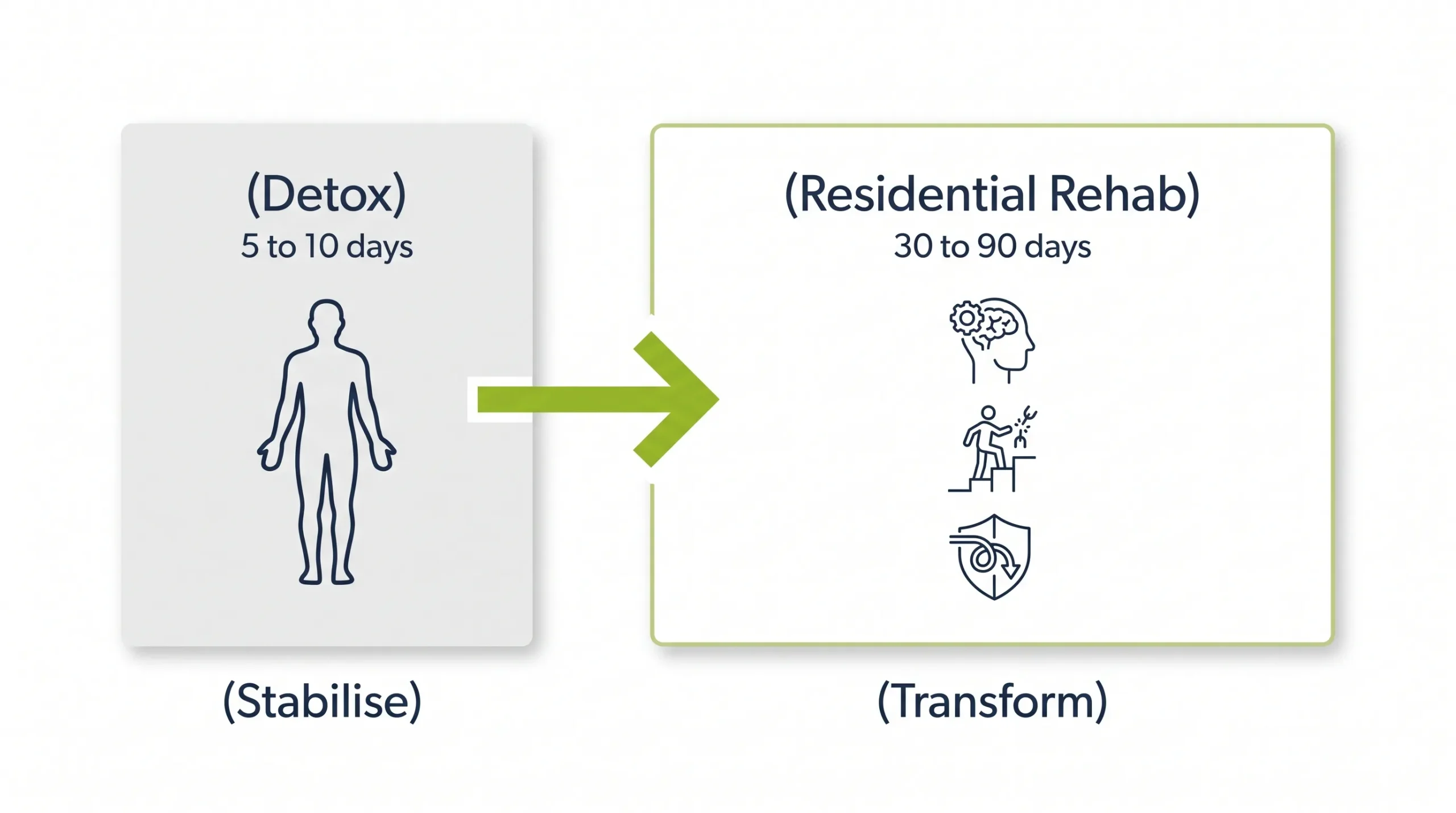
These are often spoken of as the same thing. They are not.
A general detox unit exists mainly to make the body physically safe as alcohol leaves it. That is necessary work, and sometimes it is all a place does. A private alcohol rehab clinic treats the drinking and the emotional weather underneath it at the same time, with a multidisciplinary team rather than a single shift of nurses.
The difference shows up in what the day contains. Alongside medical care there is psychological work, attention to nutrition, and physical activity that helps the brain and body recover from sustained alcohol use. The drinking is treated as a symptom of something, not as the whole story. Stabilise the body without touching the rest, and you have a sober person with every original reason to drink still intact.
| Setting | Primary aim | Typical length | What it does not do on its own |
|---|---|---|---|
| Detox unit | Physical stabilisation as alcohol clears | 5-10 days | Address triggers, trauma, or relapse risk |
| Private residential clinic | Stabilisation plus behavioural and psychological change | 30-90 days | Replace the need for long-term outside support |
How to tell whether you need medical detox first
This is the part that frightens people most, and the fear is not irrational. For some drinkers, stopping suddenly without supervision is genuinely dangerous.
The body that has adapted to a daily, heavy intake can react badly when it is taken away abruptly. Withdrawal can bring seizures, severe agitation, tremor, and in the most serious cases a medical emergency. This is precisely why it should not be attempted alone. The American Society of Addiction Medicine’s clinical guideline on alcohol withdrawal management sets out how this is done safely – under medical observation, with medication used to ease the worst of it and to prevent the dangerous turns.
A proper admission assessment establishes early whether medically supervised detox is needed before the rest of the work begins. For many people it is. For some it is not. That judgement belongs to a clinician, not a guess.
Detox and residential rehab are not the same word
People use these interchangeably and then feel cheated when one does not deliver what the other promised.
Detox is the short opening act, usually somewhere between five and ten days. Its single job is to clear the body of alcohol and get the person physically stable. That is all it claims to do. Residential rehab is the long middle, where the actual change happens – behavioural patterns, the processing of old injuries, the slow building of a different response to stress.
The evidence here is unambiguous and worth holding onto. Detox without ongoing psychological and social treatment almost always ends in a quick return to drinking. The National Institute on Drug Abuse’s account of treatment and recovery describes detox as a starting point and nothing more. A clean body with no new skills is a relapse waiting for a reason.
How long is enough
The common programme lengths are thirty, sixty, and ninety days. The honest answer to “which one” is that it depends, and any clinician who gives you a flat number before assessing you is selling something.
Depth of dependence matters. So does the state of someone’s mental health, and what they have already tried. A four-week stay gives the nervous system room to recalibrate and gets the person out of immediate danger. Sixty to ninety days lets the new patterns hold long enough to survive contact with real life again. The brain recovers on its own timeline, not on a billing cycle, and the research on treatment outcomes consistently links longer engagement with better odds of lasting change.
Not sure which programme length is right?
A confidential conversation with our clinical team takes no more than twenty minutes and carries no obligation. We can help you understand what level of care fits the situation.
A day inside, hour by hour
Structure is not decoration here. It is one of the active ingredients.
Drinking erodes the shape of a day until there is no shape left, only the next drink and the gap before it. A treatment day rebuilds that shape deliberately, dividing the hours between therapy, rest, physical activity and personal reflection. The rhythm itself begins to teach the body that days can be predictable and survivable without alcohol holding them together.
Individual therapy, group work, and relapse prevention
One-to-one sessions with qualified psychotherapists are where the quiet, root-level work happens. The aim is not to lecture someone about drinking. It is to find the emotional source the drinking was answering – the thing that made it feel necessary.
Group work surprises people who arrived guarding their privacy. Small groups led by experienced clinicians create a room where the usual judgement is absent, and the isolation that runs through this illness starts to loosen. Hearing another person describe your private experience out loud does something no individual session quite can.
Relapse prevention is practical rather than abstract. Through cognitive behavioural methods, residents learn to spot the states that precede a craving, to handle anger and pressure, to meet the ordinary temptations of a normal week with a plan rather than a reflex. Our structured residential programme brings these modalities together in a sequence shaped around each person’s needs.
What if there is anxiety, depression, or trauma underneath
Very often there is. The drinking and the suffering it medicates arrived together, and pretending otherwise sets the whole thing up to fail.
A great many people drink to quiet severe anxiety, to climb out from under a clinical depression, to numb the residue of trauma. Treat only the drinking and leave the fear or the despair untouched, and you have removed the person’s coping mechanism without replacing what it was for. The relapse, when it comes, is almost predictable. This is why integrated care matters. The emotional disorder and the physical dependence are addressed in the same place, by the same team, at the same time.
Dual diagnosis, and why it should shape where you go
Dual diagnosis simply means a mental health condition and a substance problem present at once, in the same person. It is not unusual. It is closer to the norm.
Research consistently shows that close to half of people struggling with alcohol carry at least one accompanying psychiatric condition. That number should change how you choose a centre. A place equipped only for the drinking will keep sending people home with the engine of the problem still running. Reaching the emotional root requires a setting that treats the whole person – and for those navigating grief or loss alongside dependency, the connection between the two is often central to recovery, something we explore in the context of grief in early adulthood and what it means for lasting recovery.
Can it really stay private
This is the question that keeps capable people drinking for years. The fear of being found out.
Good private clinics treat confidentiality as a clinical obligation, not a courtesy. Records are held to strict information-security protocols. Medical information is not passed to any outside party – not an employer, not an insurer, not a colleague – without the patient’s own written and informed consent. Discretion is woven through admission, treatment, and discharge. For someone whose livelihood genuinely depends on this not becoming public, that is not a luxury feature. It is the thing that makes asking for help possible at all.
Does a private room actually matter
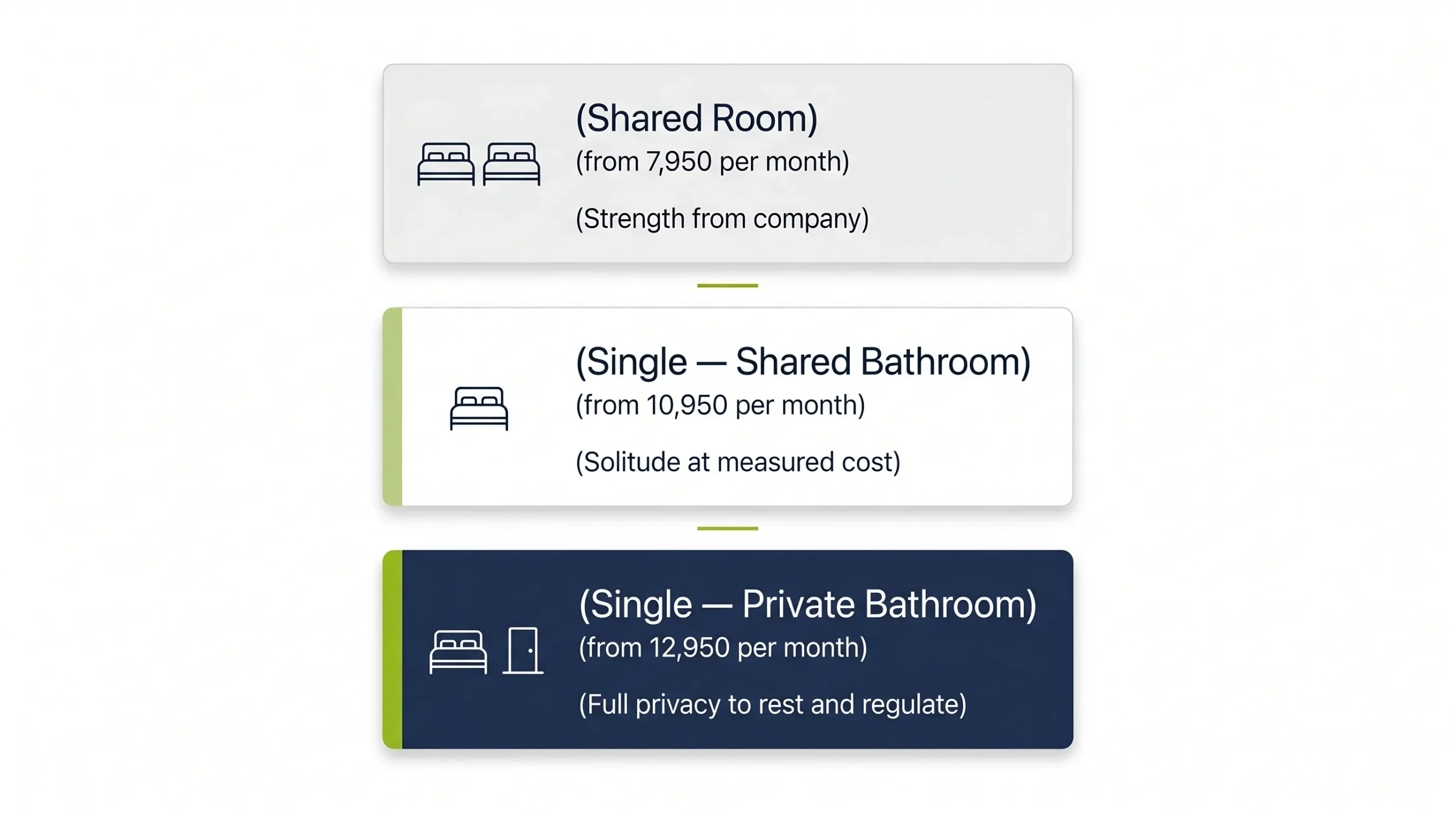
It matters more in the first fortnight than at any other time, and for a specific reason.
The early weeks of physical withdrawal are loud inside the body. Sleep is fragile, emotions arrive without warning, and the work of regulating them is exhausting. A private room offers a place to be quiet, to come apart and reassemble without an audience, to actually sleep. A shared room builds connection and is right for some people. But in those first raw days, having somewhere to retreat is not indulgence. It is part of how the nervous system settles.
| Room tier | From (per month, all-inclusive) | Suits |
|---|---|---|
| Shared room | €7,950 | Those who draw strength from company |
| Single, shared bathroom | €10,950 | Those wanting solitude at a measured cost |
| Single, private bathroom | €12,950 | Those who need full privacy to regulate and rest |
Each tier is all-inclusive. Accommodation, meals, clinical and group sessions, farm and adventure activities, and airport transfers are covered. Personal spending money is the only extra.
Why some people choose to do this abroad
There is a clinical logic to leaving the country, not only a romantic one.
Recovery undertaken abroad puts real distance between the person and the entire scaffolding of their drinking life – the places, the people, the routines that quietly pulled them back. Beyond the geography there is a psychological effect that residents describe again and again. Arriving somewhere quiet and anonymous lets them begin from a genuinely clean page, without the weight of every familiar face that knew the old version of them.
The questions to ask, and the warnings to heed
Before committing, ask who provides the clinical care and what their qualifications are. Ask how the centre assesses you and tailors the programme. Ask how it handles co-occurring mental health conditions, what its relapse-prevention plan looks like, and exactly what the fee covers. The CDC’s guidance on seeking medical care abroad and what to verify before you go is worth reviewing before any decision involving travel.
Some answers should make you walk away. A promise of complete, guaranteed success is not confidence – it is a falsehood, because any honest clinician will tell you no such guarantee exists. The same applies to the absence of permanent medical staff, or any difficulty producing official licensing documents when asked plainly.
What it costs, and what moves the number
The price of private alcohol rehab varies, and the variation is not arbitrary.
It tracks the ratio of clinicians to residents, the depth of the psychological programme, the standard of accommodation and food, and whether doctors and psychiatrists are actually present on site rather than on call. The differences between programmes are real. Ask for a full, itemised breakdown of what is and is not included before any stay begins. A centre that hesitates to give you one has told you something important.
What the family is for, and what it is not
There is a thin and important line between supporting someone and quietly keeping the drinking possible.
The second is called enabling, and it is rarely cruel. It usually looks like love that has run out of other options. Bringing the family into the treatment itself – through family sessions and guided support – helps redraw that line. It builds steadier ground for the person to come home to, so that re-entry lands in a household that has changed alongside them rather than one waiting unchanged for the old pattern to resume.
After the centre, where recovery is really tested
The real work starts on the day the structure falls away and ordinary life returns. This is the part nobody photographs.
A detailed aftercare plan is what carries the gains forward. Continued contact with therapists. A connection to support groups. A clear map of the first vulnerable weeks at home. And an honest understanding of relapse, because a slip is not the end of recovery. It is information. It signals that the plan needs adjusting, not that the person has failed. Treating it as a verdict is how people abandon recovery entirely. Treating it as data is how they continue. The outdoor and activity-based elements of treatment – including work through our adventure challenge programme – build exactly the kind of resilience and self-trust that the post-treatment period demands.
Frequently Asked Questions
How quickly can someone be admitted to Holina Village Cyprus?
Admission can be arranged within a very short window once an initial assessment is complete. The first step is a confidential call with our team, which takes around twenty minutes and carries no obligation. From there, we move as quickly as the situation calls for.
Is Holina Village able to treat someone with both alcohol dependency and a mental health condition?
Yes. The programme is built around integrated care, meaning the dependency and any co-occurring condition – whether that is anxiety, depression, PTSD, or another diagnosis – are addressed together rather than sequentially. Treating one without the other rarely produces lasting change.
What happens if someone relapses after leaving?
A relapse is treated as clinical information, not a failure. It tells us that the aftercare plan needs adjusting or that further support is needed in a specific area. Our team remains in contact with residents after discharge, and the pathway back into support is always clear and available.
Will my employer or insurance company find out I have been in treatment?
No information is shared with any outside party – including employers, insurers, or family members – without the resident’s own written and informed consent. Confidentiality is a clinical obligation at Holina Village, not simply a policy statement.
Can a family member call on behalf of someone who has not yet agreed to go?
Yes. Many initial conversations are with a partner, parent, or sibling who is trying to understand the options before the person in question is ready to speak for themselves. We can help you think through how best to approach the conversation and what care might look like, without any pressure on anyone at that stage.
Is medical detox available on site, or would that happen elsewhere first?
Whether medically supervised detox is needed, and how it is managed, is established during the pre-admission assessment. Our clinical team works with each person’s specific situation rather than applying a fixed protocol. That assessment conversation is the right place to discuss this in detail.
Private alcohol rehab works when it does one thing well – it treats the whole person, not just the drinking. That means combining medically sound detox with serious psychological work, addressing the co-occurring conditions that almost always sit underneath the dependency, and building a clear plan for the period after the centre. The setting, the discretion, and the quality of clinical relationships all shape how possible that work feels.
If you or someone close to you is at the point of asking the question, that is already something. The team at Holina Village is available for a confidential conversation – no pressure, no obligation, just an honest exchange about what the situation involves and what care might look like.
Ready to take the first step?
Speak with our clinical team at Holina Village Cyprus. The conversation is confidential, takes no more than twenty minutes, and places no obligation on you or your family to proceed.
About the Author

Yossi Zubari
CEO & Founder
Director and Senior Therapist working with addiction for over 25 years, and in personal recovery for almost 30 years.