The kitchen light has been on since four in the morning. Someone is sitting at the table with a glass of water they have not drunk, waiting for a body to stop shaking in the next room. If you have arrived here in something like that state, this article is written for you. It covers how medical drug detox works at a physiological level, where the genuine dangers lie, and what supervised residential care adds that attempting this alone cannot replicate. Not reassurance for its own sake. The mechanics, plainly stated.
Reading time: 5 minutes
Key Points
- Medical detox addresses the physiological process of clearing a substance from the body – it is not treatment itself, but the necessary precondition for it to begin.
- Alcohol and benzodiazepine withdrawal carry a genuine risk of seizures and delirium without clinical supervision; round-the-clock monitoring exists because some complications are not foreseeable hours in advance.
- Residential care removes proximity to the substance at precisely the moment a person cannot remove it themselves – this single factor changes outcomes more than motivation alone.
- Detox ends the acute phase of physical dependence. What follows it – therapeutic work, relational repair, structured aftercare – determines whether that ending holds.
What drug detox is, and what is happening underneath it
Detox is not the treatment. It is the part that comes before treatment can begin.
The word refers to the physiological process of clearing a substance from the body and reaching a stable physical baseline. That is its whole job. Prolonged use of alcohol, opioids, benzodiazepines, or stimulants reshapes the brain’s chemistry. The nervous system adapts to the substance being present and recalibrates around it. When the substance is suddenly removed, those adapted systems are left firing into empty space. That mismatch is what withdrawal is.
Stabilisation is the quieter work that follows. Restoring sleep. Replacing fluids lost to sweating and nausea. Getting food in. Meeting the first waves of craving without drama. The symptoms here are not a sign that something has gone wrong. They are the body trying to find its footing again. The published clinical literature on detoxification and substance abuse treatment protocols is consistent on one point: detox is a doorway, not a destination.
Why attempting it alone at home is the mistake families keep repeating
The most common story we hear is not a first attempt. It is a fourth or fifth one. Each time at home. Each time with the belief that willpower, a locked door, and a long weekend should be enough.
Supervised detox means a trained team is present and watching, around the clock, while the body destabilises and re-stabilises. This matters for a reason that has nothing to do with comfort. Some withdrawals are genuinely dangerous. Severe alcohol and benzodiazepine withdrawal can produce seizures and delirium. The clinical reviews of withdrawal syndromes across substance classes are unambiguous that these can be life-threatening without proper monitoring.
There is a second, less obvious danger. At home, the substance is roughly twenty minutes away. In the worst hour of withdrawal, that proximity is what ends most attempts. A supervised setting removes the option at exactly the moment the person cannot remove it themselves. That single fact moves the odds more than any pep talk.
What the word “medical” adds at the clinical level
A question worth asking directly: what does “medical” actually buy you?
Medical drug detox means an active clinical envelope sits around the process. Vital signs checked on a schedule. Blood pressure, pulse, and temperature tracked across the day rather than glanced at once. Neurological and functional checks repeated as the picture changes. And, where indicated, prescription medication used to ease physical symptoms and hold the person safe.
The aim is narrow and honest. Short-term support and stabilisation. Not the construction of a new dependence to replace the old one. Any honest clinician will tell you that the goal of medication in detox is to make itself unnecessary as quickly as the person’s physiology allows.
Supervised versus medical – a distinction worth getting right
People use these two terms as if they were interchangeable. They overlap, but they are not identical.
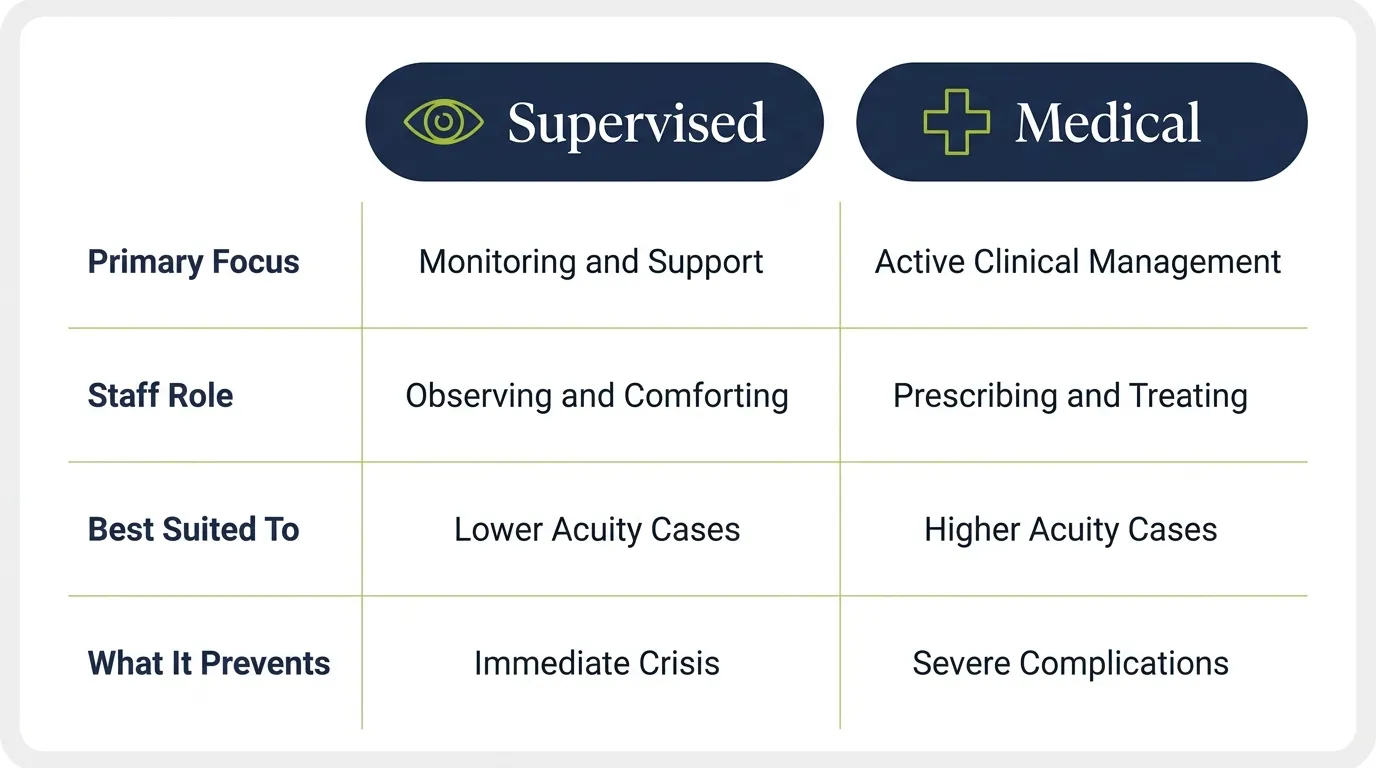
| Element | Supervised Detox | Medical Detox |
|---|---|---|
| Primary focus | Monitoring, emotional support, removal of access | Active clinical management of acute symptoms |
| Staff role | Observation and reassurance, round-the-clock presence | Doctors and nurses able to prescribe and adjust medication |
| Best suited to | Lower-risk withdrawals, strong support need | Alcohol, benzodiazepine, complex or high-risk withdrawals |
| What it prevents | Relapse in the worst hour, isolation | Seizures, delirium, dangerous vital-sign swings |
In practice, good programmes do not force a choice. They begin with the medical assessment, then provide the level of support the person’s history and physical state actually call for. Most people need both, weighted differently across the same stay.
The residential question – why the room you wake up in matters
Residential detox means the whole process happens inside a place you live in for the duration. You are not commuting to appointments and returning each evening to the same flat where the worst nights happened.
The clinical value of that is separation. Distance from daily triggers, familiar routes, and relationships organised around use. The frameworks covering settings and levels of care in withdrawal management identify residential care as the appropriate fit when the home environment is unstable or when previous attempts have failed there.
Why the physical setting changes the odds
Withdrawal raises stress and anxiety on its own. The environment can either feed that baseline tension or settle it. At Holina Village, the setting is a working farm in Achnas, with orchards, animals, and open sky. Green space, privacy, and a contained quiet are not decoration. They lower the level of stimulation a nervous system is already fighting, and allow the person to spend their attention on recovering rather than on bracing for what comes next.
Wondering if residential detox is the right level of care?
A quiet, confidential conversation with our team costs nothing and commits you to nothing. We can talk through what you are facing and what the options actually look like.
How long detox takes, and what stretches it
The honest range for the acute phase is a few days to approximately two weeks. But that average hides a great deal.
What lengthens it is, first, the substance itself. Opioids, benzodiazepines, and stimulants follow meaningfully different timelines. Then the duration of use, the doses involved, and the person’s general physical health. There is also a second, longer tail. After the acute phase settles, some people experience a post-acute period where sleep, mood, and concentration remain unsettled for weeks. Anyone who promises you a fixed number of days is guessing, or selling. An individualised assessment is the only honest basis for a timeline.
The first day
Most people arrive frightened, and most of that fear is uncertainty. So here is the shape of it.
The first day is mainly assessment. A clinical and medical intake. Vital signs taken. An honest conversation about substance history, physical health, and what previous attempts looked like. From that, a plan is built for this particular body, not a template applied to everyone who walks through the door. Then the settling-in period. Meeting the team, learning the rhythm of the day, beginning whatever physical or medication support the assessment has indicated. We treat the first day as relational, not just procedural, because that contact is often what determines whether someone stays.
Common symptoms, and the ones that mean call someone now
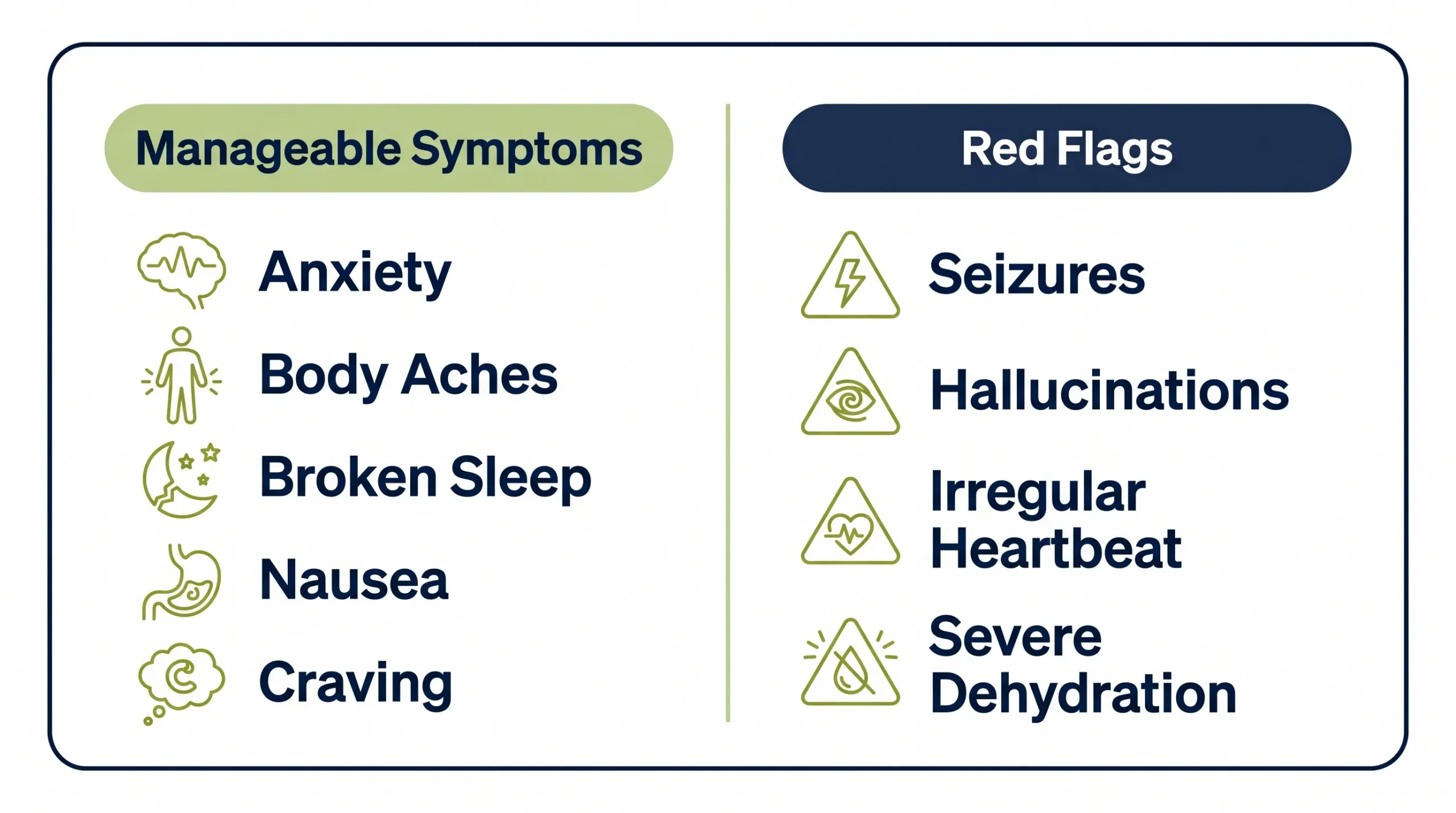
Most withdrawal symptoms are unpleasant rather than dangerous. Anxiety. Body aches and sensitivity. Broken sleep. Nausea. A fine tremor. Strong craving. These are met with support, fluids, rest, and medication where it genuinely helps.
Then there are the red flags. Withdrawal seizures. Strong hallucinations. An irregular heartbeat. Severe dehydration from repeated vomiting. These require urgent medical intervention, and they are the precise reason supervision exists. A trained team reads the early signs before they become emergencies. The point of having people present overnight is not that the worst will happen. It is that if it begins to, the gap between noticing and acting is measured in minutes, not hours.
Whether medication is always required
No. This surprises people who assume medical detox means a drip and a handful of pills from day one.
Medication is a clinical decision, not a default. For some withdrawals it is a safety requirement. Supervised alcohol withdrawal, in particular, often needs it to prevent seizures and delirium. For others, careful monitoring and supportive care are entirely sufficient. The professional approach uses the smallest effective dose, with a clear tapering plan written from the start. Be alert, also, to anything marketed as a fast or total cure for dependence. Products in this category keep appearing and keep harming people – the FTC’s guidance on common health scams targeting people in recovery exists for exactly this reason.
Who residential detox is actually for
Not everyone needs a residential setting. But certain situations point clearly toward one.
People whose home detox attempts have already failed, more than once. People using more than one substance at the same time. People carrying a mental health condition alongside the addiction, where the two feed each other and need to be held together rather than treated in isolation. And people whose home environment is unstable, tense, or where the substance is easily accessible. If you are weighing a comprehensive, individually built option, it is worth reading what a full residential recovery programme includes – because the structure built around detox often matters more than the detox itself.
Detox and rehab are not the same thing
This confusion costs families more than almost any other misunderstanding in this field, so it is worth being direct.
Detox answers one question: how do you stop using safely. That is all it does. Rehabilitation answers a different and much larger one: how do you build a life in which you do not need to start again. Behavioural change, processing what sits underneath the use, learning the skills that relapse exploits. Physical detox without what follows it leads to high rates of relapse. Clearing someone’s system and then sending them home is, in our clinical experience, the surest route back to the same situation in three months.
What follows detox, and why it decides the outcome
The day the acute symptoms ease is not the finish line. It is the moment the real work becomes possible.
A continuum of care should be built before detox even ends. Group work. Individual sessions using evidence-based modalities such as CBT, DBT, and Motivational Interviewing. Family involvement, because the people around a person are part of what recovers or fails to. Aftercare planning for re-entry into ordinary life, which is where most relapses actually happen. A therapeutic community supplies something a clinic cannot: a relational substrate, a group of peers living the same work at the same time. That shared ground becomes the anchor when motivation thins, which it always eventually does.
At Holina, adventure activities and the farm environment are built into the programme alongside clinical work – not as recreation, but as structured engagement with the physical world that supports confidence, regulation, and the slow recovery of agency. You can read more about how we integrate those elements within our adventure and challenge-based activities.
What residential detox costs at Holina, and what is inside it
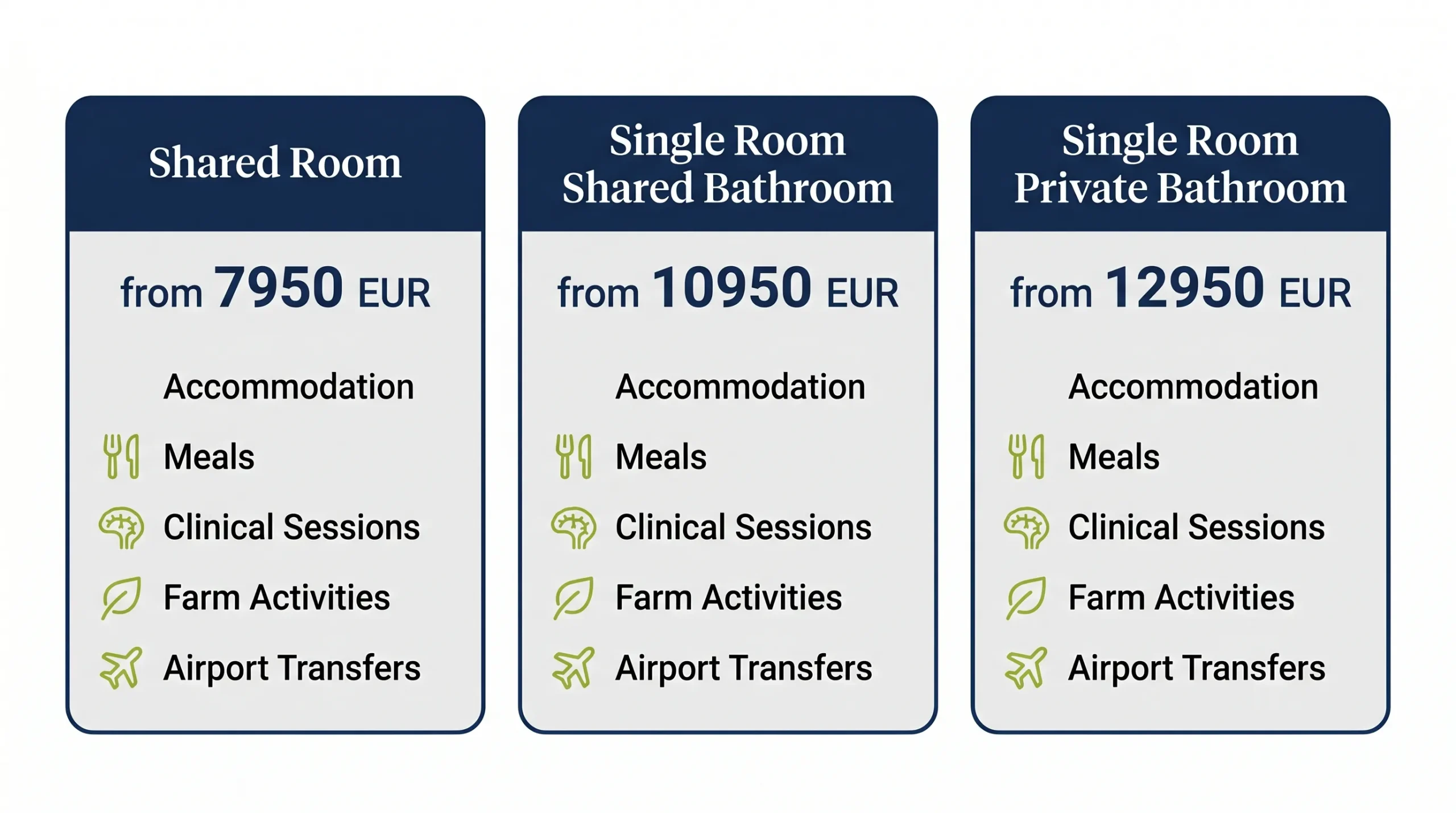
Cost varies with accommodation type, the staffing a person’s needs require, and the length of stay. We keep pricing transparent.
| Room Type | From (per month) | What is included |
|---|---|---|
| Shared Room | €7,950 | All-inclusive: accommodation, meals, clinical and group sessions, adventure and farm activities, airport transfers |
| Single Room, Shared Bathroom | €10,950 | As above, with private sleeping space |
| Single Room, Private Bathroom | €12,950 | As above, with full privacy |
Personal spending money is the only thing not covered. The plainer financial truth beneath the table is this: getting comprehensive, safe, properly supervised care once is, over time, far less costly than a series of failed home attempts that each end where they started.
What to ask before committing to any programme
You are allowed to interview a programme. You should.
Ask the ratio of staff to residents. Ask about the clinical training of the people who will actually be in the room overnight. Ask directly how medical emergencies are handled, and who is present at three in the morning. Ask what happens after detox ends, because the answer tells you whether they understand the difference between stopping and recovering. A programme that has no clear answer to that last question is telling you something important.
Holina Village operates to international standards of safety and discretion on a quiet, secluded campus in Cyprus. Detox is held inside a longer programme rather than offered as a standalone fix. The people who deliver that programme are not anonymous – you can meet them before you decide. Our clinical and care team is visible because we think transparency is part of trust.
Frequently Asked Questions
Medical detox is the physiological starting point: clearing the body, stabilising the nervous system, and creating the physical conditions in which the real work of recovery can begin. Done in a supervised residential setting, with clinical oversight and a team that is present when the night gets difficult, it is meaningfully safer and more likely to hold than an attempt made alone. But it is only one part of what needs to happen.
If you are thinking about this for yourself or someone close to you, the most useful next step is a conversation with someone who can assess the actual situation – no commitment, no pressure, just clarity. You are welcome to reach our team for a private, unhurried conversation. That is where it starts.
Ready to talk through what comes next?
No obligation. No pressure. An honest, confidential conversation about your situation and the options available – that is all the first step has to be.
About the Author
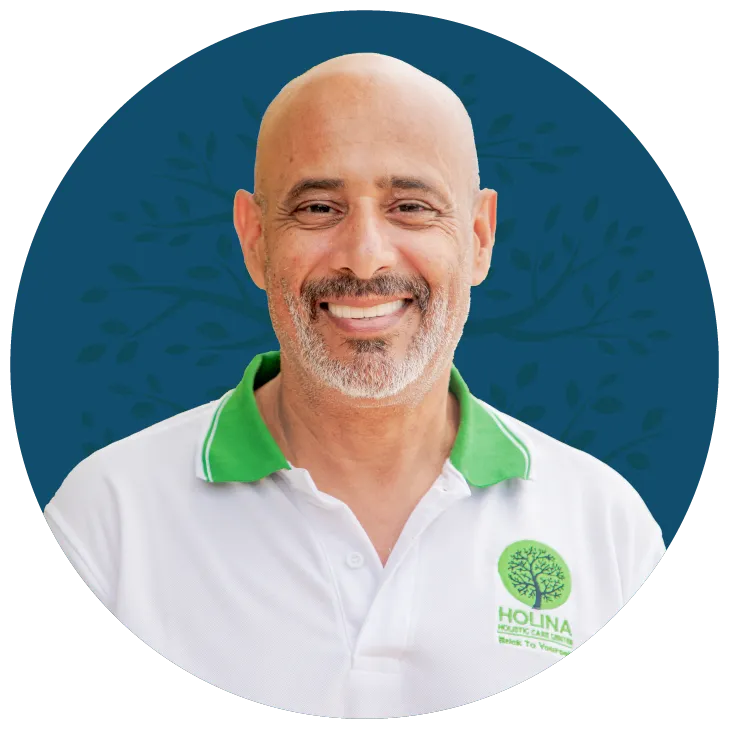
Yossi Zubari
CEO & Founder
Director and Senior Therapist working with addiction for over 25 years, and in personal recovery for almost 30 years.
“`