
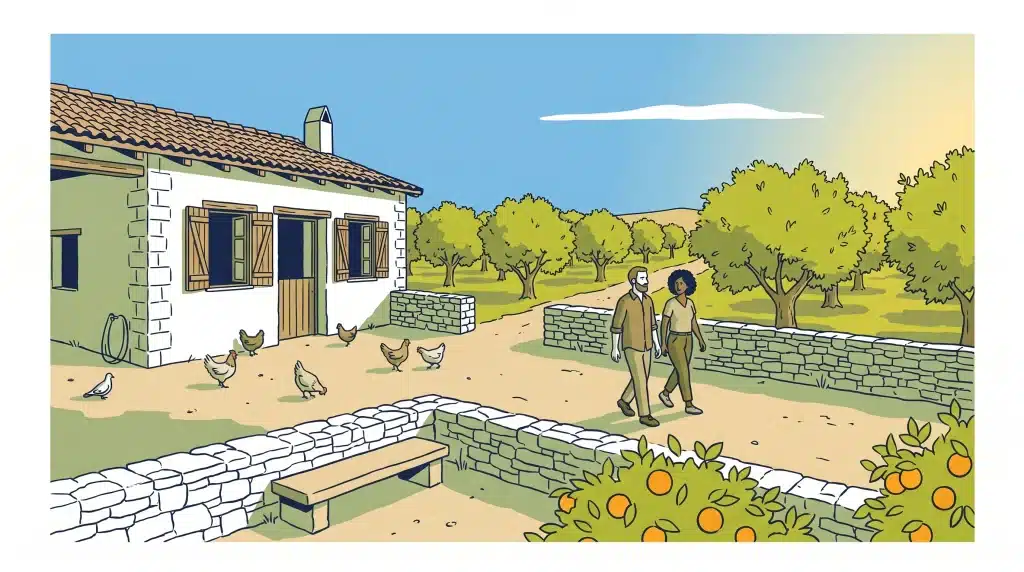
Marcus sits in the bright Cypriot morning, the limestone walls of his family home gleaming white around him. He is twenty-two. Six months ago he completed his final university exams; three months ago he moved back to his parents’ house. The structure that held him—deadlines, lectures, the implicit permission to be unfinished—has evaporated. His mother has begun leaving pamphlets about “getting a job” on his desk. His father asks him twice a week when he will “sort himself out.” Marcus recognises that something is wrong. He has trouble sleeping. He moves through afternoons in a fog. He has looked up therapists in Nicosia but the waiting lists are twelve weeks long, and the private fees are beyond what he can justify to himself. He is too old for his parents’ insurance, too young for most occupational health schemes, too functional to warrant crisis intervention. He exists in a peculiar silence, neither adolescent nor adult, neither acutely unwell nor visibly struggling enough to access help.
Marcus is one of millions occupying what researchers and clinicians are beginning to recognise as the eighteen to twenty-five gap: a developmental period of profound transition during which mental health difficulties emerge or intensify, yet conventional support structures systematically fail to meet these individuals where they are. The conditions that arise in this window—depression, anxiety disorders, emerging personality patterns, substance use, identity-related distress—are frequently dismissed as either “adolescent turbulence” or “young adult adjustment,” a semantic blur that renders them invisible to services designed for either younger or older populations. This piece is for individuals between eighteen and twenty-five who recognise that something is not right, and for families watching a son, daughter, or partner drift into isolation during what should be a vital period of psychological development.
What This Is, Specifically
The eighteen to twenty-five period is increasingly understood as a distinct developmental stage rather than a simple extension of adolescence. The Lancet and major psychiatric epidemiological studies have documented that the incidence of first-episode mental illness peaks in the late teens and early twenties. This age group experiences particularly high rates of major depressive disorder, anxiety disorders, and emerging personality difficulties, yet faces a paradoxical service gap.
The World Health Organization acknowledges that young adults aged eighteen to twenty-five occupy a liminal space within healthcare systems. They have typically exited child and adolescent mental health services (CAMHS equivalent services vary by country, but typically serve up to age eighteen or nineteen), yet have not fully integrated into adult services, which often prioritise acute or chronic conditions. The transition itself, known as “transition readiness” in clinical literature, is frequently poor or completely absent.
What distinguishes this cohort is not merely the conditions they experience, but the convergence of factors: neurobiological development continues (particularly prefrontal maturation), identity formation remains fluid, social and educational transitions compress multiple stressors simultaneously, and institutional support evaporates. Unlike older adults, their difficulties are often normalised (“everyone struggles at university”; “it’s just a phase”). Unlike younger adolescents, they are presumed to have developed adequate coping mechanisms.
Why Standard Treatment Often Misses This
Conventional mental health architecture fails this group through a combination of bureaucratic discontinuity and clinical underestimation. When an eighteen-year-old transitions from adolescent to adult services, handover is frequently incomplete or absent altogether. Research published by the National Institute for Health and Care Excellence has highlighted gaps in transition planning for young people with mental health conditions, noting that the period between seventeen and twenty-five is associated with disengagement and deterioration when systematic transition support is absent.
Second, this age group often does not fit the diagnostic or functional thresholds that trigger intervention. A young person experiencing emerging depression or anxiety may still attend university or hold a job. They may not be expressing active self-harm or suicidal ideation. By conventional severity metrics, they appear “sub-threshold” or “not unwell enough.” This threshold blindness means that what are actually significant difficulties go unrecognised until they intensify into acute illness.
Third, the presenting problems are frequently misattributed. A young person withdrawing from social life is told they are “introverted.” Sleep disturbance is framed as “poor sleep hygiene” rather than a symptom of underlying mood disorder. Performance decline at university is blamed on “lack of motivation” rather than recognised as a behavioural consequence of depression or anxiety. The language of normalcy masks genuine psychopathology. Additionally, many eighteen to twenty-five-year-olds have limited insight into their own mental health needs. They have not yet developed the vocabulary or self-awareness to articulate distress in ways that conventional services recognise.
The Neurobiology of This Particular Moment
Understanding why this age group is uniquely vulnerable requires attention to ongoing neurobiological development. The prefrontal cortex, responsible for decision-making, impulse control, and future planning, is not fully mature until the mid-twenties. This is not deficit but rather a developmental reality that means young people in this window have greater neuroplasticity, greater capacity for change, but also greater vulnerability to disruption.
Simultaneously, this period coincides with the delayed onset of conditions such as schizophrenia spectrum disorders, personality pathology, and bipolar disorder. Research consistently shows that the peak age of onset for major depression is the late teens to early twenties. The convergence of neurobiological vulnerability, emerging psychiatric illness, and social transition creates a window of both risk and considerable opportunity for intervention. Early intervention in psychosis (EIP) services have demonstrated significant benefit precisely because they identify and treat first-episode psychosis in the eighteen to twenty-five range, when brain plasticity remains high.
What is less well developed across most health systems is equivalent early intervention for the entire spectrum of mental health difficulties in this age group, not merely psychotic disorders. A young person experiencing emerging depression or anxiety in their early twenties has significant potential for recovery and skill development if supported appropriately, yet most standard services do not offer structured, developmentally informed intervention at this stage.
What a Residential Period Provides
A residential programme designed specifically for this population offers something that outpatient care cannot replicate: continuity of containment, peer community, and intensive developmental work conducted within a holding environment. Rather than attending weekly therapy whilst remaining embedded in the systems and relationships that may be sustaining difficulty, a person enters a structured community where their entire living context becomes part of the therapeutic intervention.
This is not crisis care or acute psychiatric treatment. It is rather a period during which psychological work, social reconnection, skill development, and stabilisation can occur without the constant pull of fragmented living. The therapeutic community at Holina Village offers precisely this: a setting where eighteen to twenty-five-year-olds can address underlying difficulties, develop genuine peer relationships with others navigating similar transitions, and establish the foundations for sustainable recovery. The Mediterranean setting itself offers a further container: distance from the systems and relationships that may be maintaining difficulty, combined with the psychological and neurobiological benefits of natural environment, routine, and community.
For those who recognise the gap, who sense that something requires attention but find themselves untouched by conventional services, a residential period represents a genuine alternative. It is an investment in this particular moment, when intervention is most likely to be transformative.
If you or someone you know falls into this gap, explore what our programme offers.