The test is booked for Tuesday. It is now Saturday night, and someone in the house is doing arithmetic that no one talks about out loud. Counting backwards. Counting forwards. Trying to work out whether Thursday counts, whether the amount was small enough, whether the body has had time.
If you have arrived at this page in that state, or you are a parent who found this search open on a screen that wasn’t yours, take a slower breath. The question underneath the question is rarely just chemistry. But the chemistry is real, and you deserve a straight answer. This article walks through what actually happens to ketamine in the body, how long different tests can detect it, and what the timeline does and does not tell a worried family.
Reading time: 7 minutes
Key points
- The psychoactive effect of ketamine fades within one to two hours, but detectable by-products remain far longer.
- Urine testing typically detects ketamine for two to four days after occasional use, and up to two weeks or more after chronic heavy use.
- A short half-life does not mean low risk. Dependence can build quickly regardless of how fast the drug clears the blood.
- Home remedies such as excess water or saunas do not speed clearance and can flag a sample as diluted, which raises suspicion rather than lowering it.
Table of contents
- How long does ketamine stay in your system
- Feeling clear headed versus testing clean
- Ketamine’s half-life explained
- Detection windows by test type
- Norketamine and why it extends detection
- Workplace drug testing
- What a hair test can and cannot tell you
- Single use versus chronic use
- What changes clearance speed
- The water myth
- Exercise, saunas, and detox claims
- Home testing reliability
- False positives
- When worry turns into a bigger pattern
How long does ketamine stay in your system?
The short version: the feeling leaves fast, the traces do not. The psychoactive experience of ketamine fades within an hour or two. What stays behind is a different story, because the body breaks the drug down into by-products that a targeted test can find for far longer.
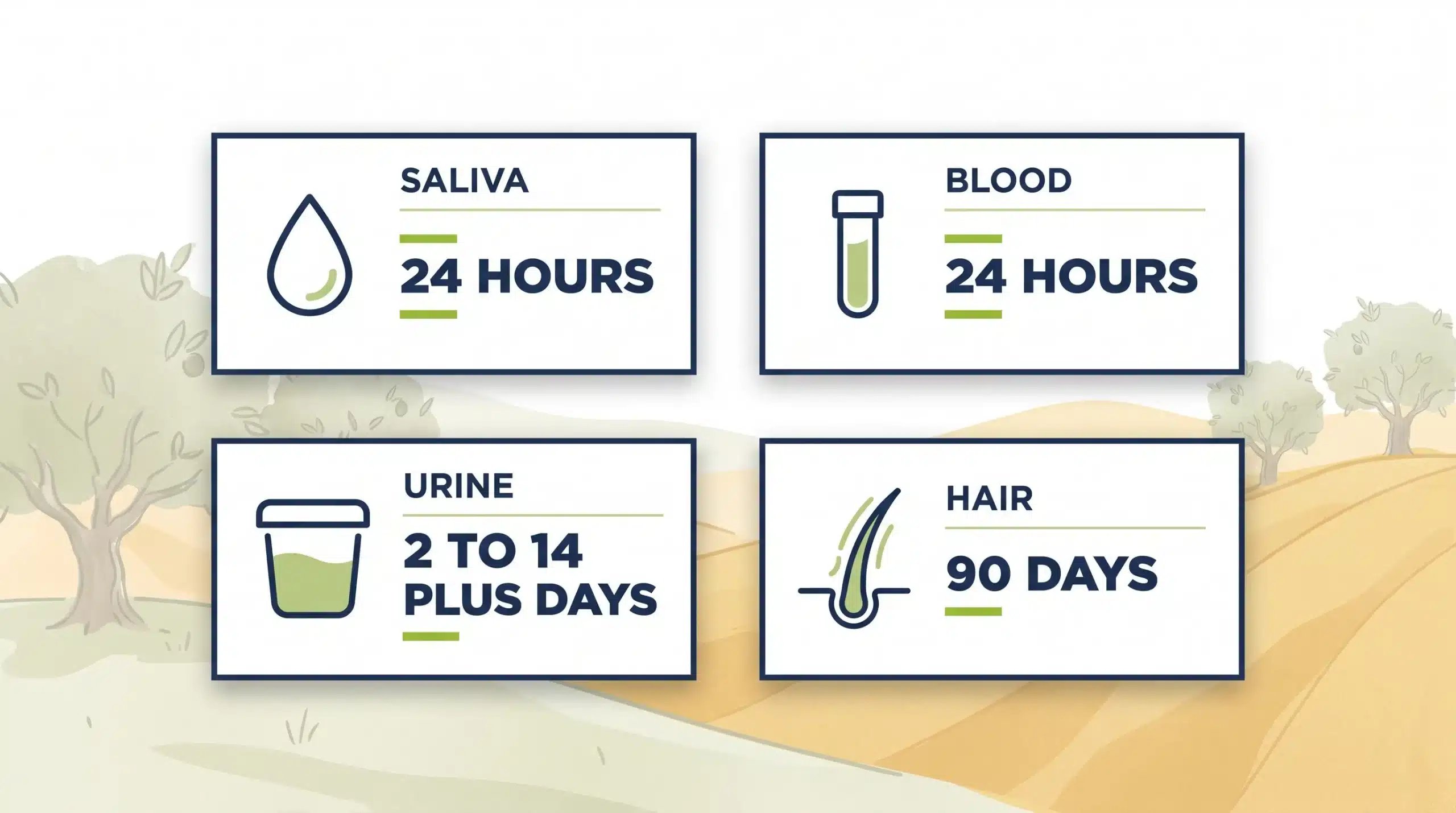
There is no single number that answers how long ketamine stays in your system, and anyone who gives you a flat figure is guessing. A single recreational dose clears differently than months of heavy use. As a rough map, blood and saliva hold traces for roughly a day, urine for a few days up to two weeks or more with chronic use, and hair for up to about ninety days. The clinical detail of how ketamine moves through the body is well documented in the StatPearls pharmacology overview of ketamine.
“How long it affects me” and “how long it shows up” are not the same question
People collapse these two into one and then panic. They are separate.
The subjective effect, the dissociation, the cognitive fog some users call the “k-hole”, usually runs its course inside sixty to a hundred and twenty minutes. That is the part the person feels. It is also the part they use to reassure themselves.
Imagine a nineteen-year-old who used at a party on Friday. By Sunday afternoon he feels completely clear-headed, sharp, back to himself. He genuinely is. And yet active metabolites are still sitting in his system, invisible to him, entirely visible to a lab. Feeling fine and testing clean are two different clocks, and they do not run at the same speed, a distinction covered in the clinical review of ketamine toxicity.
What is ketamine’s half-life, in plain terms?
Half-life is simply the time it takes for the amount of a drug in your blood to fall by half. It is a decay curve, not an on-off switch.
Ketamine’s own half-life is fairly short. In the main elimination phase it sits at roughly two to three hours. That sounds reassuring, and it partly explains why the high fades so quickly. But half-life describes the parent drug in the bloodstream, not the by-products in urine, and not the psychological pull that forms around repeated use.
That pull matters more than the pharmacology here. The short half-life is exactly why some people convince themselves the drug is harmless. It leaves the blood fast, so it must be leaving the person fast. Dependence does not read the same textbook. Psychological and physical reliance can build quickly, and people caught in that cycle can find real, structured help through a dedicated residential treatment programme in Cyprus.
Why you see different half-life numbers everywhere
Because the route changes everything. Injected, snorted, or swallowed, each is absorbed and broken down at a different pace, so the figures shift. Then there is the person. Liver and kidney function vary from body to body, and those two organs decide how fast the drug is metabolised and cleared. Two people, same dose, same night, can carry very different numbers by morning.
How long ketamine stays in urine
This is the question most families actually mean. For typical, occasional use, urine detection usually falls between two and four days. For someone using heavily and regularly, it can stretch past two weeks.
Knowing this window is not the same as knowing your child. A parent who understands the timeline is less likely to be reassured by a clean Wednesday test when use happened the weekend before, and less likely to spiral over a positive that reflects an old, single incident. The number gives you context, not a verdict.
Saliva
Up to around 24 hours
Very recent use, within hours
Blood
Up to around 24 hours
Recent use, fast and clinical
Urine
2 to 4 days typical, 14 or more with heavy use
The most common screen
Hair
Up to around 90 days
A history of use, not one moment
Norketamine, the by-product that lengthens the whole timeline
Here is the part most articles skip. The liver breaks ketamine down into a metabolite called norketamine, and norketamine is the reason detection windows are longer than the two-to-three-hour half-life would suggest.
Norketamine hangs around considerably longer, with a half-life often cited near twelve hours or more. That is why laboratories frequently look for it rather than for ketamine itself. The parent drug has largely gone; the metabolite is still there, quietly extending the window, a conversion described in the clinical literature on ketamine metabolism. In practice it means the body’s own filing system keeps a record longer than the person expects.
Does ketamine show up on a standard workplace drug test?
Usually, no. A standard workplace panel, the common five-substance screen, does not include ketamine by default. Someone worried about a routine test at work is often worried about the wrong thing.
That said, it is testable. In cases of specific suspicion, in safety-sensitive roles such as driving or security, or on expanded ten and twelve substance panels, a lab can be asked to look for ketamine directly. The structure of federally regulated workplace testing and which specimen types are authorised is set out in the SAMHSA workplace drug testing FAQs. The point is that ketamine is not routine, but it is never impossible to find when someone is actually looking for it.
Why a hair test does not mean someone was high that day
A hair result is a diary, not a snapshot. Substances lock into the hair follicle only after the hair grows out, so a positive hair test speaks to patterns of use across recent months.
It cannot tell you what happened this morning. It cannot tell you someone was impaired at the moment the sample was cut. What it can tell you is that use has been part of the picture over a stretch of time, which is a very different, and often more useful, piece of information for a family trying to understand whether they are dealing with one bad decision or an ongoing habit.
After a single use versus after heavy use
For a one-off, occasional dose, taken once at a party and not repeated, the urine window is usually short. Twenty-four to seventy-two hours at most. The kidneys clear the metabolites, nothing has accumulated in tissue, and the record fades quickly.
Chronic use is a different picture. Ketamine is partly fat-soluble, so with heavy, daily use it and its by-products accumulate in tissue and release slowly, stretching the urine window to fourteen days and sometimes beyond. When the timeline behaves like that, the conversation is no longer about a test. It is about dependence that has taken hold and needs proper clinical attention.
What actually changes how fast your body clears it
The variation between people is not random. It tracks a handful of things.
Individual metabolic rate sets the baseline pace. Body weight and fat percentage matter because of that fat-solubility. Age and general health shift the numbers. And above all, liver and kidney function, the two organ systems that break the drug down and filter it out, do much of the deciding. When kidney function is compromised, the whole clearance process slows, a point the NIH lays out plainly in its patient guidance on kidney disease and how the kidneys filter the blood.
What happens when it’s mixed with alcohol or other drugs
Mixing overloads the liver and slows ketamine’s clearance, and that is the least of the danger. Combining ketamine with alcohol or other depressants raises a real risk of respiratory depression and loss of consciousness. This is not a testing problem, it is a survival one, and it is well documented in the way alcohol distorts the metabolism and effect of other substances.
The water myth, and why it backfires
Drinking enormous amounts of water does not wash ketamine out of the system. It is one of the most persistent beliefs and one of the most useless.
What over-hydrating actually produces is a diluted urine sample. Labs test for dilution routinely. A sample that reads as too dilute is not a clean sample, it is a flagged one, and it usually triggers an immediate re-test and, quietly, more suspicion than a straightforward result would have. The effort to look clean is the thing that makes a person look like they were hiding something.
Do exercise, saunas, and “detox” protocols speed it up?
Barely, and effectively not at all. Sweating it out in a sauna, hammering a workout, buying a detox kit, none of it meaningfully moves the rate at which the body processes ketamine.
The body works on its own biological schedule of filtering and breaking down. Time and stopping are the only two things that actually clear it. That is unglamorous and it is true. The person selling you a faster route is selling you a story.
Are home urine tests for ketamine reliable?
They have a place. A home test can give a parent a first indication, a rough read on whether a worry has substance behind it.
They are also less accurate than laboratory instruments, more prone to error, and they carry a cost the box does not mention. When a home test becomes an instrument of surveillance and punishment, it can end the honest conversation before it starts. Screening is a first step; confirmatory laboratory testing is what settles the matter. Used gently, a home test is information. Used as a trap, it usually costs more than it gains.
Can ketamine trigger a false positive for something else?
It can. On some rapid immunoassay screens ketamine has been misread as a substance in the PCP family, because of a partial structural resemblance the quick test cannot distinguish.
This is precisely why a positive screen is not a conclusion. Screening is the first step; confirmatory laboratory testing, using more precise methods, is what settles the matter. If a result surprises you, or accuses someone of something that does not fit, the right response is to ask for confirmatory testing, not to react to the screen alone.
What to do when a test is coming and there’s real worry
If a test is on the calendar and there is genuine fear about what it will show, notice what that fear is telling you. The panic around a urine test is rarely about the test. It is a signal that use has slipped out of the person’s control and become the thing that hides inside secrets and small lies at home.
The instinct to beat the system is understandable and it leads nowhere good. The more useful move is to stop trying to outmanoeuvre a lab and start an honest conversation instead. For families in this exact spot, living in the shadow of the next test, a first, no-obligation conversation with our team is often where families finally set down the arithmetic they have been doing in secret.
When it stops being a one-off
There are markers worth knowing. A sudden and total change in the circle of friends. School or work quietly falling away. Lies that have stopped being occasional. Emotional weather that swings hard and without warning. And physically, one of ketamine’s own tells, persistent abdominal pain and bladder trouble that heavy users develop over time.
None of these on its own proves anything. Together, they describe a pattern that has moved past experiment. If that pattern is what you have been quietly watching, the point is not to catch the person. It is to reach them. That work happens best in a contained space that feels nothing like a clinical facility, on a working farm with open sky and animals and room to settle, where a person can step out of the daily pressure long enough for something honest to take hold.
If you want to understand how that setting actually works, our clinical team will talk it through with you, plainly, and without pushing. No pressure, no obligation, just an honest conversation.
Frequently asked questions
Does drinking a lot of water help someone pass a ketamine test?
No. It only dilutes the urine sample, and labs check for dilution as a matter of routine. A diluted sample is usually flagged and retested, which tends to draw more attention rather than less.
How long does ketamine stay in urine after a single use?
For a one-off, occasional dose, urine detection is usually twenty-four to seventy-two hours. With regular or heavy use, the window can stretch to two weeks or longer because the drug accumulates in fatty tissue and releases slowly.
Will ketamine show up on a standard workplace drug test?
Usually not. The common five-panel workplace screen does not test for ketamine by default. It can be added to an expanded panel or requested specifically in safety-sensitive roles or where there is direct suspicion.
What is the difference between ketamine and norketamine on a test?
Ketamine itself clears the bloodstream within hours. Norketamine, the metabolite the liver produces from it, lingers considerably longer, which is why laboratories often test for norketamine to extend the detection window beyond what ketamine’s own half-life would suggest.
Does a fast half-life mean ketamine is less risky?
No. A short half-life only describes how quickly the drug leaves the bloodstream. It says nothing about dependence, which can build psychologically and physically regardless of how fast the substance itself clears.
The number you came here for is real, and now you have it. Ketamine’s effects pass quickly, but its by-products, particularly norketamine, can be detected in urine for days and in hair for months, with the exact window shaped by dose, frequency of use, and individual liver and kidney function. But the arithmetic in the hallway was never really about days. It was about a person you are frightened for. If that is where you are tonight, an honest, unhurried conversation is available whenever you are ready for it.

About the Author
Yossi Zubari
CEO & Founder
Director and Senior Therapist working with addiction for over 25 years, and in personal recovery for almost 30 years.